

Content teams are under pressure. Publish more. Rank higher. Show up in AI answers. Do it all with the same headcount. The manual approach no longer works.
A single strategist using the right content automation platform can orchestrate hundreds of pieces per month, maintain brand consistency across channels, and track exactly how that content performs.
A team without one is stuck in a production bottleneck before strategy even begins.
This guide covers the 10 best content automation platforms in 2026, what each one does well, who it's built for, and how to choose the right fit for your workflow.
Top Content Automation Platforms: Quick Comparison
Tool | Best For |
Erlin | AI visibility tracking + content strategy automation |
Jasper | Enterprise brand voice consistency at scale |
AirOps | No-code content pipeline automation |
Surfer SEO | Data-driven SEO content optimization |
Copy.ai | GTM teams automating sales and marketing content |
Writer | Regulated industries needing compliance guardrails |
HubSpot Content Hub | Teams already on the HubSpot ecosystem |
Writesonic | Budget-friendly AI writing with GEO features |
MarketMuse | Site-wide content gap analysis and planning |
CoSchedule | Editorial calendar and social media workflow automation |
What Is a Content Automation Platform?
A content automation platform is software that handles repeatable tasks across the content lifecycle: research, writing, optimization, publishing, and performance tracking.
The best ones do not just generate text. They connect your keyword data to your publishing workflow, enforce brand voice without constant editing, and surface gaps in your strategy before competitors find them.
The category has matured quickly. Platforms that launched as AI writing tools in 2023 now operate as full content operations systems. The defining shift in 2026 is AI search visibility.
Content created today needs to rank in Google and get cited by ChatGPT, Perplexity, and Gemini. Platforms that only optimize for traditional SEO are already behind.
According to HubSpot's 2026 State of Marketing report, 83% of marketers now use AI tools in their content workflows. The question is no longer whether to automate. It is which platform fits your strategy and where your bottleneck actually sits.
1. Erlin — Best for AI Visibility Tracking + Content Strategy Automation
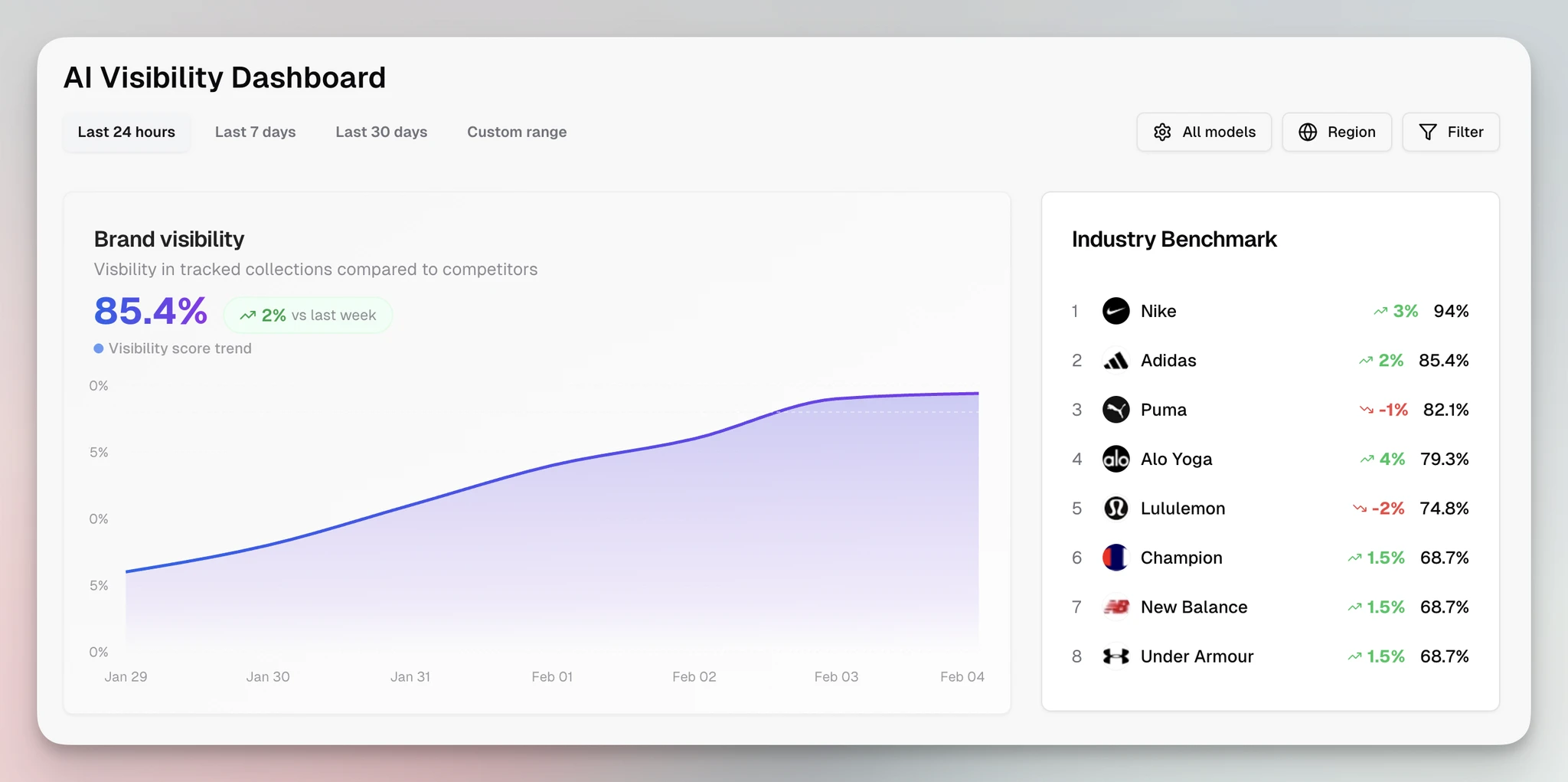
Erlin is a multi-agent AI visibility platform that connects content strategy to AI search performance. Most content platforms tell you what to write. Erlin tells you where you are invisible to AI and what to do about it.
The platform runs on three pillars: Insights, Opportunities, and Actions. Insights tracks your brand's prompt coverage across ChatGPT, Perplexity, Gemini, and Claude, giving you a real-time score of how often AI models mention your brand in relevant queries.
Opportunities identifies the content gaps and quick wins that would move your coverage score. Actions deploys fixes to your content operation, so the loop from insight to published content closes faster.
The data behind it is significant. Erlin tracks 500-plus brands, and the gap between the top performers and the bottom is stark. Brands that optimise all four key drivers of AI visibility achieve 78% prompt coverage. Brands that do not average 9%. (Erlin data, 2026)
Erlin also surfaces the conversion case. Traffic from AI referral converts at 4.4 times the rate of traditional organic search. (Erlin client data, 2026) That is not a marginal gain. That is a fundamental argument for reorienting content strategy around AI search.
Key features: AI visibility score and prompt tracking, brand coverage monitoring across four major AI platforms, competitor citation analysis, content opportunity surfacing, action center for deploying fixes, and sentiment tracking.
Best for: Marketing teams and agencies that need to track and improve AI search presence alongside traditional SEO, particularly in SaaS, fintech, and B2B categories where buyers research through AI interfaces before visiting brand websites.
Pricing: Starts at $47/month. Tiered plans are available for individuals, teams, and agencies.
2. Jasper — Best for Enterprise Brand Voice Consistency
Jasper is the most widely adopted AI writing platform for marketing teams. Its core strength is not speed. It is consistency. You train Jasper on your brand's style guide, existing content, and terminology, and it applies that voice across every asset every writer on your team produces.
The 2026 version runs 100-plus specialised AI agents and supports end-to-end campaign workflows called Content Pipelines. A single campaign brief can generate blog posts, social copy, email sequences, and ad variations, all aligned to the same messaging framework.
Jasper's multi-model routing selects between GPT-4, Claude, and Gemini automatically based on the task, which adds output reliability without requiring the user to manage model selection.
The integration with Surfer SEO is genuinely useful for SEO-focused teams. Write in Jasper's long-form editor and see Surfer's real-time content score and keyword recommendations without switching tools.
Key features: Brand voice training, Content Pipelines for multi-asset campaign production, 100-plus AI agents, Surfer SEO integration, team collaboration and approval workflows, Chrome extension for in-context writing.
Best for: Enterprise and mid-market marketing teams with established brand guidelines who need to produce high volumes of on-brand content across multiple channels. Less suited for solo operators or teams that do not yet have documented brand standards.
Pricing: Creator plan from $39/month per user (billed annually). Business plans with custom pricing for larger teams.
3. AirOps — Best for No-Code Content Pipeline Automation
AirOps is not a writing tool. It is a pipeline builder. You connect AI models, data sources, and publishing tools into automated workflows, and the entire content process runs without manual intervention between steps.
A typical AirOps workflow pulls keyword data from Semrush or Perplexity, generates outlines based on competitor analysis, drafts content using your brand guidelines, runs an SEO optimisation pass, and formats for publishing.
Each step is a node in a no-code canvas. Teams with established processes and high production volumes use it to scale output without scaling headcount.
The setup investment is real. AirOps requires understanding both AI prompting and your content process in detail. For teams publishing fewer than ten pieces per month, that investment is not justified. For teams that need to produce at scale with consistent quality, it is the right infrastructure.
Key features: No-code workflow builder, multi-model support (GPT-4, Claude, Gemini), integration with SEO data sources, bulk content generation, custom prompt libraries, CMS publishing connectors.
Best for: Content teams with established processes that need to scale output without expanding headcount. Strong fit for agencies running high-volume SEO campaigns.
Pricing: Tiered plans based on usage volume. Contact for enterprise pricing.
4. Surfer SEO — Best for Data-Driven SEO Content Optimisation
Surfer SEO takes a fundamentally different approach. It does not generate content. It tells you exactly what your content needs to rank. The Content Editor analyses the top-ranking pages for your target keyword and provides a live score that updates as you write, covering keyword terms, heading structure, word count, and semantic relationships.
Studies have found that Surfer's use of Google's NLP APIs closely matches how Google actually ranks content, more so than other platforms. (Source: Ethical SEO, 2026)
The SERP Analyser goes deeper than keyword density, evaluating content architecture and competitor strategies to show what is working across your category.
Surfer's weakness is its floor. The recommendations are data-driven but mechanical. Following every suggestion without editorial judgment produces content that reads like an SEO checklist. The best teams use Surfer as a guide, not a score to chase.
Key features: Real-time Content Editor with live scoring, SERP Analyser, AI article generation built around live SERP data, keyword research, content audit for existing pages, integrations with WordPress, Semrush, and Google Search Console.
Best for: SEO-focused content teams in competitive niches where marginal optimisation differences have a measurable impact on rankings. Also works well as an add-on to a writing tool like Jasper.
Pricing: Essential plan from $89/month. Higher tiers unlock more capacity and team features.
5. Copy.ai — Best for GTM Teams Automating Sales and Marketing Content
Copy.ai evolved from an AI copywriting tool into a go-to-market workbench. The workflow builder connects content generation to your actual business processes. You can build a sequence that generates social posts when you publish a blog article, or creates email sequences when a new product launches, triggered automatically by CRM data or campaign milestones.
The native Salesforce and HubSpot integrations are what separate Copy.ai from most content automation platforms. Sales teams pull live prospect data into copy and push outputs back into the pipeline without leaving the platform. This bridges marketing content and sales communication in a way that most dedicated content tools cannot.
Key features: Workflow builder for multi-step content automation, GTM templates, CRM integrations (Salesforce, HubSpot), Infobase for uploading company knowledge, team workspaces, 90-plus copywriting templates.
Best for: Revenue teams that need content automation integrated with their sales and marketing tech stack. Strong fit for B2B companies with high-velocity sales processes that require personalised outreach at scale alongside content marketing.
Pricing: Free plan available. Pro at $49/month. Team plan at $249/month.
6. Writer — Best for Regulated Industries
Writer is a full-stack generative AI platform built for governance, compliance, and brand consistency. Where Jasper focuses on voice enforcement, Writer focuses on guardrails.
The platform flags content that violates regulatory requirements, brand policies, or style rules before it publishes, which matters significantly in sectors like healthcare, financial services, and legal.
The Palmyra language models are trained specifically for enterprise use cases, with better factual accuracy and fewer hallucinations on technical or regulated topics compared to general-purpose models.
Security features include role-based permissions, audit logs, and enterprise-grade deployment options that IT and legal teams require.
Key features: Compliance guardrails, custom model training on company data, brand voice enforcement, fact-checking layer, enterprise security controls, knowledge graph for company-specific terminology.
Best for: Enterprise teams in regulated industries where legal review, compliance requirements, and governance controls are non-negotiable.
Pricing: Contact for enterprise pricing.
7. HubSpot Content Hub — Best for Teams Already on HubSpot
HubSpot Content Hub is the strongest choice for teams that already use HubSpot for CRM, email, or marketing automation. The value is not the content generation itself, which is functional but not best-in-class. It is the integration.
Content performance data connects directly to contact records and deal attribution, so you can trace content-to-revenue in the same platform where your sales team works.
The AI Content Remix feature stands out. Publish a blog post and automatically generate social media variations, email content, and ad copy, all in the same brand voice, without switching tools or rebuilding context.
For teams managing multi-format content from a single brief, this saves significant coordination overhead.
Key features: AI content generation, Content Remix for multi-format repurposing, built-in SEO tools, CRM-connected performance analytics, landing page builder, multi-format publishing across blogs, emails, and website pages.
Best for: Marketing teams already embedded in the HubSpot ecosystem who want to consolidate their content stack. Weaker choice if you are not already using HubSpot, due to the cost premium and the learning curve for teams starting from scratch.
Pricing: Professional plan from $800/month.
8. Writesonic — Best for Budget-Conscious Teams Wanting GEO Features
Writesonic started as an AI writing tool and has expanded significantly into the GEO territory. The platform now tracks how your brand ranks in responses from ChatGPT, Gemini, Claude, and Perplexity, alongside traditional content creation.
For teams that cannot yet justify the cost of dedicated AI visibility platforms but want to start tracking their presence in AI search, Writesonic offers a practical entry point.
The content quality is serviceable across most formats. Reddit-sourced feedback notes that outputs can include inaccuracies if not reviewed, which applies to most AI writing tools but warrants attention for fact-heavy categories.
The GEO features receive better reviews than the core writing, given that they bring enterprise-adjacent AI visibility capabilities at a significantly lower price point.
Key features: AI article writer, GEO visibility tracking across four major AI platforms, brand voice settings, SEO optimisation mode, bulk article generation, integrations with WordPress and Semrush.
Best for: Early-stage teams and startups that need a single tool covering AI writing, basic SEO optimisation, and introductory GEO tracking without a large budget commitment.
Pricing: Free plan available. Paid plans start around $20/month, scaling with usage volume.
9. MarketMuse — Best for Site-Wide Content Gap Analysis
MarketMuse looks at your entire content library, not just individual pages. It rates each published page for quality and relevance, identifies gaps across your content inventory, and surfaces the highest-value topics to add or update based on your authority in a given subject area.
The SERP X-ray and Heatmap features are useful for competitive audits across multiple sites, giving content strategists a clear view of where their coverage is strong and where competitors are winning.
The downside is the price and the learning curve. MarketMuse costs significantly more than per-page tools like Surfer and Clearscope, and you need at least 100 published pages to justify it.
For smaller sites, the site-level analysis does not have enough material to generate meaningful insight.
Key features: Topic modelling, site-wide content inventory analysis, content gap identification, page-level quality scoring, competitive benchmarking, and first draft generation.
Best for: Content teams managing large existing libraries (100-plus published pages) who need strategic direction on what to build next, not just optimisation of individual pieces.
Pricing: Starting from $149/month. Higher tiers required for full site analysis features.
10. CoSchedule — Best for Editorial Calendar and Social Workflow Automation
CoSchedule solves a different problem from the rest of this list. It does not generate content. It orchestrates it. The unified marketing calendar shows all content activities across channels in one visual interface, connecting blog publishing, social scheduling, email campaigns, and campaign milestones in a single view.
The ReQueue feature automates social media by continuously recycling top-performing content to fill scheduling gaps. For teams with significant back catalogues, this maintains a consistent social presence without requiring someone to manually curate and reschedule posts.
Approval workflows keep stakeholders aligned without email threads, and native integrations with WordPress, HubSpot, Mailchimp, and major social platforms keep content moving from draft to distribution.
Key features: Unified marketing calendar, ReQueue for automated social content recycling, approval workflows, campaign management, native integrations with WordPress, HubSpot, and major social platforms, and content performance analytics.
Best for: Content and social media teams that need visual planning tools, workflow coordination, and social automation. Less suited for teams whose primary bottleneck is content creation volume rather than editorial coordination.
Pricing: Tiered plans. Marketing Suite starts from $39/month per user.
How to Choose the Right Content Automation Platform
The right platform depends entirely on where your content operation breaks down.
If your bottleneck is AI search visibility, start with Erlin. Traditional SEO platforms cannot tell you why your brand is invisible to ChatGPT or what to do about it. Erlin tracks prompt coverage, surfaces the gaps competitors are exploiting, and deploys fixes through its Action Center. Traffic from AI referral converts at 4.4 times the rate of organic search. (Erlin client data, 2026) That is the metric worth optimising.
If your bottleneck is brand consistency at scale, evaluate Jasper or Writer. Jasper suits marketing teams with multiple content creators who need every asset to sound like the same brand. Writer suits regulated industries where legal review and compliance guardrails are non-negotiable.
If your bottleneck is production volume, AirOps is the infrastructure choice for teams with established workflows. Surfer SEO solves the optimisation quality problem for SEO-focused teams. Writesonic is the starting point for teams with a limited budget.
If your bottleneck is strategy and planning, MarketMuse identifies site-level gaps. CoSchedule coordinates editorial operations. HubSpot Content Hub ties content performance to CRM revenue attribution.
Most teams at scale combine two to three tools. A common stack in 2026: Erlin for AI visibility strategy, Jasper or AirOps for production volume, and Surfer SEO for per-article optimisation quality.
The cost of not tracking AI visibility is concrete. Brands without an AI visibility monitoring tool take an average of 67 days to detect errors in how AI models describe them. Monitored brands correct them in 14 days. (Erlin data, 500+ brands, 2026) Over a competitive content cycle, that gap compounds.
Frequently Asked Questions
What is content automation?
Content automation is the use of software to handle repeatable tasks across the content lifecycle, including research, writing, optimisation, publishing, and performance tracking. Modern platforms handle end-to-end workflows rather than individual tasks.
Do content automation platforms replace human writers?
No. The strongest performing teams use automation for execution at scale while humans handle strategy, quality control, and editorial judgment. Automation removes production bottlenecks. It does not replace expertise or original thinking.
What is GEO, and why does it matter for content automation?
GEO stands for Generative Engine Optimisation. It refers to the practice of creating content structured to appear in AI-generated answers from platforms like ChatGPT, Perplexity, and Gemini. Traditional SEO optimises for Google rankings. GEO optimises for AI citation. Content automation platforms that include GEO features help brands appear in both.
How do I know if my content is getting cited by AI?
Platforms like Erlin track your brand's prompt coverage across major AI engines, showing how often and in what context AI models mention your brand in response to relevant queries. Without a dedicated monitoring tool, brands have no visibility into this channel.
Is content automation suitable for small teams?
Yes. The economics are most compelling for small teams. A single strategist using the right platform can orchestrate content production that would otherwise require a team of five. Writesonic and Copy.ai both offer accessible entry points, while Erlin's prompt coverage tracking is relevant regardless of team size.
Share
Related Posts
Generative Engine Optimization Trends for 2026
7 GEO trends reshaping AI search visibility in 2026, with data on citations, structured data, and what actually drives brand coverage.
15 Generative Engine Optimization Best Practices Backed by Latest Research
Generative engine optimization best practices backed by 2026 research. 15 tactics to get your brand cited by ChatGPT, Perplexity, and Google AI Overviews.
AI for Content Planning & Strategy: A Complete Guide
AI for content planning in 2026 means planning for AI search visibility, not just faster drafts. Five-layer workflow, what to automate, what stays human.