

If you're still measuring brand health with Google Alerts and social listening tools, you've already got a blind spot, and it's growing fast.
AI search is now where a lot of purchasing decisions start. Someone asks ChatGPT, "What's the best CRM for a small sales team?" and gets a list of three tools.
If your brand isn't one of them, that conversation happened without you, and you had zero visibility into it.
That's the problem AI brand monitoring tools are built to solve. They track how your brand appears (or doesn't) in responses generated by tools like ChatGPT, Perplexity, Gemini, and Google AI Overviews.
They measure your share of voice, surface sentiment patterns, and flag the gaps that stop you from being cited in the first place.
This guide reviews 10 of the best tools available in 2026, with honest assessments of strengths, pricing, and who each tool is built for.
What Is an AI Brand Monitoring Tool?
An AI brand monitoring tool scans large language models and AI search engines to detect brand mentions, measure share of voice, analyze sentiment, and identify visibility gaps in generated responses.
Unlike traditional social listening tools, these focus on AI-generated outputs: the actual answers people receive when they ask ChatGPT or Perplexity for product recommendations.
The distinction matters more than it sounds. When a user asks an AI assistant which tools to use, there are no clicks, no sessions, and no visible referrals in standard analytics.
Standard Google Analytics reports nothing for brand influence that happens entirely within a ChatGPT conversation. That makes dedicated LLM monitoring tools non-optional for brands serious about growth in 2026.
AI models can also describe your brand based on outdated or inaccurate information. If your positioning has changed, your pricing is different, or a competitor recently overtook you, the AI version of your brand might still reflect how you looked a year ago.
Buyers often don't verify these summaries, so the AI description becomes the version they remember.
Best AI Brand Monitoring Tools at a Glance
Tool | Best For | Starting Price |
Erlin.ai | All-in-one growth teams | $97/mo |
Semrush | AI visibility and SEO in one platform | $99/mo for AI Visibility; SEO + AI from $199/mo |
Profound | Enterprise compliance | $499/mo |
Peec AI | Global multi-language tracking | €89/mo |
Otterly.AI | Budget-friendly entry point | $29/mo |
Ziptie | Fast AI performance benchmarking | $69/mo |
LLMrefs | Citation-level insights | $79/mo |
AthenaHQ | CPG brands and sentiment alerts | $295/mo |
Scrunch AI | AEO optimization at volume | ~$199/mo |
Ahrefs Brand Radar | Multi-index coverage for SEO teams | $199/mo add-on |
How to Choose the Right Tool
Before you pick a platform, it helps to know what you're actually trying to solve.
Are you running a growth team trying to build content that gets cited in ChatGPT? You probably need a tool that combines monitoring with optimization workflows, something like Erlin.ai or Scrunch AI.
Are you a compliance-focused enterprise that needs audit-level data and historical replays? Profound is designed for exactly that.
Running a multi-country brand with different language needs? Peec AI's international setup is purpose-built for this.
Beyond use case, here are the practical questions worth asking:
Which AI platforms are covered? ChatGPT is the obvious one, but brands should also track Perplexity, Gemini, Google AI Overviews, and increasingly Copilot and Claude. Not every tool covers all of them.
How does it handle optimization, not just monitoring? Some tools stop at showing you where you're missing. The better ones tell you what to do about it: content gap analysis, citation source breakdowns, structured answer suggestions.
What integrations matter to your team? If your team lives in Slack, a daily alert that lands in a shared channel is more useful than a dashboard people forget to open. GA4 and GSC integrations matter if you want to connect AI visibility to actual traffic and conversions.
Does the pricing make sense for your query volume? Many tools charge per prompt, so the math changes quickly at scale. A $29/mo plan with 10 prompts looks cheap until you realize you need 200 tracked queries to get meaningful data.
Evaluation Criteria
We assessed each tool across five dimensions:
Criteria | What It Covers |
AI Platform Coverage | Number of LLMs tracked (ChatGPT, Perplexity, Gemini, etc.) |
Pricing Flexibility | Tiers, trials, and value relative to prompt/brand volume |
Analytics Depth | Sentiment, share of voice, historical data, citation tracking |
Integrations & Alerts | Slack, GA4, real-time notifications |
Optimization Tools | Content suggestions, workflows, and AEO features |
The 10 Best AI Brand Monitoring Tools in 2026
1. Erlin.ai: Best for Growth Teams Combining SEO and AI Visibility
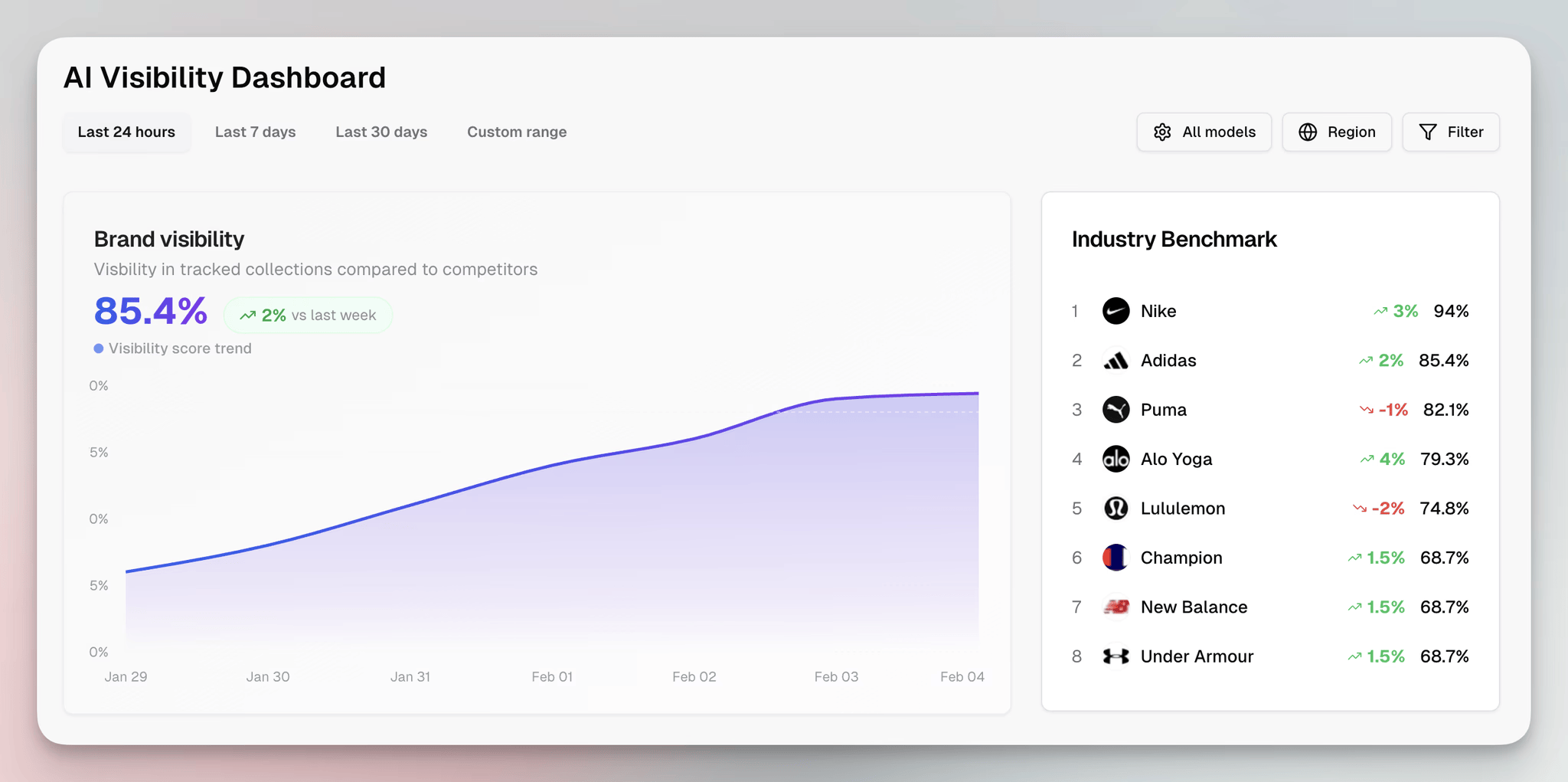
Erlin.ai is an AI search operating system built around three pillars: insights, opportunities, and actions.
It tracks brand visibility across ChatGPT, Gemini, Claude, and Perplexity, audits how AI understands your brand, and identifies which sources AI trusts, such as Reddit and community platforms.
What separates it from most monitoring-only tools is the execution layer: a multi-agent system that analyzes visibility gaps and builds workflows for FAQs, structured answers, schema markup, and comparison content.
In Erlin's own audits across 150+ ecommerce brands, brands with strong, structured brand context were cited more often in AI shopping panels and recommendation lists, sometimes outperforming competitors with better domain authority but weaker semantic clarity.
Strengths
Unified data from AI search, SEO, Google Analytics 4, and Search Console in a single view
Proprietary Fire Score that prioritizes which actions to take first
Automated workflow system builds FAQs, structured content, schema markup, and comparison pages
Integrates with Shopify, GA4, GSC, and Slack for attribution and alerts
Real client results include up to 75% citation increases in 90 days and 40% qualified traffic growth
Considerations
Higher tiers required for enterprise-scale tracking and multi-brand management
Custom pricing for some advanced modules
Best Use Cases
Growth and content teams that need monitoring and execution support in one platform
E-commerce brands that want to optimize for high-intent AI shopping queries
Agencies managing AI visibility across multiple client accounts
Pricing
Standard: $97/mo
Pro: $249/mo
Enterprise: Custom
2. Semrush: Best for Teams Managing AI Visibility and SEO in One Platform
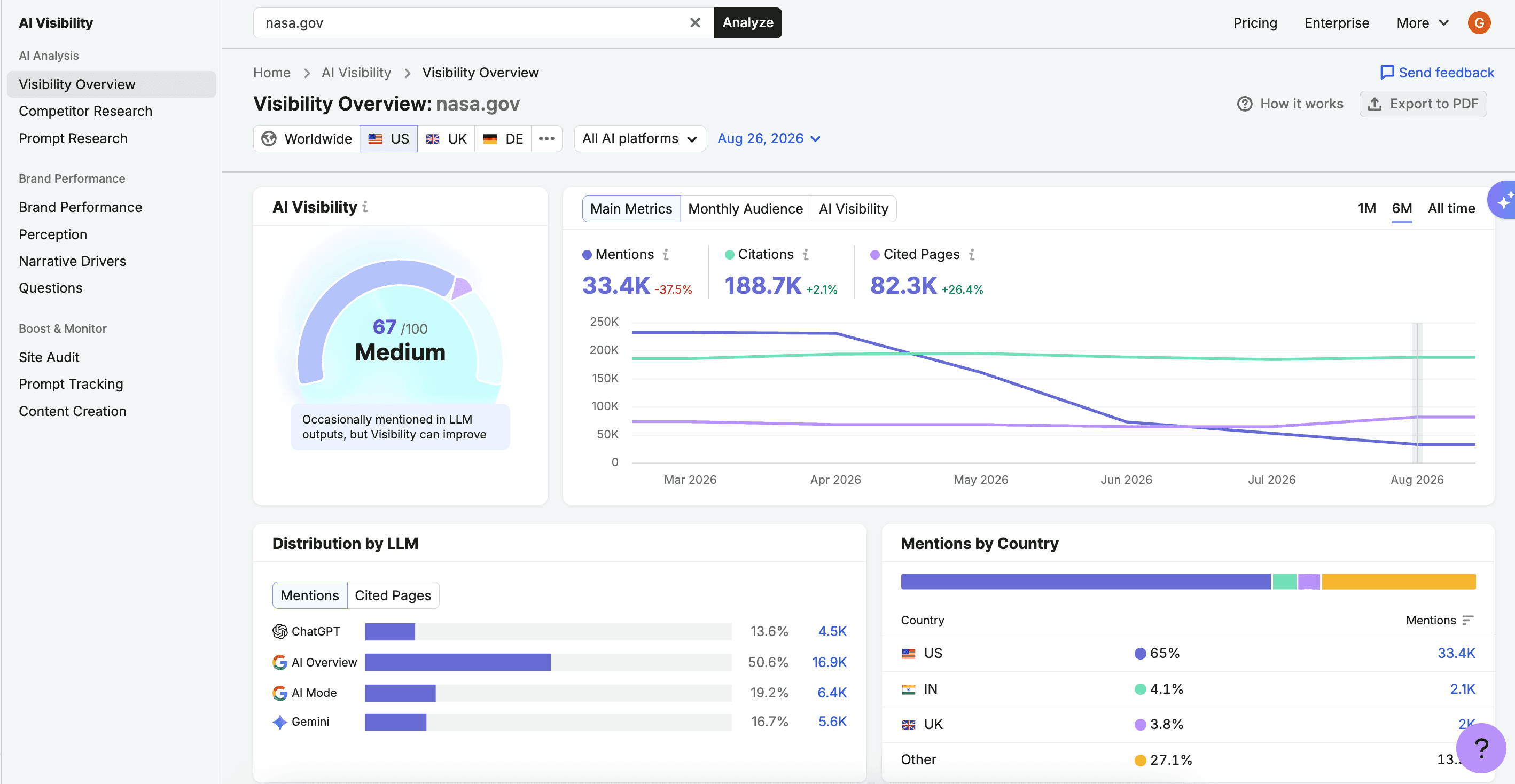
Semrush tracks brand visibility across AI-generated answers and organic search from a single platform. Its AI Visibility Toolkit covers ChatGPT, Google AI Overviews, Google AI Mode, Gemini, and Perplexity alongside keyword research, backlink analysis, and technical audits. Teams that need both AI monitoring and SEO in one place don't have to pay for two separate tools.
For teams already using Semrush, it's the most practical path into AI monitoring. Your existing data connects directly to your AI visibility findings, so you can see both channels in one place rather than juggling separate dashboards.
As one analysis put it, AI visibility isn't just about tracking brand mentions in isolation; it's about understanding the web signals behind those answers, which is where Semrush's traditional data layer becomes genuinely useful.
Strengths
Ties AI visibility data to traditional search metrics
Five-step AI monitoring framework that's more structured than most competitors
Established platform reliability; teams don't need to bet on a new startup
Multi-domain tracking useful for agencies managing multiple brands
Content gap identification tied to competitive keyword data
Considerations
AI features require a paid add-on on top of the base Semrush subscription
Less specialized than pure AI monitoring tools for teams that don't need the full SEO suite
Teams already paying for a separate SEO platform will find the most value here; if AI monitoring is the only need, a standalone tool costs less.
Best Use Cases
SEO teams making the transition toward GEO and AEO workflows
Agencies with existing Semrush subscriptions looking to add AI monitoring without switching tools
B2B brands auditing sentiment alongside organic search performance
Pricing
AI Toolkit: $99/mo per domain (add-on)
Semrush Pro base: $139.95/mo
Free trial available
3. Profound: Best for Enterprise Compliance and Audit-Level Data
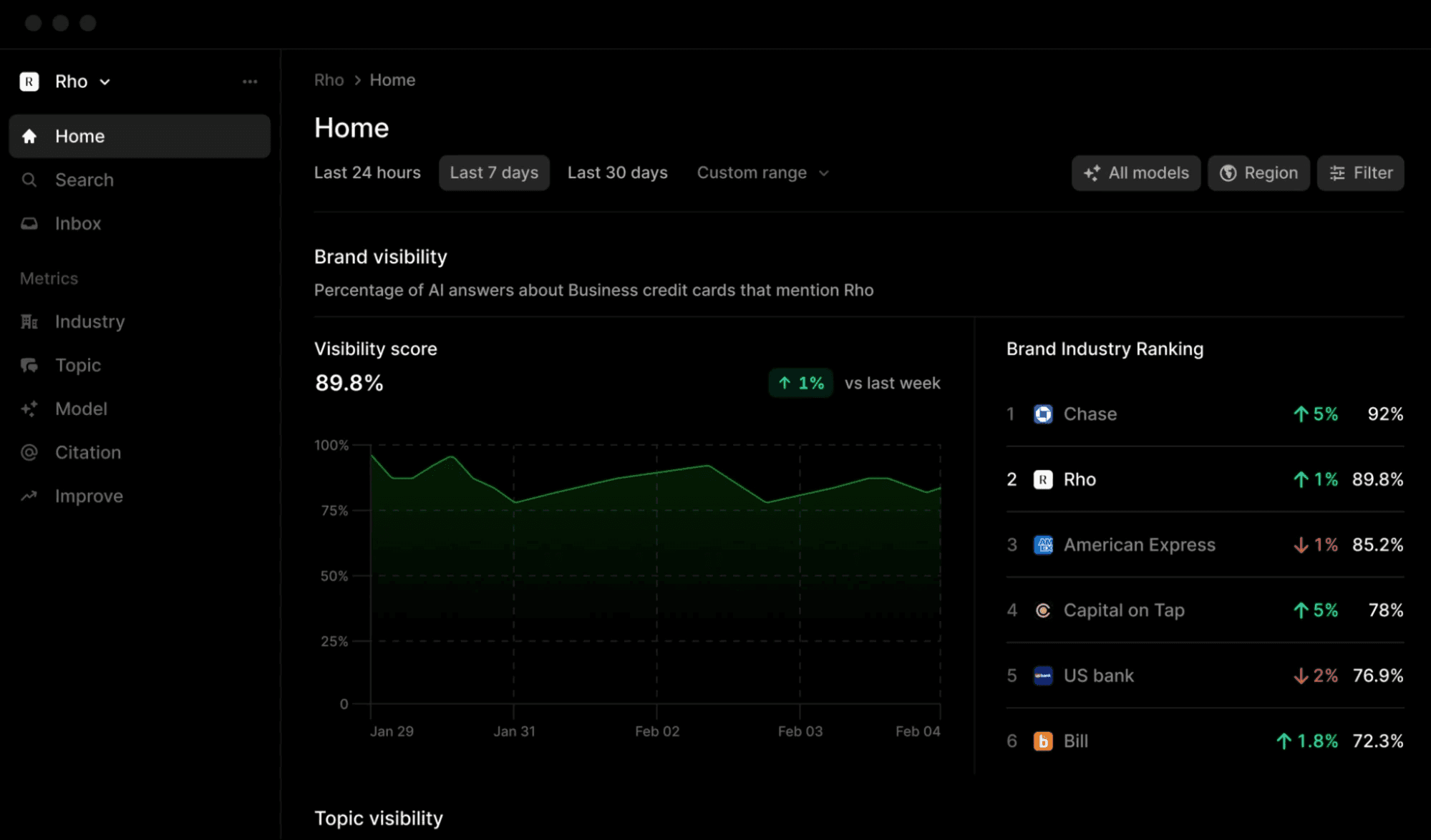
Profound is a brand intelligence platform that specializes in AI visibility tracking with the rigor that compliance teams and large organizations need.
It covers ChatGPT, Perplexity, and other major LLMs, offering multi-layer sentiment analysis, historical response replays, and share of voice benchmarking across industry narratives.
With SOC2 compliance and $23.5M in funding, it's built to run at enterprise scale.
Strengths
Advanced sentiment analysis across multiple dimensions, not just positive/negative
Historical replay capability lets teams audit how AI described their brand at specific points in time
Covers AI search, SEO mentions, and media references in a single dashboard
SOC2 Type II compliance for teams with data governance requirements
Built-in prompt designer to ensure tracked queries stay relevant over time
Enterprise integrations with AWS and Cloudflare
Considerations
The entry price ($499/mo) rules it out for smaller teams right away
Predefined prompt structures can limit customization for niche use cases
Less emphasis on content optimization compared to some competitors
Best Use Cases
C-suite teams and compliance officers who need governance-grade data
Large brands monitoring for reputation risks and category narrative shifts
Teams that require detailed historical analysis for reporting or audits
Pricing
Lite: $499/mo (3 users, 24k responses/month)
Higher tiers: Custom
Free demo available
4. Peec AI: Best for International and Multi-Language Brands
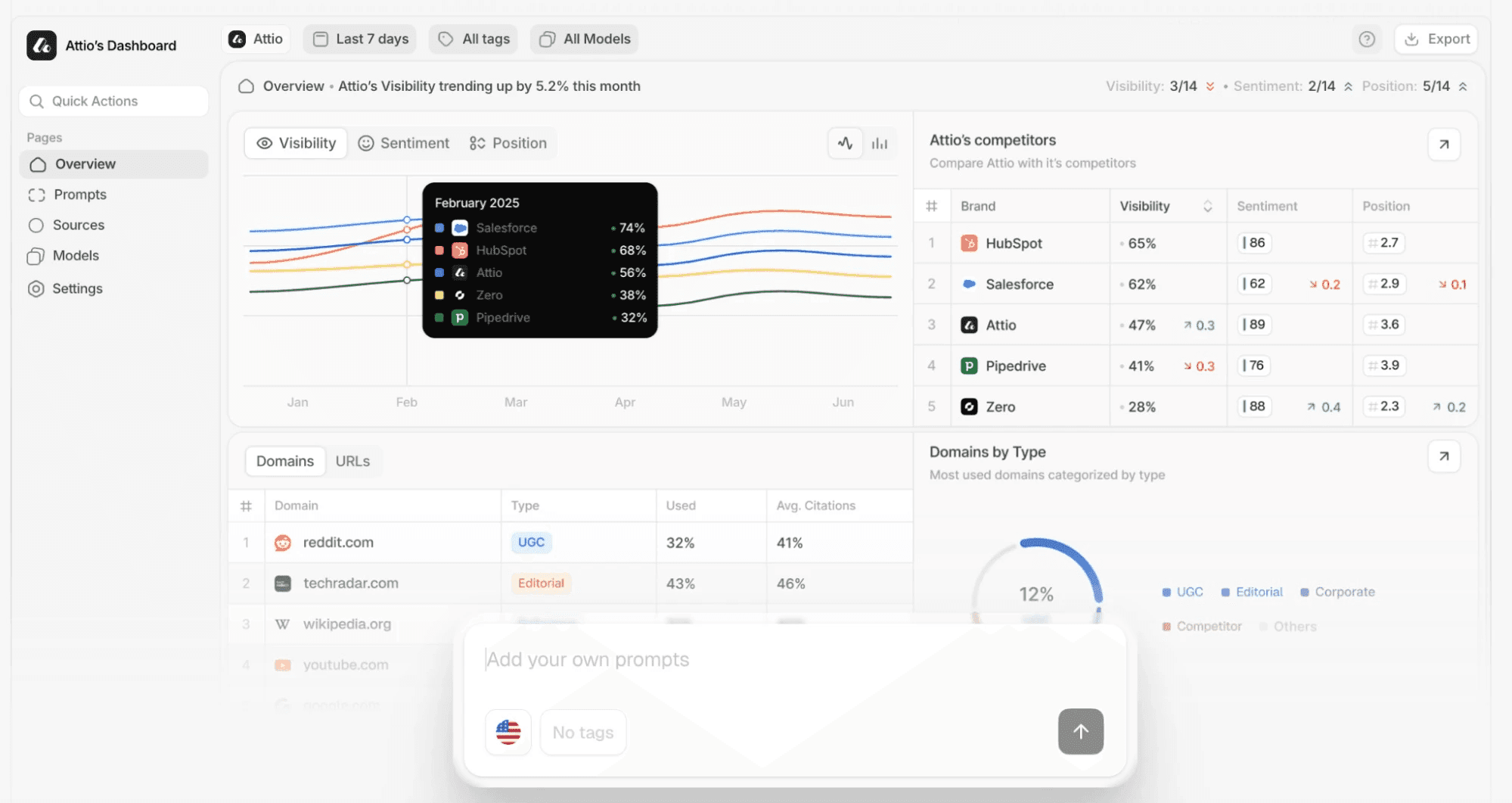
Peec AI, founded in 2025 and backed by a €21M Series A following a €5.2M seed round, is built for brands that need to track AI visibility across multiple countries and languages.
It monitors brand mentions, sentiment, and competitive positioning across major AI search engines, with the ability to segment results by model, country, and audience persona.
Prompts run every 24 hours across selected AI models, giving teams a consistent data rhythm rather than one-off snapshots.
One customer noted that after using Peec AI to identify which content types were being surfaced in specific LLMs, their team drove a 5x year-over-year increase in traffic and demo requests from AI search.
Strengths
Percentage-based visibility metrics make it easy to track progress over time
Segment results by model, region, and audience (e.g., US vs. UK, awareness vs. purchase intent prompts)
Unlimited team seats on all plans; no per-seat charges as your team grows
GEO and AEO optimization insights alongside monitoring data
Add-ons available for Gemini, Claude, DeepSeek, Llama, Grok, and others beyond the base coverage
7-day free trial
Considerations
Prompt limits on lower tiers mean larger campaigns require Pro or Enterprise plans
Workflow automation is less developed than platforms like Erlin.ai
High-volume enterprise tracking needs the Enterprise tier
Best Use Cases
International brands running campaigns across multiple languages and markets
Content teams optimizing for AI search across different audience segments
Mid-market companies that want clean, focused dashboards without feature overload
Pricing
Starter: €89/mo (25 prompts, ~2,250 answers/month, 3 countries)
Pro: €199/mo (100 prompts, ~9,000 answers/month, 5 countries)
Enterprise: €499/mo (300+ prompts, dedicated support)
7-day free trial
5. Otterly.AI: Best for Budget-Conscious Teams Getting Started
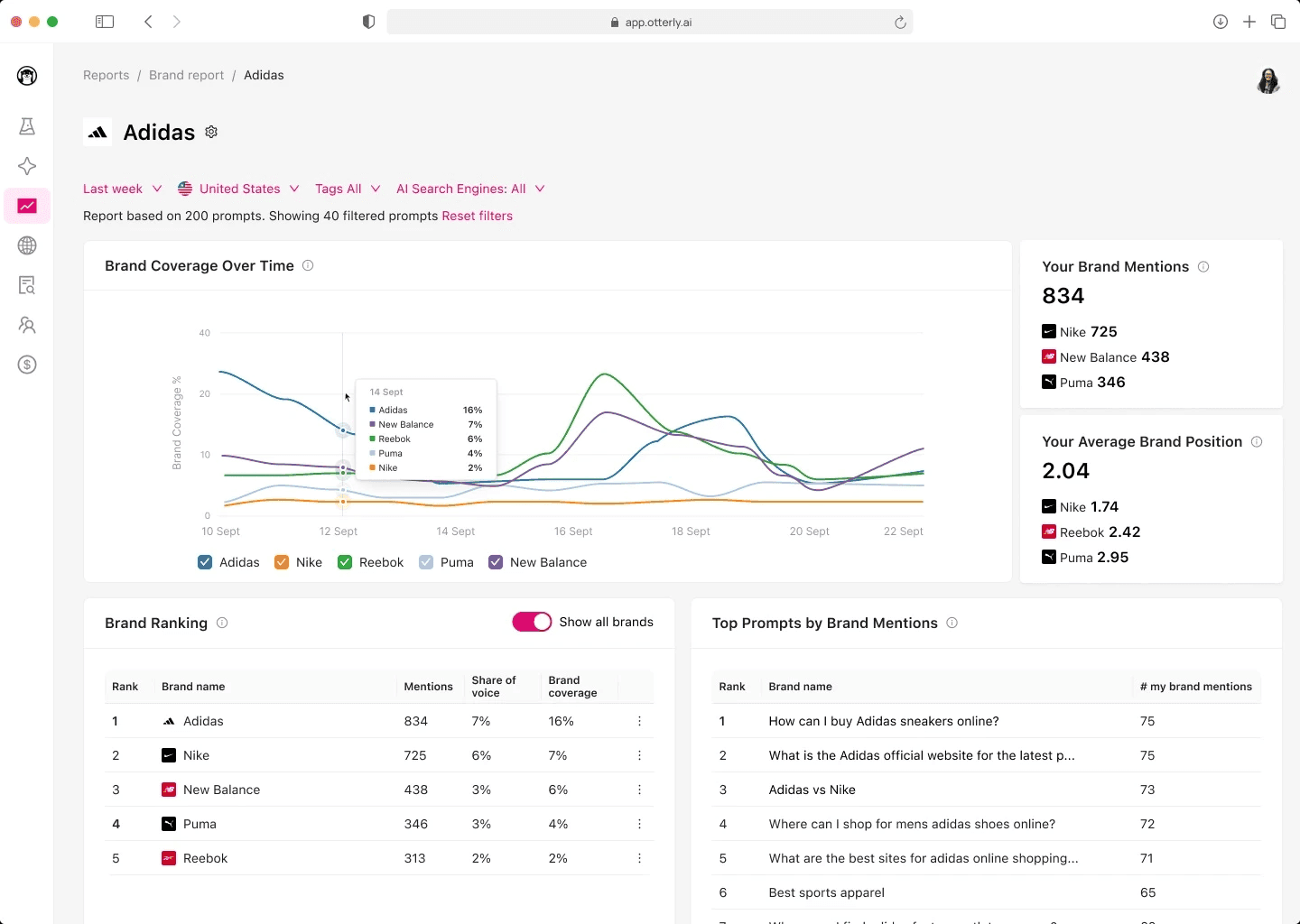
Otterly.AI is the most accessible entry point in this list. It tracks brand mentions across ChatGPT, Perplexity, and Copilot, surfaces competitive benchmarks, and shows where your brand is being mentioned (and where it isn't).
It's used by over 20,000 marketing professionals and has picked up recognition from G2, OMR, and Gartner.
For smaller teams that want to understand their AI presence without a big upfront commitment, this is the obvious starting point.
Strengths
Low barrier to entry; $29/mo gets you live with 10 tracked prompts
Covers multiple AI engines and shows citation-level detail
Quickly surfaces missing mentions so teams know where to focus
Semrush integration if you're already in that ecosystem
No training required to start reading the reports
Considerations
Sentiment analysis is fairly basic compared to enterprise tools
Prompt and historical data caps on lower tiers
No workflow automation or content generation tools
Doesn't include governance or compliance features
Best Use Cases
Small teams doing their first AI presence audit
Startups testing whether AI monitoring is worth deeper investment
Budget-conscious brands that need a quick pulse check on AI visibility
Pricing
Lite: $29/mo (10 prompts)
Standard: $189/mo (100 prompts)
Pro: $989/mo (1,000 prompts)
Free trial available
6. Ziptie: Best for Quick AI Performance Benchmarking
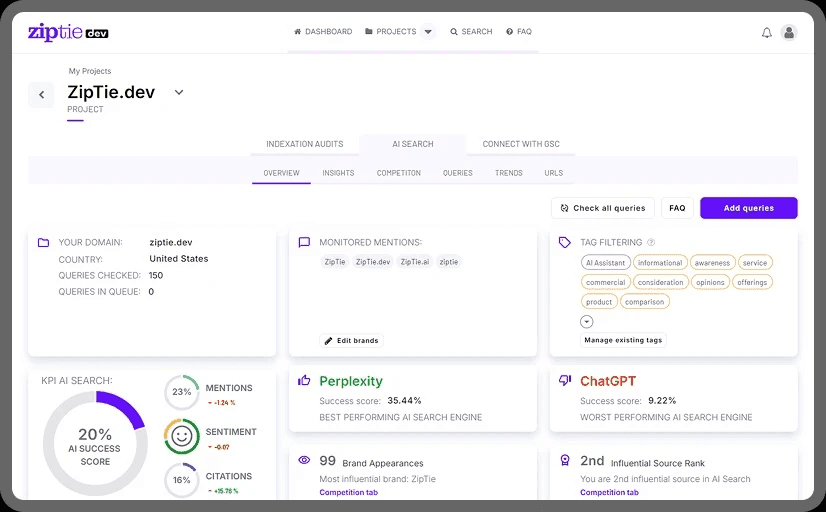
Ziptie monitors AI mentions by simulating actual user queries across ChatGPT, Google AI, and Perplexity, then assigns success scores and content recommendations based on what it finds.
Rather than treating AI monitoring as a passive tracking exercise, Ziptie is designed to push you toward specific actions quickly, which makes it a good fit for teams that want to close visibility gaps without building out a full research workflow.
Strengths
Simulates real user queries rather than scraping outputs after the fact
Citation share and competitive tracking at the project, category, and query levels
Content optimization suggestions tied directly to gap findings
Complements existing SEO workflows rather than replacing them
Considerations
Not a full SEO replacement. Best used alongside your existing rank tracking
Newer tool with less proven performance data at enterprise scale
Custom enterprise pricing isn't published, which makes budgeting harder
Best Use Cases
Brands that want to close visibility gaps fast without a long onboarding process
SEO teams adding an AI layer to their existing workflows
Category-specific performance tracking where benchmark comparisons matter
Pricing
Starter: $69/mo
Pro: $159/mo
Enterprise: Custom
7. LLMrefs: Best for Citation-Level Tracking on a Budget
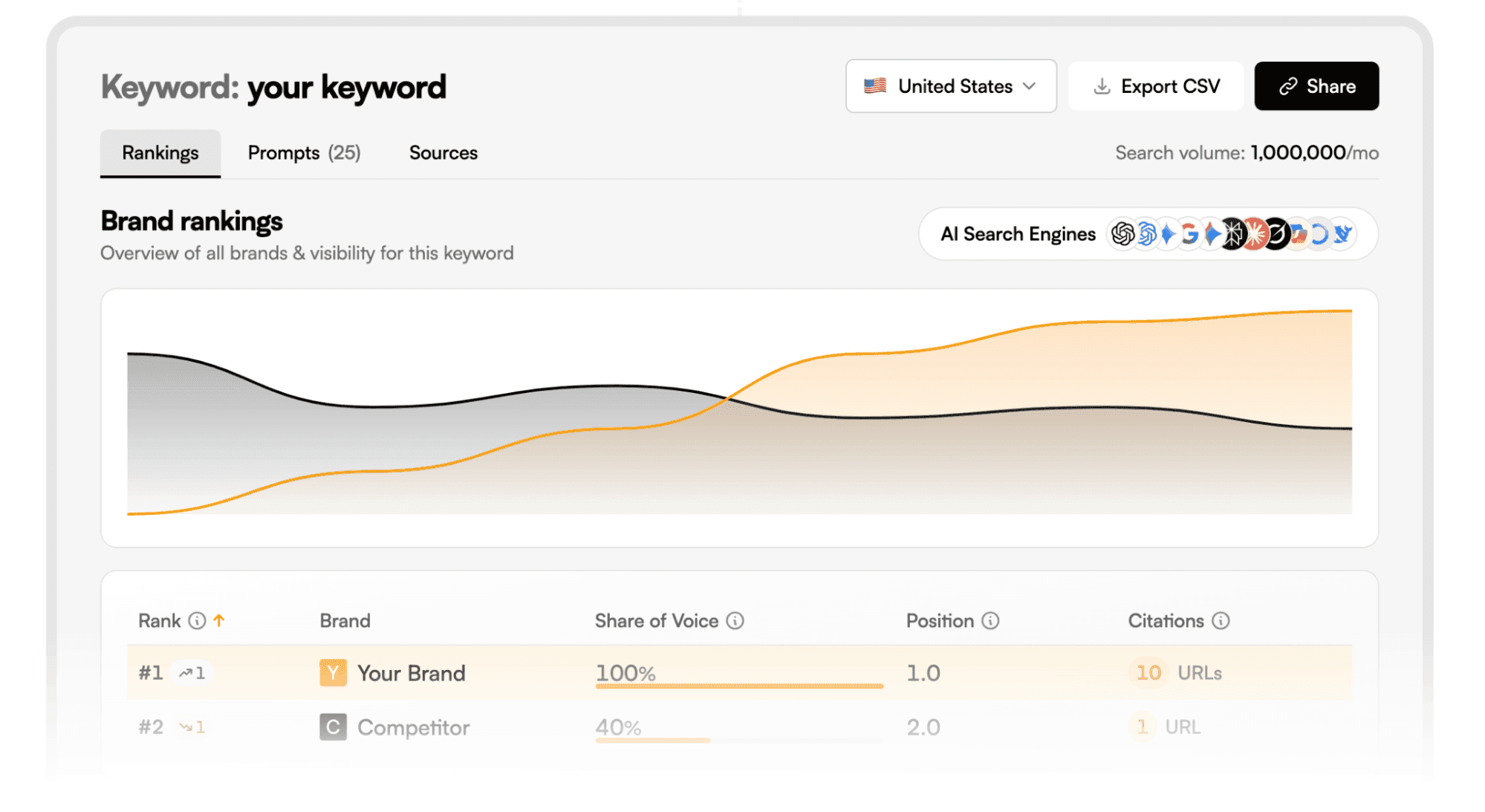
LLMrefs focuses on one thing particularly well: showing you which sources AI models are pulling from when they talk about your brand.
That includes Reddit threads, specific domains, individual articles, and community posts. It auto-generates tracking prompts, gives unlimited team access on a single tier, and provides a direct optimization roadmap based on what it finds. At $79/mo flat, it's one of the cleaner value-for-money options in the space.
Strengths
Unique source impact breakdowns: shows which URLs and domains AI is citing about your brand
Auto-generated prompts reduce setup time
Unlimited team members on a single-tier pricing model
Direct optimization roadmaps based on citation gaps
Broad platform coverage for the price point
Considerations
A single pricing tier may not scale well for high-volume enterprise needs
Focused on AI answer engines only, not a social listening or web monitoring tool
Real-time alerts are less robust than some competitors
Best Use Cases
Brands actively building for AI citation and want to know which sources to target
Product and marketing teams tracking category-specific AI queries (e.g., skincare, B2B SaaS)
Value-driven teams that want broad coverage without complex pricing
Pricing
$79/mo flat rate
Free trial available
8. AthenaHQ: Best for CPG Brands Needing Real-Time Sentiment Alerts
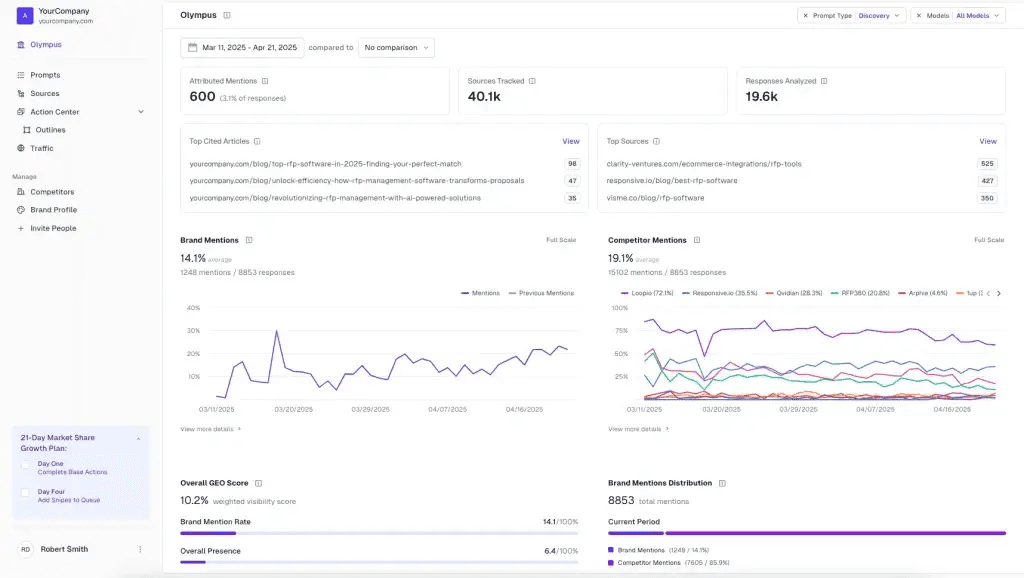
AthenaHQ is purpose-built for consumer packaged goods brands operating in competitive, fast-moving categories. It monitors brand mentions across major LLMs in real time and flags sentiment shifts.
It also includes impersonation detection: a feature that matters when copycats or counterfeit products might be appearing in AI search results under your brand name.
With unlimited seats and role-based access control, it's designed for larger teams where multiple stakeholders need visibility into the same data.
Strengths
Real-time alerts for sentiment changes; faster reaction time than batch-refresh tools
Impersonation detection is a genuinely unique feature in this category
Unlimited seats and role-based access control (RBAC)
Traffic analytics integration for connecting AI mentions to actual site behavior
3,500 monthly credits allow substantial prompt coverage
Considerations
Premium pricing ($295/mo starting) is steep for teams outside the CPG space
A credit-based model means heavy users hit limits faster than expected
The CPG focus limits its utility for SaaS, services, or B2B brands
Best Use Cases
CPG brands competing in categories where AI product recommendations carry real weight
Teams that need fast alerts when AI sentiment shifts around their brand
Companies worried about impersonation in AI-generated answers
Pricing
Starter: $295/mo
Higher tiers: Custom
Trial available
9. Scrunch AI: Best for Advanced AEO Optimization at Volume
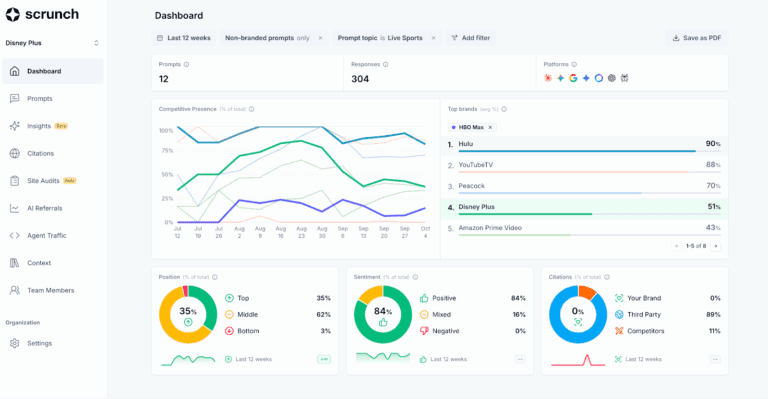
Scrunch AI is for teams that want to run a lot of queries and get structured data back quickly. Its Pro plan handles 5,000 queries monthly with API access and custom reporting, making it the most technically extensible option on this list for teams that want to build AI monitoring into their own data pipelines.
The platform covers all major AI platforms and includes team collaboration tools for organizations managing visibility across multiple brands or markets.
Strengths
High query volume on Pro plans; 5,000 queries monthly
API access for teams that want to integrate visibility data into their own dashboards
Custom reporting for client-facing or executive-level presentations
All major AI platforms covered in one subscription
Strong collaboration tools for distributed teams
Considerations
Starter plan brand limits can constrain multi-brand agencies
The feature set is enterprise-heavy; smaller teams may not use most of it
Best Use Cases
AEO-focused teams running high volumes of tracked queries
Teams or agencies that need API-level integrations into existing data infrastructure
Organizations that want advanced analytics and custom report exports
Pricing
Starter: ~$199/mo (1,000 queries)
Pro: ~$499/mo (5,000 queries)
Free trial available
10. Ahrefs Brand Radar: Best for Ahrefs Users Expanding into AI Monitoring
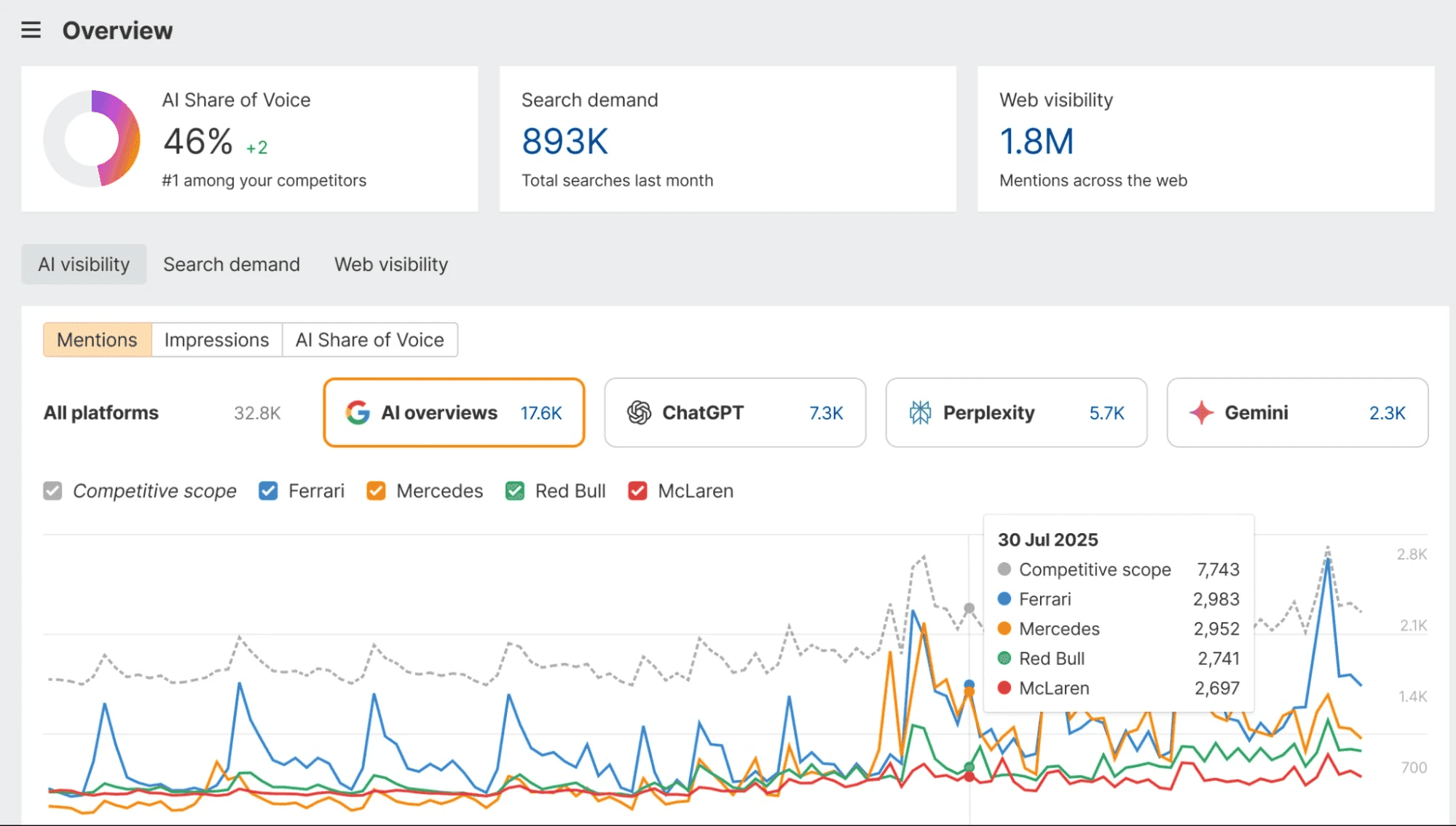
Ahrefs Brand Radar is an add-on to the Ahrefs platform that monitors brand mentions across six AI indexes.
If you're already an Ahrefs customer, this is the most natural path into AI brand monitoring. Your backlink data, keyword rankings, and competitive research all live alongside your AI visibility metrics in one workspace.
For new Ahrefs customers, however, the total cost ($129/mo base + $199–$699/mo add-on) is a significant commitment.
Strengths
Covers six AI indexes; broader than most standalone AI monitoring tools
Backlink and keyword data connects directly to AI visibility findings
Detailed query breakdowns that show which specific prompts are surfacing competitors
Trusted SEO accuracy that Ahrefs users are already used to
Potential bundle savings if you're consolidating SEO and AI monitoring
Considerations
The total monthly cost ($828+/mo for full access) is one of the highest on this list
AI-specific workflows are thinner than purpose-built AEO tools like Erlin.ai or Scrunch AI
Primarily relevant for existing Ahrefs customers; harder to justify as a standalone product
Best Use Cases
Ahrefs users who want to extend into AI monitoring without switching platforms
Enterprise SEO teams adding AI visibility to existing comprehensive workflows
Multi-index competitive analysis where breadth of AI coverage matters
Pricing
Single AI index: $199/mo add-on
All 6 indexes: $699/mo bundle
On $129/mo Lite base
Trial available
FAQs
What makes AI brand monitoring different from traditional social listening tools?
Traditional social listening tools track mentions across news sites, social platforms, and forums: the inputs to the web. AI brand monitoring tools track AI-generated outputs: the actual answers users get from tools like ChatGPT and Perplexity. The critical difference is that social listening shows where people are talking about you; AI monitoring shows what AI systems are saying about you. These are increasingly separate things, and brands need both.
How accurate are the visibility metrics these tools report?
They work by submitting prompts and recording AI responses at scale, which means accuracy depends on prompt volume and platform coverage. LLMs are probabilistic: the same prompt can return different results on different runs. That's why tools with higher query volumes (like Scrunch AI or Erlin.ai) tend to produce more statistically reliable data. Smaller prompt sets give you directional signals, not precise numbers.
Can small businesses afford these tools?
Yes. Otterly.AI starts at $29/mo, and LLMrefs charges $79/mo flat. Both provide meaningful visibility data for small teams. The main trade-off is prompt volume. Lower tiers limit how many queries you can track simultaneously, which means you're monitoring a sample of your brand's AI footprint rather than the full picture.
What if my brand isn't appearing in any AI results yet?
That's actually the most useful thing to find out. Tools like Erlin.ai and Ziptie are specifically designed to surface these gaps and tell you what's causing them, whether it's missing schema, inconsistent product categorization, lack of third-party citations, or something else. Being absent from AI results in 2026 isn't permanent; it's a content and structure problem that's solvable.
Do I need a separate tool, or can I use my existing SEO platform?
If you're using Semrush or Ahrefs, both now offer AI monitoring add-ons that let you stay on one platform. For teams that want deeper AI-specific workflows, like content generation, citation building, and structured answer optimization, a dedicated tool like Erlin.ai or Scrunch AI will go further. It depends on whether you need monitoring alone or monitoring plus optimization.
How often should I be checking AI brand visibility data?
Most tools refresh daily, which is the right cadence for tracking trends. AI responses can shift when new sources get indexed, competitors publish new content, or the models themselves are updated, often without any change on your end. A weekly review rhythm works for most teams, with real-time alerts configured for significant sentiment changes.
What should I look for in an AI monitoring tool for an agency?
Multi-brand management, white-label reporting, and per-seat (or seat-unlimited) pricing are the key features. Peec AI and LLMrefs both offer unlimited seats. Scrunch AI has dedicated client reporting features. For agencies that manage e-commerce brands specifically, Erlin.ai's workflow automation can significantly reduce the time it takes to move from insight to deliverable.
Share
Related Posts
Generative Engine Optimization Trends for 2026
7 GEO trends reshaping AI search visibility in 2026, with data on citations, structured data, and what actually drives brand coverage.
15 Generative Engine Optimization Best Practices Backed by Latest Research
Generative engine optimization best practices backed by 2026 research. 15 tactics to get your brand cited by ChatGPT, Perplexity, and Google AI Overviews.
AI for Content Planning & Strategy: A Complete Guide
AI for content planning in 2026 means planning for AI search visibility, not just faster drafts. Five-layer workflow, what to automate, what stays human.