The seven best AI visibility tools in 2026 are Erlin.ai, Profound, Peec AI, Otterly.AI, Ziptie, Semrush and Ahrefs Brand Radar. Erlin.ai suits brands that want to act on gaps, Profound fits enterprise monitoring, Peec AI covers multi-market tracking, and Otterly.AI at $29/month is the budget entry point. Choose on engine coverage, data quality, pricing, and whether you need monitoring or execution.
AI visibility tools are multiplying fast. New platforms pop up every few weeks, each promising to tell you how your brand appears in ChatGPT, Perplexity, Gemini, and the rest.
Most of them do roughly the same thing. We spent time evaluating seven of the best, across engine coverage, data quality, pricing, and whether they actually help you do something about what they find.
The 7 best AI visibility tools at a glance
- Erlin.ai for brands that want to go beyond monitoring and actually execute on what they find
- Profound for enterprise teams that need multi-AI monitoring and data they can defend to leadership
- Peec AI for clean, fast tracking across multiple markets and engines
- Otterly.AI for teams getting started with AI visibility on a budget
- Ziptie for competitive citation analysis across ChatGPT, Perplexity, and AI Overviews
- Semrush for SEO teams that want AI visibility built into their existing workflow
- Ahrefs Brand Radar for benchmarking brand presence in AI responses against a massive keyword dataset
What is an AI visibility tool?
An AI visibility tool measures how often and how accurately your brand appears in AI-generated responses.
Instead of tracking where you rank on page one of Google, it tracks whether ChatGPT recommends you when someone asks, "What's the best [product] for [use case]?"
The category goes by a few names: GEO (generative engine optimization) platforms, AEO tools, and LLM monitoring software. They all solve the same core problem: traditional SEO metrics, such as impressions, CTR, and page rankings, don't capture what happens when a user never leaves the AI interface.
Most platforms focus on monitoring: run a set of prompts, see which brands get recommended, and compare against competitors. The more sophisticated ones add sentiment tracking, citation source analysis, and content recommendations.
A smaller number of systems, Erlin.ai being the clearest example, are built around execution.
How we evaluated these tools
We assessed each platform across five criteria relevant to small businesses, mid-market teams, and enterprise organizations.
| Criteria | What it covers |
|---|---|
| AI coverage | Which LLMs are tracked (ChatGPT, Gemini, Perplexity, Claude, AI Overviews), query volume, and whether data comes from real-time UI scraping or API sampling, the latter tends to differ from what users actually see |
| Accuracy and insight quality | Hallucination detection, sentiment analysis, prominence scoring, and whether the platform tells you why you're missing from a response, not just that you are |
| Pricing and scalability | Tiered plan structure, per-prompt costs at each tier, enterprise custom options, and whether the platform grows with you without a major price jump |
| Ease of use | Onboarding time, interface clarity, seat limits, and how much GEO expertise you need to get value out of the tool from day one |
| Execution support | Integrations with SEO tools (Semrush, Ahrefs), export options (CSV/API), content workflow support, and whether the platform helps you act on what it finds or just reports it |
The list covers different budget levels and use cases, from teams running their first AI visibility audit to enterprises monitoring multiple brands across regions.
Best LLM monitoring tools comparison
| Tool | Best for | Pricing |
|---|---|---|
| Erlin.ai | Brands that need execution, not just monitoring | Pricing on request |
| Profound | Enterprise multi-AI monitoring and defensible data | $99+/month |
| Peec AI | Clean, fast tracking across markets and engines | $89+/month |
| Otterly.AI | Budget-friendly entry into AI visibility | $29+/month |
| Ziptie | Competitive citation intelligence | ~$50+/month |
| Semrush | Teams already running SEO in Semrush | $129+/month |
| Ahrefs Brand Radar | Benchmarking against large-scale keyword data | $129+/month + add-on |
The 7 best AI visibility tools in 2026
1. Erlin.ai, best for brands that want to act on what they find
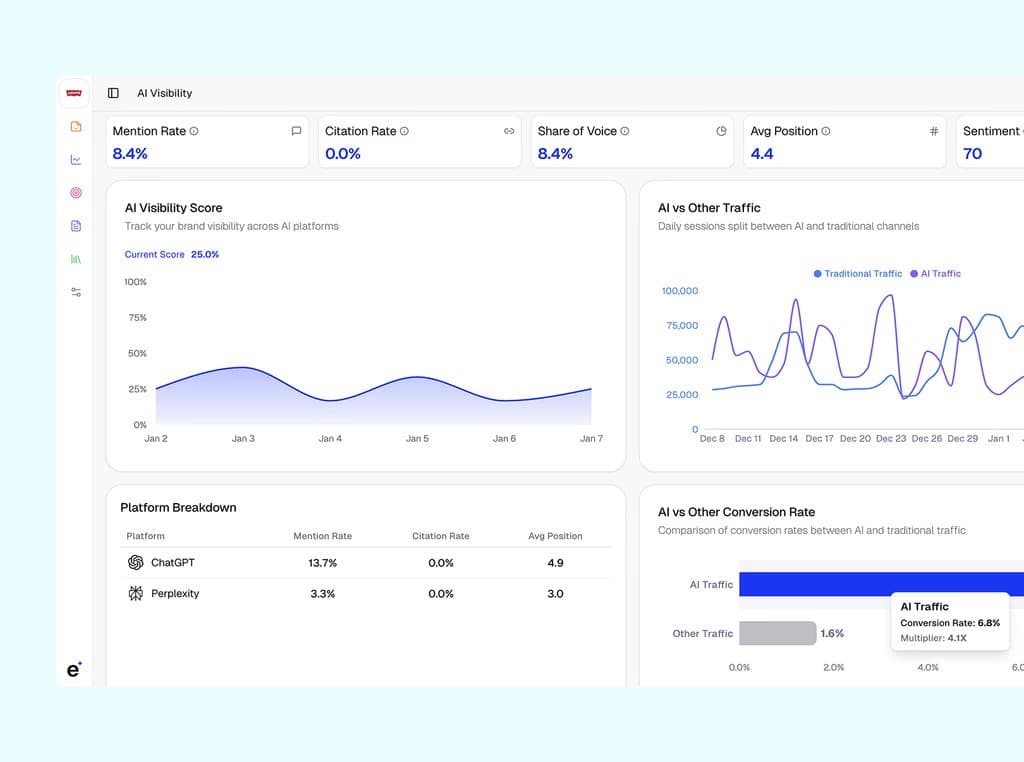
Here's the thing about most AI visibility tools: they show you a problem and then leave you to figure out what to do with it. "Your brand isn't appearing for this prompt." Okay. Now what?
Erlin.ai answers that question. It tracks mentions and citations across ChatGPT, Perplexity, Claude, Google AI Mode, Gemini, and Copilot, but the differentiator is what happens after the gap is identified.
Action Center converts opportunities into tasks automatically, prioritized by impact, assigned to team members, and tracked in one place. No more pulling a report and then spending an afternoon building a doc to figure out what to do with it.
The content workflow follows the same logic. When Erlin spots a gap, say, you're not appearing for "best [your category] for small teams", it pulls the research, builds the content brief, and produces a first draft. You review and approve.
There's also a Reddit monitoring layer: it finds threads where your brand or category is being discussed, drafts responses for your review, and tracks visibility impact after you post.
Pricing: Pricing on request. Book a demo for pricing.
2. Profound, best for enterprise-scale monitoring
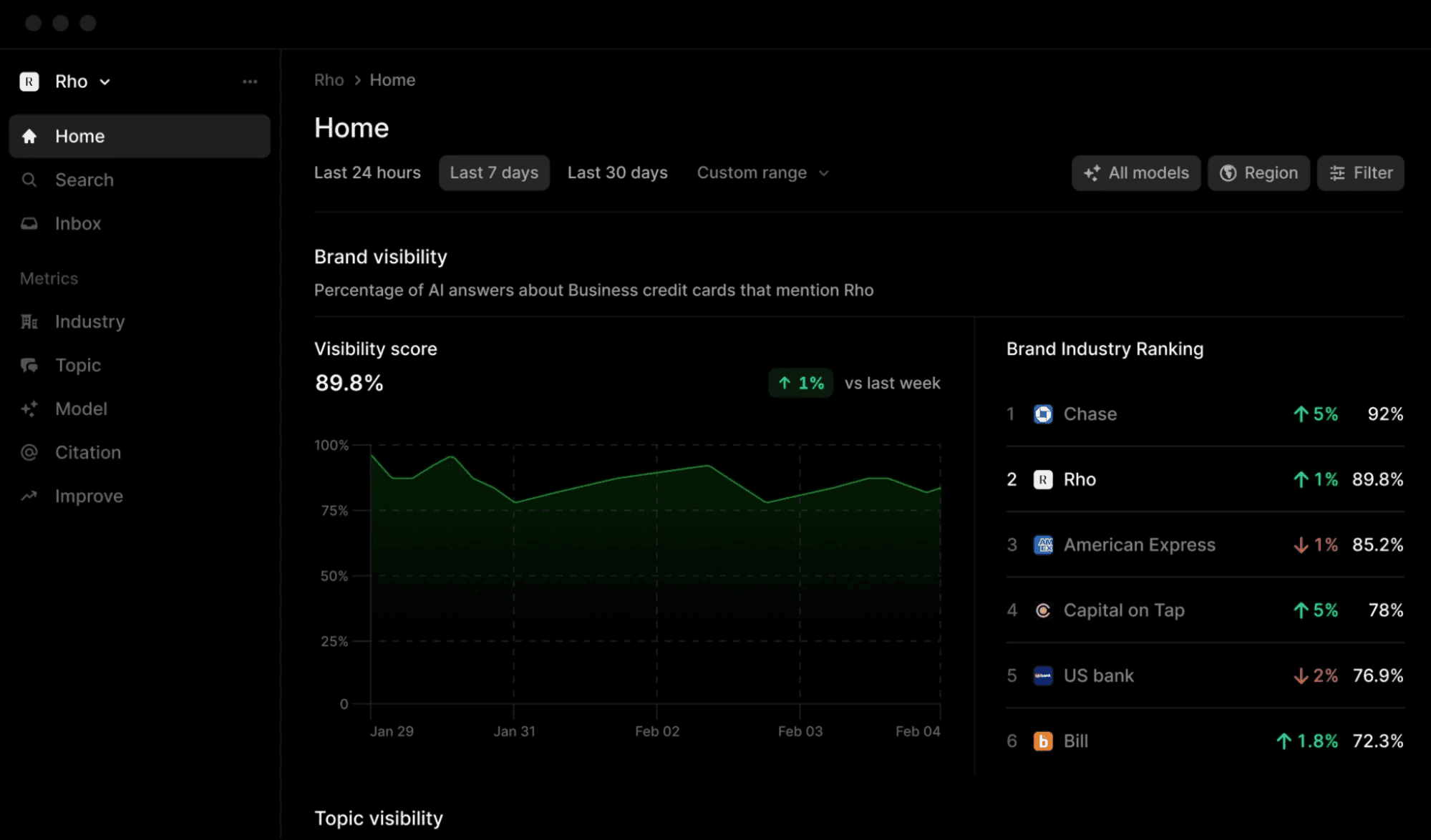
Profound is what you buy when you need to take AI visibility seriously across a large organization and need the data to hold up under scrutiny, not just from your marketing team, but from leadership.
The platform's main strength is data quality. It uses direct monitoring rather than API sampling, so results reflect what real users see. The personas feature lets you segment AI responses by audience type (role, industry, buyer stage), which matters when you're selling to multiple buyer profiles.
Recent additions include a Profound MCP server that pipes AI visibility data directly into Claude Desktop, automated content operation workflows, and support for 30+ languages for international teams. G2 named it the category leader for AEO platforms in Winter 2026.
It's priced accordingly. At $399/month for the Growth plan, about 48% above the market average, it's not where you start. But for enterprise marketing teams that need defensible reporting and multi-region depth, it's hard to argue with.
Pricing: Starter $99/month; Growth $399/month; Enterprise custom. Free trial available.
Worth knowing: Starter plans have limited historical data, and getting real value from the platform usually requires someone with GEO strategy experience. It's a research-grade tool, not a self-serve quickstart.
3. Peec AI, best for teams that need clarity
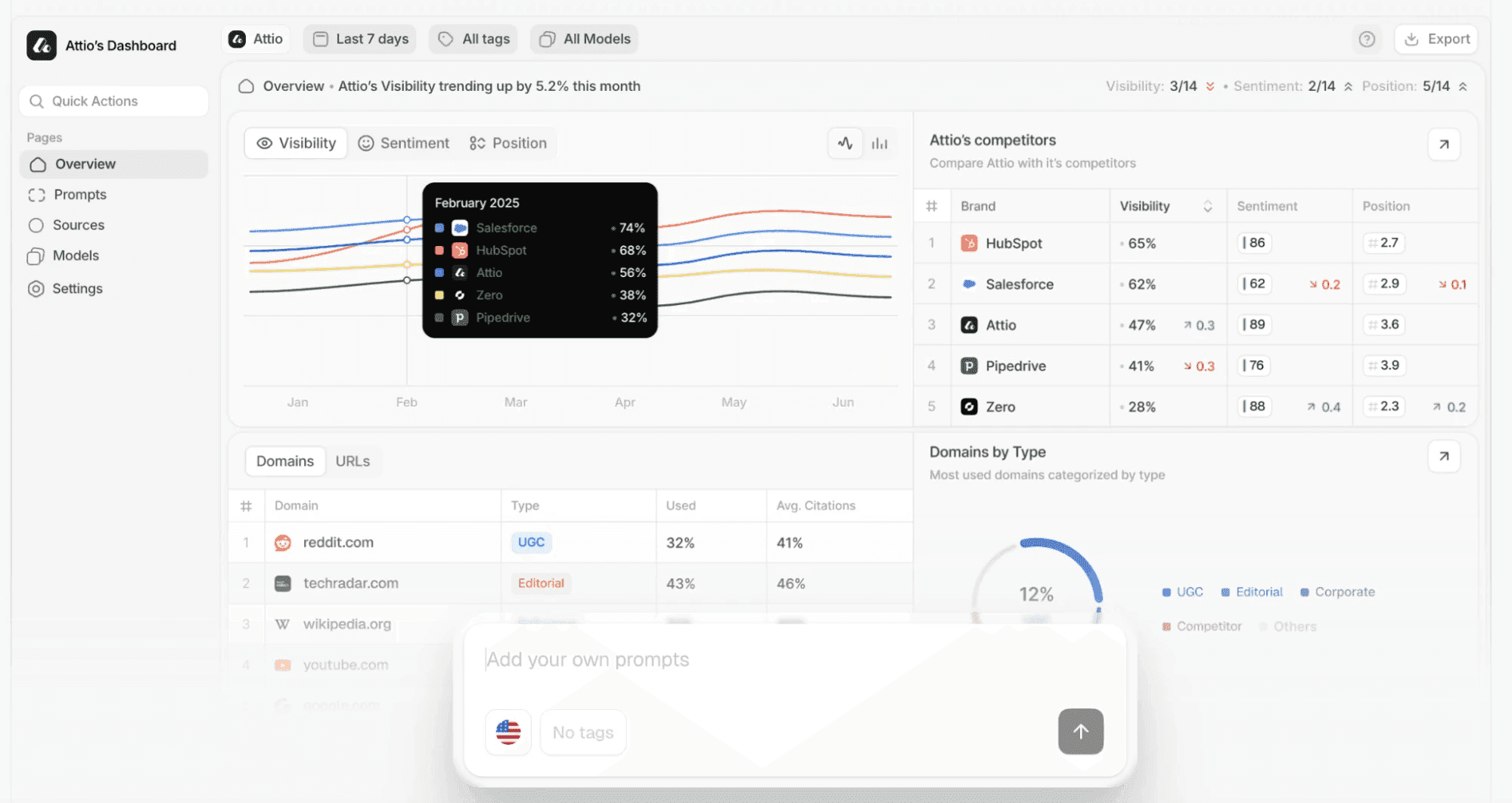
Peec AI is for marketing teams that want solid AI visibility tracking without spending weeks getting up to speed.
The interface is clean, onboarding is fast, and the platform covers ChatGPT, Perplexity, Google AI Overviews, and Gemini with daily updates. The competitive benchmarking shows you not just where you stand, but exactly which competitors are appearing in your place, and for which prompts.
Unlimited seats across all plans matter for agencies managing multiple clients or teams where several people need access.
The "unlimited countries" option in higher plans is useful if you're running multi-market programs and need to compare AI visibility across geographies.
It also makes reporting to stakeholders straightforward: clean dashboards, shareable workspaces, no need to export to a spreadsheet to make the data legible.
Pricing: Starter $89/month (25 prompts/month); Pro $199/month (100 prompts); Enterprise $499/month. Free trial via demo.
Worth knowing: Prompt limits in lower tiers fill up faster than you'd expect if you're tracking a broad keyword set. The platform is strong on reporting, but stops there; you'll take the insights somewhere else to act on them.
4. Otterly.AI, best entry point for teams new to AI visibility
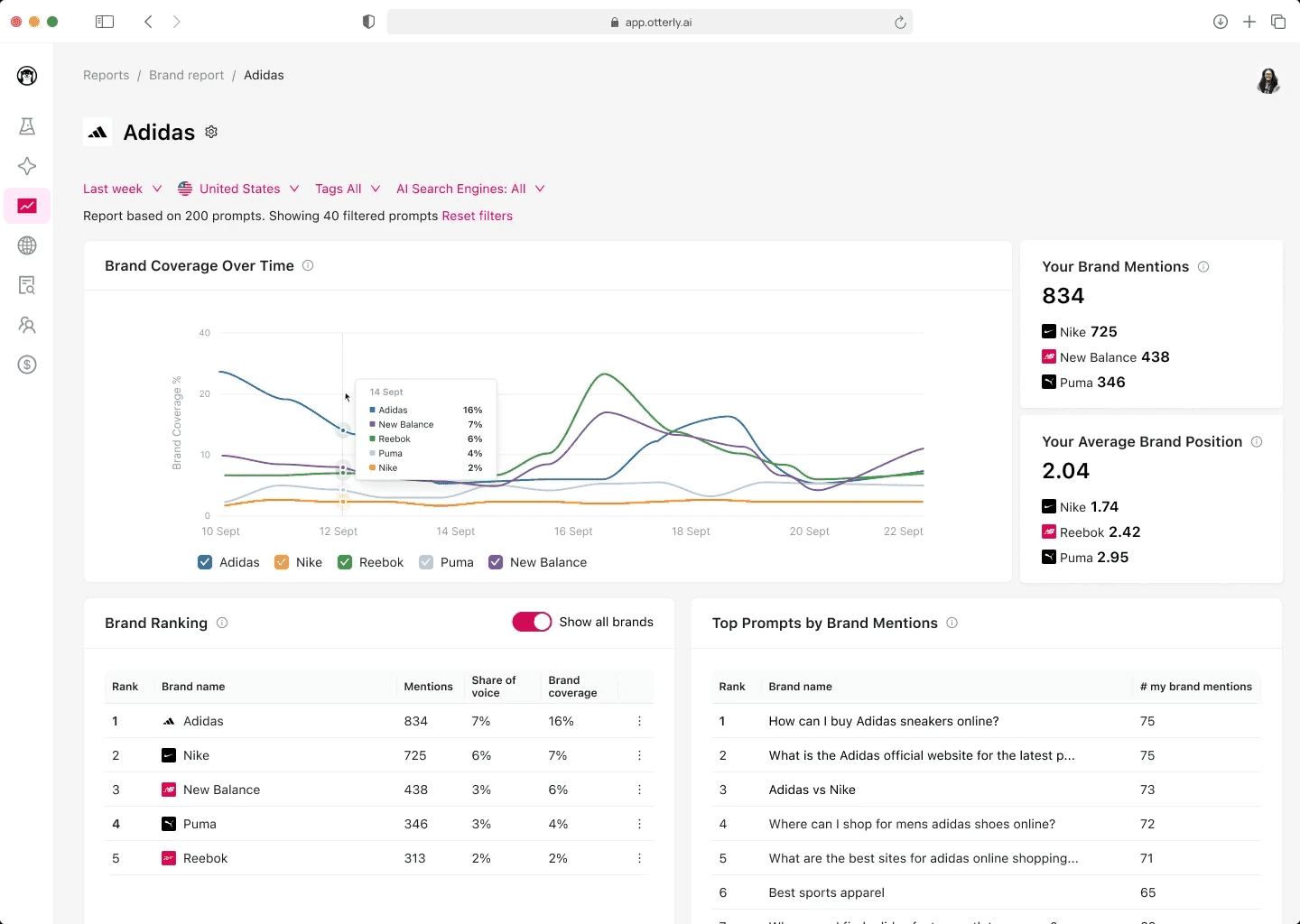
If you want a first read on how your brand appears in AI responses without committing to a large budget, Otterly.AI is where to start.
At $29/month for the Lite plan, it's the most accessible option here. The platform tracks brand coverage, mention frequency, position, and a proprietary Visibility Index across ChatGPT, Copilot, and other engines.
Its GEO audit checks over 25 technical and content factors, such as schema usage, page structure, multilingual content, etc., and outputs prioritized recommendations with a clear order of urgency.
The audit reports are one of the better implementations of this in the market: specific, actionable, and sequenced rather than just a list of things that could be improved.
Teams that have been putting off AI visibility work because it seemed overwhelming often find Otterly a good place to start. It proves the concept without a major investment.
Pricing: Lite $29/month (15 prompts); Standard $189/month (100 prompts); Premium $489/month (400 prompts); Enterprise custom.
Worth knowing: You'll likely hit the ceiling of the Lite plan quickly if you're actively tracking competitive terms. Sentiment tracking and some audit depth require higher tiers, and there are no execution tools; this is a monitoring and audit platform, not an action platform.
5. Ziptie, best for competitive citation intelligence
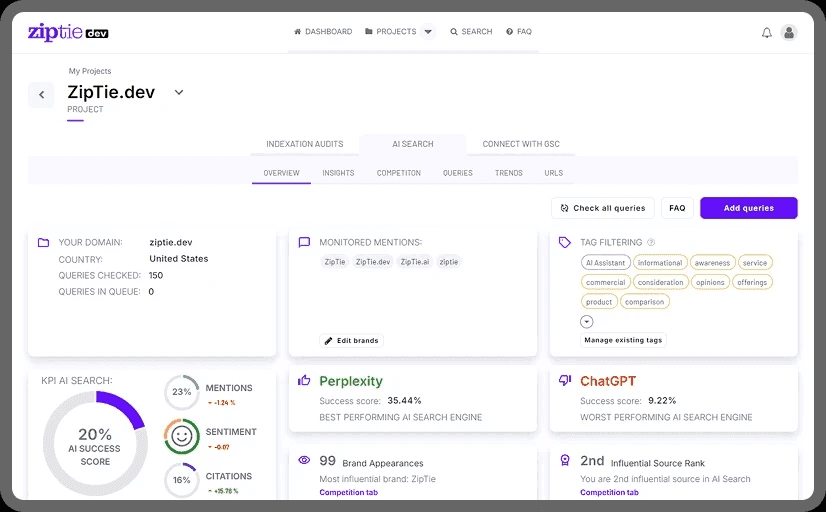
Ziptie's focus is narrower than some of the other tools here, but it's genuinely useful for a specific problem: understanding not just whether your brand appears in AI answers, but who's being cited instead of you and from which sources.
The platform monitors visibility across Google AI Overviews, ChatGPT, and Perplexity with a strong emphasis on citation tracking and competitive intelligence.
The source monitoring shows you which pages and publications AI is pulling from when it answers questions in your category, which can point you toward content gaps or PR opportunities you wouldn't have found otherwise. Annual billing saves 15%.
Pricing: Basic starts around $50/month; higher tiers for broader coverage available. Annual discount of 15%.
Worth knowing: Pricing details beyond the basic tier require a conversation, which makes it harder to budget without a demo. If you still need traditional SERP tracking alongside AI monitoring, this isn't a full-stack solution.
6. Semrush, best for teams already inside the Semrush ecosystem
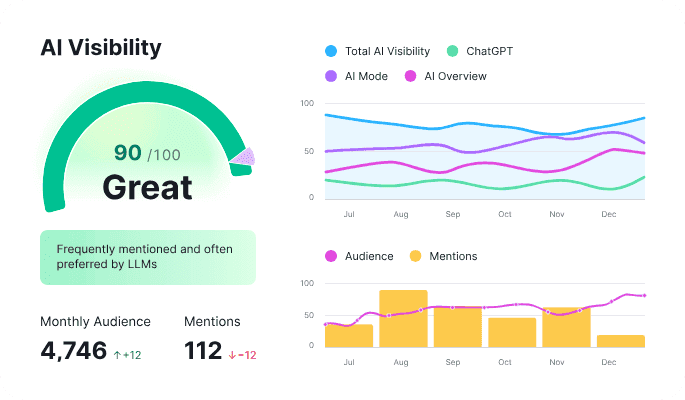
Semrush added AI visibility tracking to its platform in 2025, and for existing users, it's the most obvious next step. The AI Visibility Index monitors brand mentions and sentiment across ChatGPT and Google AI Overviews, and it connects to the keyword and content workflows most SEO teams already live in.
The argument for Semrush isn't depth, it's consolidation. You can see which keywords are driving traditional rankings and AI citations in the same interface, which makes cross-channel reporting cleaner and gives leadership a simpler picture of search performance.
For teams that are still managing traditional SEO alongside AI visibility, that matters.
Pricing: Pro plan from $129/month; Business from $249/month. AI features are included in higher tiers. Free trial available.
Worth knowing: The AI features are newer and less granular than purpose-built GEO platforms. If AI visibility is your primary concern and not just one metric among many, a dedicated tool will give you more signal.
7. Ahrefs Brand Radar, best for benchmarking against a large keyword dataset
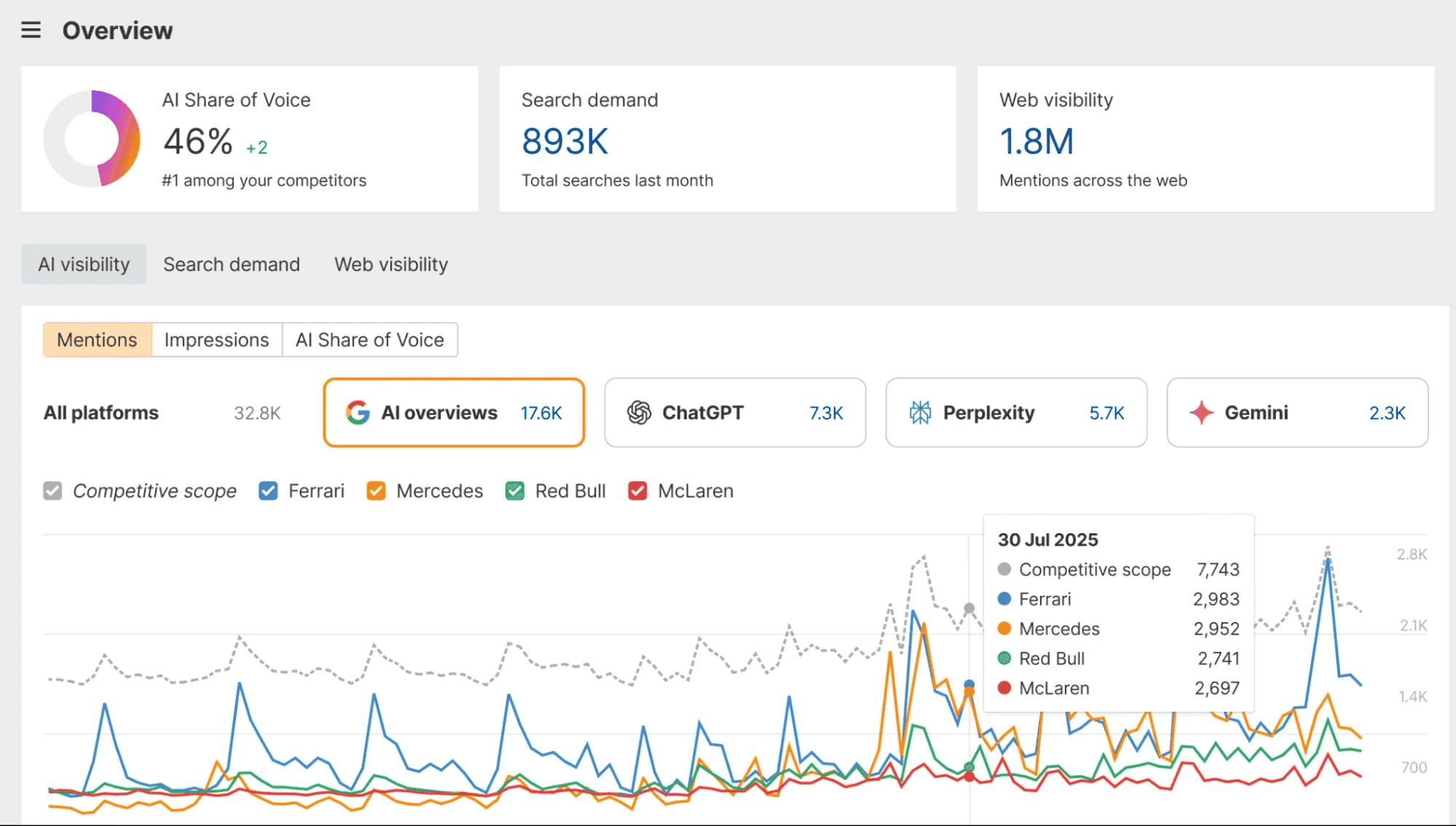
Ahrefs Brand Radar draws on a database of 100+ billion keywords to query how brands appear across ChatGPT, Perplexity, Gemini, and Google AI Overviews. The scale is the point; rather than working from a curated prompt list, you're measuring against what people are actually searching at volume.
It also pulls in multi-channel brand signals: Reddit discussions, YouTube mentions, and broader web presence alongside AI responses. For brand teams that want a more complete picture of how they're perceived across the web, not just in AI answers, that wider lens is useful.
Pricing: All plans start at $129/month and include base Brand Radar features. Full AI tracking requires an add-on at $199/month per index or $699 as a bundle.
Worth knowing: The AI tracking is an add-on, so the total cost is higher than the starting price implies. If you're not already using Ahrefs for core SEO, it's a lot of platform for AI visibility alone.
How to choose the right AI visibility tool
The decision mostly comes down to what you need to do with the data once you have it.
Starting out? Otterly.AI at $29/month gives you a baseline without a budget commitment.
Managing multiple brands or clients and need clean reporting? Peec AI's dashboards and multi-market support justify the step up.
Enterprise with multi-region programs and stakeholders who need to trust the numbers? Profound is the category leader.
The more interesting question is whether monitoring is enough. Most platforms tell you that you're missing from AI responses. Then they stop. The gap between "here's your data" and "here's what to do about it" is where most marketing teams get stuck.
Erlin.ai is the clearest answer to that problem right now. It's one of the few platforms that takes you from gap identification through content production through response publishing and impact tracking, all in one workflow.
For teams that have been measuring AI visibility for a year and are ready to actually close the gaps, that's a meaningful difference.