

Content teams are managing two search engines now. Google is one. ChatGPT, Perplexity, and Gemini are the other. The tools built for 2019 SEO workflows only solve half the problem.
The right AI content strategy tool does more than suggest keywords. It tells you what to create, how to structure it for both traditional rankings and AI citations, and whether your brand actually shows up when buyers ask AI platforms for recommendations.
Only 16% of brands systematically track AI search performance, according to Erlin's 2026 benchmark dataset of 500+ brands. The rest are publishing content without knowing whether it's working across the channels that matter.
This guide breaks down the seven best AI content strategy tools in 2026, what each one does well, and which teams they're built for. The comparison table below gets you to the right answer fast.
Quick Comparison: Top AI Content Strategy Tools
Tool | Best For |
Erlin | Teams that need AI visibility tracking + content strategy in one platform |
Surfer SEO | Content teams optimizing individual pages for Google and AI search |
Semrush | Teams connecting content strategy, AI visibility, and SEO |
MarketMuse | Enterprise teams building large-scale topical authority strategies |
Clearscope | Established content teams that need clean, accurate NLP grading |
Frase | Budget-conscious teams that need fast SERP research and brief generation |
Keyword Insights | Teams building content strategies at scale through keyword clustering |
What Makes an AI Content Strategy Tool Worth Using in 2026?
The best tools solve a specific problem in the content workflow. A few solve several at once.
Before 2024, content strategy tools competed on keyword research depth, content scoring accuracy, and brief generation speed. Those capabilities still matter.
What changed is that AI search now accounts for a growing share of discovery traffic. AI-sourced traffic surged 527% year over year between early 2025 and early 2026, according to Previsible's AI Traffic Report.
Content teams need tools that optimize for both traditional rankings and AI citations, not just one.
Four things separate the strong tools from the weak ones in 2026. First, does the tool account for AI search visibility, not just keyword rankings? Second, does it help teams prioritize what to create rather than just how to optimize what's already written?
Third, does it integrate into the actual writing workflow or add another dashboard to manage? Fourth, does the pricing hold up when your content volume scales?
The tools below score well across at least three of those four criteria.
1. Erlin: Best for AI Visibility Tracking + Content Strategy
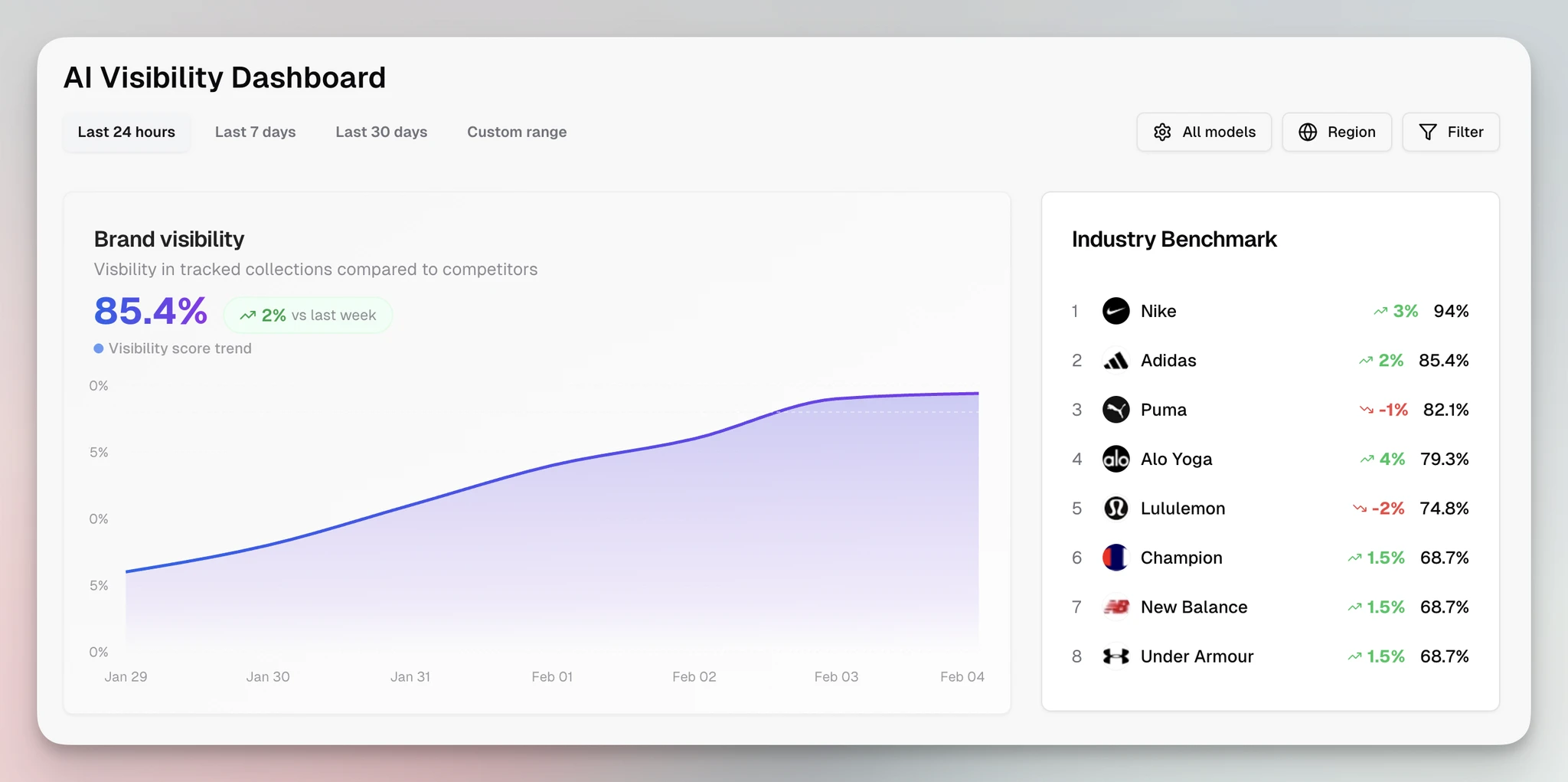
Erlin is a multi-agent AI visibility platform that helps brands get discovered, cited, and recommended across AI platforms. For content teams, that means planning and executing content with a clear view of how it performs across ChatGPT, Perplexity, Gemini, and Claude, not just Google.
The platform runs on three pillars: Insights, Opportunities, and Action Center. Insights tracks AI visibility and prompt coverage across all four major platforms.
Opportunities surfaces content gaps and quick wins. Action Center deploys the fixes. The workflow is designed to cut the planning cycle, not extend it. Brief creation that used to take two hours takes fifteen minutes with Erlin, according to client data from 2026.
What separates Erlin from traditional content strategy tools is the dataset behind it. Erlin's benchmark research covers 500+ brands tracked across 15,000+ purchase-intent prompts, giving content teams a data layer that generic SEO tools don't have.
That data reveals patterns that change what content teams should prioritize. Brands with 8+ structured attributes get cited 4.3x more than brands with fewer than 3, according to Erlin's 2026 research.
That's a structural insight, not a keyword suggestion. And brands updating content monthly see approximately 23% higher AI coverage than those with stale content, meaning the content calendar decisions teams make have measurable downstream effects on AI citation rates. (Erlin data, 500+ brands, 2026)
The platform also tracks competitor AI visibility, which helps teams identify where they're losing ground in AI recommendations before it shows up in traffic drops. Erlin's Fire Score prioritizes which content to create or refresh based on impact, so the team always has a clear answer to "what do we write next."
Best for: Content teams at B2B SaaS or growth-stage companies that want to optimize for both Google and AI search from one platform. Particularly strong for teams where the CMO is asking about AI visibility and the content team has no way to answer that question yet.
2. Surfer SEO: Best for Real-Time Page Optimization
Surfer SEO is the standard content optimization layer for teams producing content at volume. Its Content Editor is the product most people actually use: you write or paste in a draft, and Surfer scores it in real time based on what the top-ranking pages for that keyword have in common.
The scoring model analyzes NLP signals, heading structure, word count, and semantic keyword coverage against competitors. As you write, you see a content score that climbs or drops with each edit.
For teams producing 10 to 30 articles per month, that real-time feedback loop removes the guesswork from optimization and catches structural gaps before publication.
Surfer's AI Tracker, added in recent product updates, extends its reach into AI search. It tracks visibility across ChatGPT, Perplexity, and Google AI Overviews, and the Mention Gap report shows which prompts competitors appear in that your content doesn't. That's a meaningful addition for teams that need to track AI presence without switching to a dedicated platform.
The Topical Map feature helps teams plan content clusters strategically, identifying which supporting pages need to exist for a pillar page to build authority. Google Docs and WordPress integrations mean writers optimize inside the tools they already use.
Pricing starts at $89/month for the Essential plan, covering 30 articles per month. The Scale tier runs $129/month for 100 articles. A separate AI writing add-on is available for teams that want draft generation alongside optimization.
Best for: Content writers and SEO managers who publish regularly and want the most accurate real-time optimization feedback per article. Strong for agencies managing multiple clients at volume.
3. Semrush: Best for Connecting Content Strategy, AI Visibility, and SEO
Semrush is a search visibility platform that connects content strategy with performance across both organic search and AI-generated answers. Teams can research keywords and AI prompts, uncover competitor content gaps, optimize content, analyze backlinks, and audit technical accessibility from one system.
Topic Research helps teams develop ideas and build topic clusters, while Keyword Magic Tool and Keyword Gap identify valuable search terms and topics competitors rank for. The SEO Writing Assistant brings these insights into the drafting process with real-time recommendations for keyword use, readability, originality, and tone, including integrations with tools such as Google Docs.
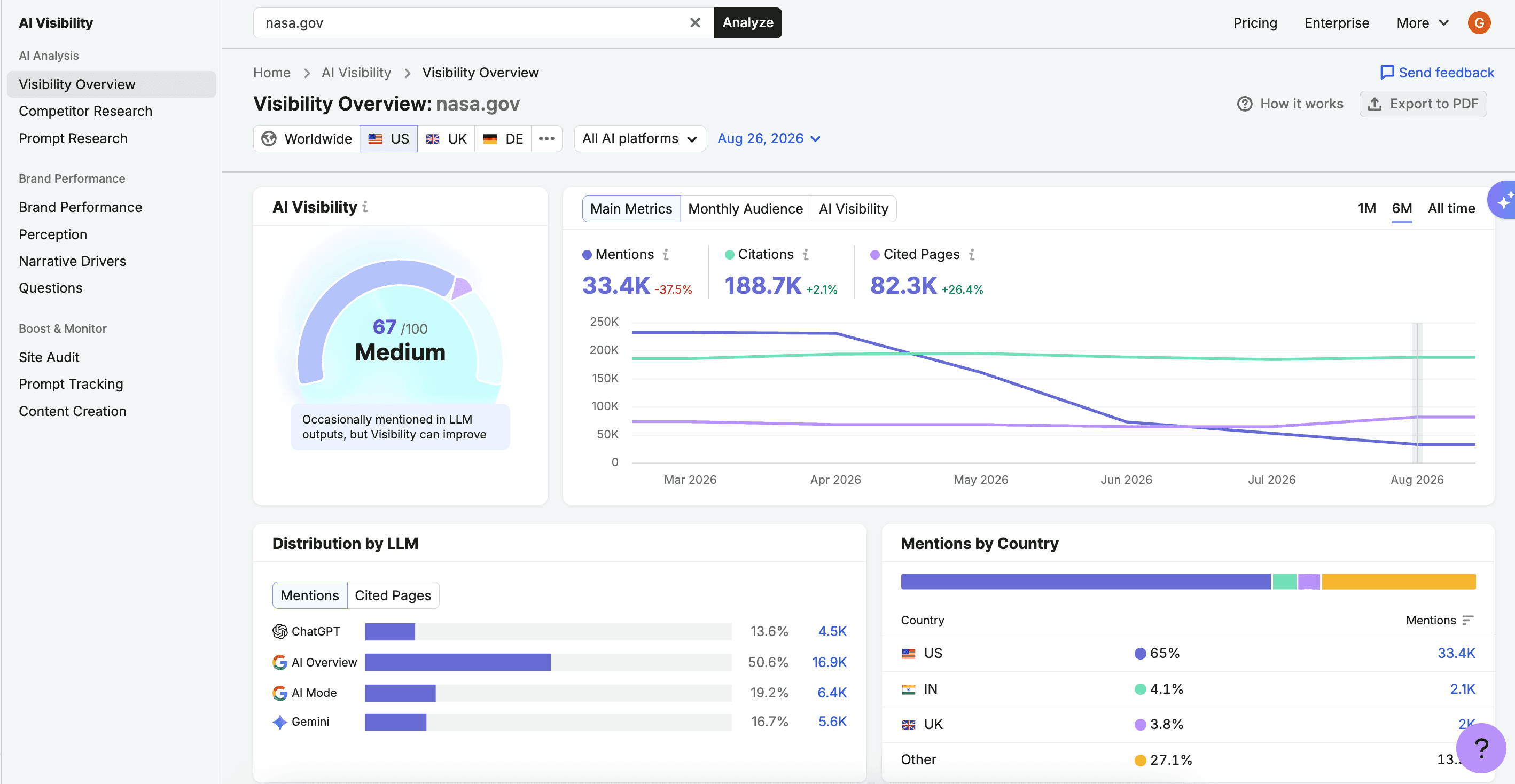
Its AI Visibility Toolkit tracks how brands appear across ChatGPT, Google AI Overviews, Google AI Mode, Gemini, and Perplexity. It includes a 0–100 AI Visibility Score, daily prompt tracking, citation tracking, sentiment analysis, share of voice, and competitor benchmarking. Because these insights sit alongside Semrush’s content and SEO data, teams can investigate why competitors appear more often in AI-generated answers rather than only monitoring the gap.
For agencies, this consolidates content, traditional search, and AI visibility reporting in one platform. Teams can show clients where they appear across both channels and use the same data to guide content, technical SEO, and competitive priorities.
Pricing: Semrush pricing starts at $139.95 per month. Check Semrush’s pricing page for current plans and inclusions.
Best for: Agencies and in-house teams that need one platform for content strategy, writing optimization, AI visibility, SEO, and competitive research. It is especially useful for SaaS and ecommerce companies where content, technical SEO, and search visibility teams need to share data.
4. MarketMuse: Best for Enterprise Content Strategy at Scale
MarketMuse works differently from most content optimization tools. Rather than scoring individual articles, it maps topical authority across your entire domain, identifying where you have gaps and where competitors have stronger coverage than you.
The platform's Content Inventory pulls all of your existing published content and runs it through topic modeling, assigning each page a coverage score and identifying cannibalization, thin content, and missing cluster pages.
For sites with 200 or more articles, this strategic view is difficult to replicate manually. MarketMuse shows you not just what to write, but what already written content is working against you by competing for the same keyword territory.
Personalized Difficulty is one of MarketMuse's most useful features. It calculates how hard it will be for your specific domain to rank for a given keyword, rather than relying on a generic difficulty score that doesn't account for your existing topical authority.
For teams making resource allocation decisions across a large content calendar, that personalization changes the prioritization math.
Content briefs are detailed, pulling in related topics, suggested word counts, and competitive analysis from top-ranking pages. The research and optimization flows are well-integrated, which helps keep large writing teams aligned without requiring constant editorial oversight.
Free tier access exists for exploration. Paid plans start at $149/month, with enterprise pricing for larger organizations. The investment is harder to justify for teams publishing fewer than 10 articles per month.
Best for: Content strategists and SEO managers at enterprise companies managing large content libraries. Best paired with a dedicated optimization tool like Surfer or Clearscope for page-level execution.
5. Clearscope: Best for Enterprise Writing Teams That Need Simplicity
Clearscope does one thing and does it well: it grades your content on how thoroughly it covers a topic compared to what's already ranking. The A++ to F grading system is intuitive enough that non-SEO writers use it independently, which matters for teams where the content operation spans multiple writers who aren't SEO specialists.
The NLP engine is widely regarded as accurate. It analyzes top-ranking pages for a given keyword, extracts the terms and concepts that correlate with strong rankings, and scores your draft against that benchmark as you write. The grade is clear and actionable, the interface is clean, and onboarding takes under an hour.
What Clearscope gets right that many tools miss is the team structure. Every plan includes unlimited user seats, which removes a friction point that trips up agencies and larger content teams. A competitor like Surfer charges per seat at higher tiers. For a team of eight writers, that pricing difference compounds quickly.
Content Inventory monitoring tracks how existing content holds up over time, flagging pages that have dropped in coverage or relevance. That feature adds strategic value beyond the writing-time optimization that the tool is best known for.
Plans start at $129/month and scale based on content reports rather than seats. The higher per-report cost means it's most cost-effective for teams publishing 15 or more articles per month.
Best for: Enterprise teams with dedicated writers who need a simple, accurate optimization tool that doesn't require SEO training to operate. Strong for agencies managing editorial teams across multiple clients.
6. Frase: Best for Budget-Conscious Teams That Need Fast Research
Frase is the entry point for teams that want structured content workflows without paying for an enterprise platform. The core product automates SERP research: enter a keyword and Frase analyzes the top 10 results, extracts headings, questions, and key topics, and generates a content brief in roughly 30 seconds.
That brief quality is where Frase earns its reputation. For teams that previously spent 45 minutes manually reviewing competitor pages before writing, Frase turns that step into a 30-second operation.
The People Also Ask integration pulls real questions from search results, which helps writers address what readers actually want to know rather than what the brief author assumed.
In late 2025, Frase added GEO scoring alongside its traditional SEO score. The dual-score approach shows content teams how a draft performs for both Google optimization and AI citation potential, which addresses the core challenge of 2026 content strategy: optimizing for two different discovery channels with different structural requirements.
AI Search Tracking monitors brand mentions across Google and eight AI platforms, making Frase a reasonable entry-level option for teams that need AI visibility data without a dedicated platform investment.
Pricing starts at $39/month with a seven-day free trial and no credit card required. All plans include the full Frase Agent, SEO, and GEO optimization, and AI visibility tracking. Plans differ on volume.
Best for: Small to mid-sized content teams publishing 5 to 20 articles per month that want fast, structured research and briefs at an accessible price. Teams at agencies managing multiple smaller clients often find strong per-article ROI here.
7. Keyword Insights: Best for Keyword Clustering at Scale
Keyword Insights focuses on a specific problem that causes consistent pain for content teams at scale: figuring out which keywords should become separate pages and which should be combined. Manual keyword grouping at 5,000+ keywords is slow, error-prone, and eats strategy time that should go to execution.
Keyword Insights clusters keywords based on actual SERP similarity rather than phrase matching. Two keywords that look semantically different might share 80% of the same top-ranking pages, which means they have the same search intent and belong on the same page.
Two keywords that look similar might rank completely differently, meaning they warrant separate content. Phrase-matching approaches miss both scenarios.
The clustering output feeds directly into content calendar planning. Teams see which clusters are under-covered, which have cannibalization risk, and which are the logical starting points for pillar content.
The auto-citations feature, added in recent updates, includes verified claims with every piece, which addresses the accuracy problem that limits how much content teams trust AI drafts.
The WordPress integration enables direct publishing from the platform, and the SERP analysis tools add competitive context to the clustering data.
Pricing starts at $39/month for the Essential plan.
Best for: Content strategists and SEO leads building large-scale content programs where keyword clustering is the strategic bottleneck. Strong for agencies that produce high volumes of content across multiple domains.
How to Choose the Right AI Content Strategy Tool
The right tool depends on what's actually slowing your team down.
If your content team can't answer "how does our brand appear in ChatGPT when buyers search for solutions like ours," that's an AI visibility gap. Erlin is built specifically for that problem and connects it to content planning so the answer drives the editorial calendar.
The gap between AI visibility winners and losers is 9x today and widening 3.2% every month, according to Erlin's 2026 data, meaning teams without a visibility tracking layer are falling further behind with each passing month. (Erlin data, 500+ brands, 2026)
If your bottleneck is individual article quality, Surfer SEO or Clearscope solves that more directly. Surfer wins on feature depth and content score accuracy at the page level. Clearscope wins on simplicity and unlimited seats for larger writing teams.
If you manage a large content library and need a strategic view of which content is working, cannibalized, or missing, MarketMuse provides the topical authority mapping that no other tool matches at enterprise scale.
For teams earlier in the build, Frase gets you to a structured brief workflow at a price that makes sense before you're publishing 20 articles per month. Keyword Insights fills the clustering gap specifically, which makes it a strong complement to any writing-focused tool.
Semrush is the default choice when you need one platform across all SEO functions, particularly for agencies that need client reporting across search channels.
Most content teams running at scale end up pairing tools: a planning layer (MarketMuse or Erlin for strategy, Keyword Insights for clustering) with an optimization layer (Surfer or Clearscope for article-level execution). The combination costs more than a single tool, but the output quality reflects it.
Frequently Asked Questions
What is an AI content strategy tool?
An AI content strategy tool helps content teams plan, create, optimize, and track content using artificial intelligence. In 2026, the best tools cover both traditional SEO optimization for Google and generative engine optimization (GEO) for AI platforms like ChatGPT and Perplexity. Core features typically include keyword research, content briefing, real-time optimization scoring, and increasingly, AI visibility tracking.
How is AI content strategy different from traditional SEO content strategy?
Traditional SEO content strategy optimizes for Google's ranking algorithm: keyword density, backlinks, technical signals, and topical coverage. AI content strategy adds a second objective: getting your brand cited when AI platforms generate answers to relevant queries. The structural requirements differ. AI engines prefer discrete, extractable facts, comparison tables, FAQ schema, and structured attributes. Content optimized only for Google may still be invisible in AI-generated answers.
Can I use multiple AI content strategy tools at the same time?
Yes, and most serious content operations do. A common stack pairs a strategic planning tool like MarketMuse or Erlin with a page-level optimizer like Surfer SEO or Clearscope. The planning layer tells you what to create. The optimization layer tells you how to structure each piece. Using both gives you coverage that neither tool provides alone. Budget-permitting, adding AI visibility tracking ensures you know whether the content is performing in the channels that matter.
What should I look for in an AI content strategy tool in 2026?
Look for four things: AI search visibility tracking (not just Google rank tracking), content brief quality (does it save real research time?), workflow integration (does it fit your existing process or require a new one?), and pricing that scales with your content volume without pricing you out at growth. Tools that only solve the Google optimization problem are solving half the brief.
How long does it take to see results from AI content strategy tools?
Traditional SEO results from new or optimized content typically take 30 to 90 days to show up in rankings. AI visibility impact can appear faster. Erlin's client data shows brands can achieve appearance in AI-generated answers within 15 days when content is properly structured for AI extraction, compared to 30 to 45 days for unoptimized approaches. (Erlin client data, 2026) The fastest wins come from refreshing existing content with structured data, comparison tables, and FAQ sections rather than publishing new pages.
Start Tracking Your AI Visibility Today
The tools above solve different parts of the content strategy problem. Most content teams need at least two. But if you only make one change to your current stack, make it this: start measuring how your brand appears in AI search.
Get Your AI Visibility Score and see exactly where your brand shows up across ChatGPT, Perplexity, Gemini, and Claude.
Share
Related Posts
Generative Engine Optimization Trends for 2026
7 GEO trends reshaping AI search visibility in 2026, with data on citations, structured data, and what actually drives brand coverage.
15 Generative Engine Optimization Best Practices Backed by Latest Research
Generative engine optimization best practices backed by 2026 research. 15 tactics to get your brand cited by ChatGPT, Perplexity, and Google AI Overviews.
AI for Content Planning & Strategy: A Complete Guide
AI for content planning in 2026 means planning for AI search visibility, not just faster drafts. Five-layer workflow, what to automate, what stays human.