

If you've tried explaining AI search visibility to your CMO or CFO recently, you probably know how that conversation goes. Someone asks for a spreadsheet. Someone else asks what any of this has to do with the Q3 pipeline number.
The problem isn't that AI visibility doesn't drive results. It does, often better than channels your team is already funding. The problem is that most marketing teams don't have the numbers to prove it yet, and walking into a budget meeting without them is a losing game.
This guide fixes that. It walks you through what AI visibility ROI actually means, how to calculate it, which metrics your leadership team will actually care about, and how to start building the business case before someone else does it for a competitor.
What is AI Visibility ROI?
AI visibility ROI measures the business return you get from being present ( cited, mentioned, or recommended) in AI-generated answers across platforms like ChatGPT, Perplexity, Google AI Overviews, Claude, and Gemini.
It's different from traditional SEO ROI in a pretty fundamental way. With SEO, you rank, someone clicks, they land on your page, and you track the conversion. The path is visible.
With AI search, users often get everything they need without clicking anything. AI narrows down the options, makes a recommendation, and the user either acts on it or doesn't. Your brand either made the shortlist or it didn't.
This is what the Erlin 2026 State of AI Search report calls the "visibility gap", the growing difference between brands AI recommends and brands AI ignores. And it's a gap that compounds.
Once a competitor earns consistent citation authority in your category, it gets harder to displace them. Erlin's data shows first-movers gain a 3–5x citation advantage over brands that optimize later for the same queries.
So AI visibility ROI isn't just a marketing metric. It's a measure of how much of your future buyer consideration you currently own, and how much you're ceding to competitors who are already in the answer.
Why AI Visibility ROI Matters More Than Ever
Here's the number that should concern most CMOs: according to McKinsey research cited in Erlin's report, by 2028, an estimated $750 billion in US revenue is expected to flow through AI-powered search. That number is probably conservative.
Even today, the shift is already underway. 44% of users now consider AI their primary source of information (Melbourne Business School, "Trust and AI" research).
About 61% of users use AI to compare products before engaging with a brand at all (Bazaarvoice). And according to Erlin's survey of 200+ marketing leaders, only 18% have any active AI visibility strategy.
That last stat is worth sitting with. If only 18% of teams are doing this deliberately, the vast majority of the market is essentially invisible in AI answers by default, not because they're bad at marketing, but because nobody has picked up the assignment yet.
There's another reason this matters right now, specifically: the conversion quality. Traffic coming from AI recommendations isn't casual browsing traffic. These users have already been pre-filtered by the AI.
They've gotten a recommendation, had their question answered, and they're clicking through because they're interested. Erlin tracks conversion rates for brands across AI platforms and consistently sees 3–6x higher rates compared to other channels. That's not a small edge. That's the difference between a channel you fund and a channel you bet on.
The standard marketing argument, "we need to be where the customers are", has never been more literal. Customers are asking AI what to buy. The question is whether your brand is in the answer.
How to Calculate Your AI Visibility ROI Step-by-Step
Here’s how to start measuring your AI visibility ROI:
Step 1: Establish your baseline
Before you can calculate ROI, you need to know where you're starting. Run 50–100 high-intent prompts across ChatGPT, Perplexity, and Gemini.
These are queries your actual customers would use when comparing solutions in your category. Track how often your brand appears in the first three citations or response paragraphs.
This gives you your starting Visibility Score (the percentage of relevant queries where your brand shows up) and Share of Voice (how your mention frequency compares to competitors across the same prompt set).
Don't skip this step. Without a baseline, you can't prove movement, and without proven movement, you can't justify the budget.
Tools like Erlin automate this entire process across platforms, but even a manual baseline from 50 prompts is better than nothing.
Step 2: Tag your AI-referred traffic
Set up UTM parameters or referral source tracking for traffic coming from ChatGPT, Perplexity, and other AI platforms. In Google Analytics 4, you can filter sessions by source to isolate AI referral sessions specifically.
Yes, this only captures the users who click through. It misses the influence AI had on users who later searched directly for your brand or typed your URL. But it's the most defensible number you can put in front of a CFO, so start here.
Step 3: Calculate AI-attributed revenue
Take your AI-referred traffic volume × your conversion rate for those visitors × your average order or deal value. That gives you a direct revenue attribution figure.
If you want a more complete picture, layer in post-purchase surveys asking "How did you first hear about us?" The percentage who mention ChatGPT, Perplexity, or "AI" as a discovery source will almost certainly be higher than your click-through data suggests, because most AI-influenced journeys don't involve a traceable first click.
Step 4: Add brand value gains
This is trickier but worth including. Brands cited more often in AI answers see downstream lifts in branded search volume, direct traffic, and reduced customer acquisition costs.
A conservative estimate from the research: every consistent AI citation touchpoint reduces subsequent CAC by creating pre-purchase familiarity. If you have data on the CAC difference between AI-referred customers and those from paid channels, use that delta as a proxy.
Step 5: Apply the formula
AI Visibility ROI = (AI-attributed revenue + brand value gains – AI visibility investment) ÷ AI visibility investment × 100
Where "AI visibility investment" includes your tracking tool subscription, content optimization work, structured data implementation, and any time spent on third-party citation building.
One of Erlin's customers ran this calculation and came back with a $200K attributable pipeline figure against a $20K spend. A 10x return. Those numbers will vary by industry, but the conversion quality advantage AI traffic carries makes a strong ROI relatively achievable compared to paid channels.
Key Metrics That Prove AI SEO ROI
When you're building the board-ready version of this story, four metrics do most of the work.
Visibility Score is the percentage of relevant queries where your brand shows up in AI answers. If you're running 100 prompts and appearing in 40, your score is 40%. According to Erlin's maturity model, brands with 40–60% coverage are "AI Present," while 60–80% puts you in "AI Preferred" territory. Scores above 80% are "AI Dominant", a position fewer than 15% of brands hold in any category.
Share of Voice compares your citation frequency to competitors across the same prompt set. This is the metric your CMO and CEO will immediately understand because it maps to competitive positioning, a language they already speak. Even if your absolute visibility is modest, showing that you're out-citing key competitors is a strong business case on its own.
Citation Rate is the percentage of your brand mentions that include an actual link or direct attribution. Showing up in an AI answer matters. Being cited with a link matters more, both for click-through attribution and as a signal that AI systems treat your content as authoritative.
Sentiment tracks whether AI answers frame your brand positively, neutrally, or conditionally. Being mentioned as "one option to consider" is different from being recommended as the best fit for a specific use case. Poor sentiment in AI answers can actively work against purchase intent even when visibility is decent.
Beyond these four, track content recency impact. Erlin's data shows brands updating content monthly see ~23% higher AI representation than brands with stale content. If visibility is dropping, content freshness is usually the first place to look.
Choosing the Right AI Visibility Tracker to Support ROI Measurement
Most teams try to patch this together with manual prompt testing in Google Sheets and UTM tracking in GA4. That works for getting a baseline. It doesn't work for ongoing measurement at the scale that actually moves the needle.
Here's what a proper AI visibility tracking tool needs to do, and why it matters for ROI specifically:
Cross-platform tracking
Your AI visibility varies significantly by platform. Erlin's 2026 report found ChatGPT drives 91% of AI referral traffic, but Perplexity delivers higher citation rates in certain B2B categories, and Google AI Overviews often convert better for e-commerce. A tool that only tracks one platform gives you an incomplete picture and can't tell you where to focus optimization efforts.
Prompt-level tracking
Share of Voice across broad categories is useful for executive reporting. But to actually improve your visibility, you need to know which specific prompts trigger your brand and which ones hand your competitors the recommendation. Prompt-level tracking lets you prioritize the gaps that matter most commercially.
Competitive monitoring
AI citation patterns shift when competitors update their content, earn new third-party mentions, or add structured data. You need to know when your competitive position changes, not six weeks later when traffic starts dropping.
Connection to real outcomes
Visibility metrics are only convincing when they connect to the pipeline and revenue. Any tool worth using should integrate with Google Analytics and Search Console to tie AI citations to downstream traffic and conversion data.
Board-ready insights without the manual work
This is where Erlin specifically does something different. The platform isn't just a visibility tracker; it's built around the ROI reporting problem, with the CMO budget conversation explicitly in mind.
Erlin tracks your AI visibility score, share of voice, and competitive position automatically across ChatGPT, Claude, Gemini, and Perplexity. It surfaces opportunities ranked by revenue impact, so your quarterly planning starts with "here's what would move the most pipeline" rather than "here's a list of content ideas."
The platform connects visibility metrics to traffic and conversions in a single view, which is what you need when leadership asks how AI search fits into the overall channel mix.
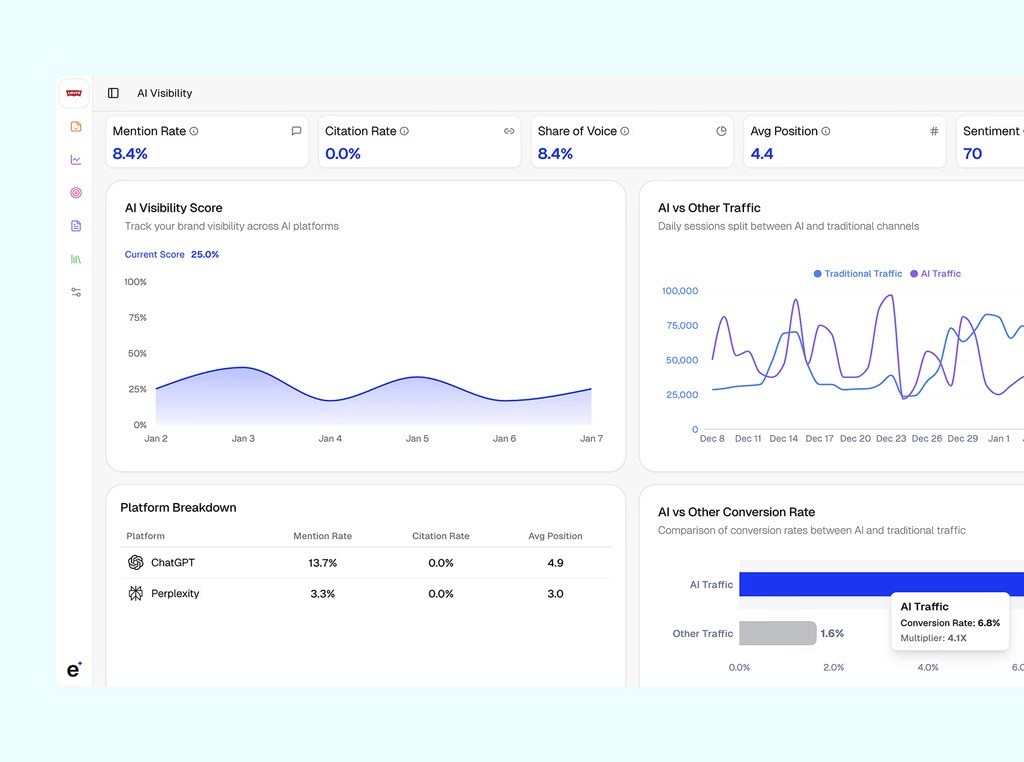
On the page level, Erlin shows every landing page with GSC impressions, clicks, and position data alongside GA traffic and conversion rates. Spot underperforming pages fast, then connect SEO and AI search data to real outcomes rather than running them in separate reports.
At the prompt level, you can see exactly which questions trigger your brand, who else shows up in those answers, and how your visibility has trended over time. That includes the full AI answers with mentions and citations, competitor presence per response, and historical data to show movement.
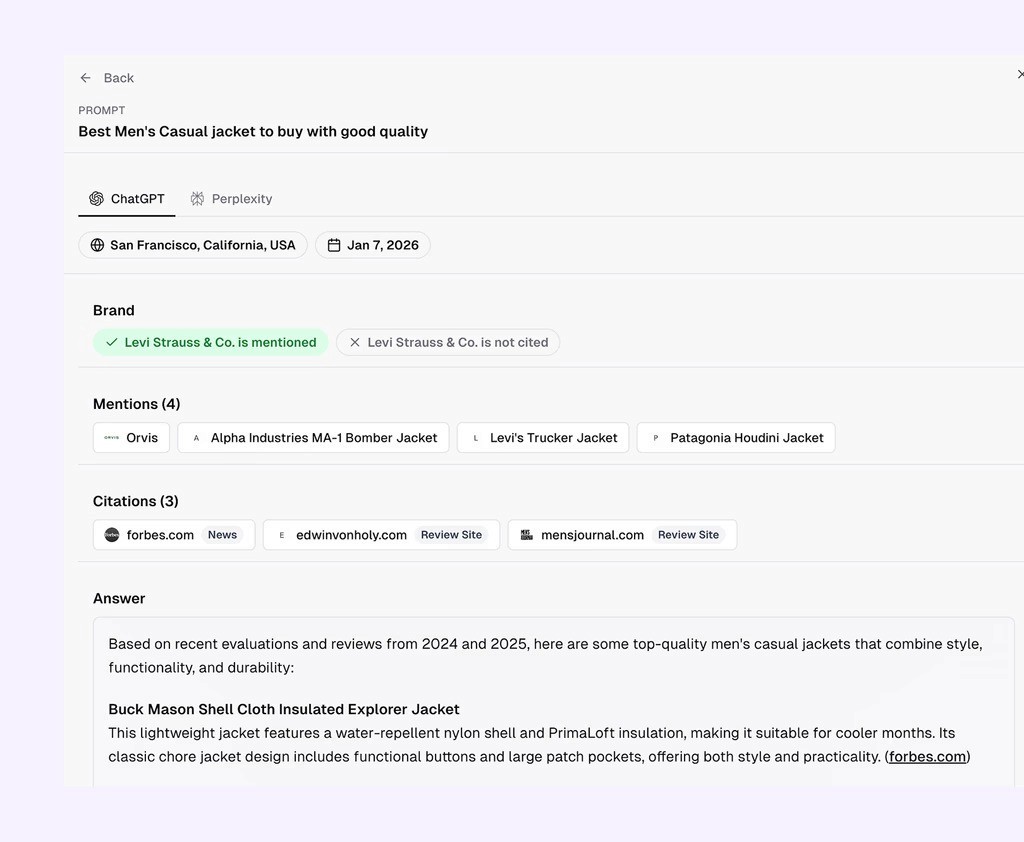
The Fire Score, Erlin's proprietary prioritization system, ranks your action items by expected business impact, so teams aren't just doing more work; they're doing the work that actually changes the numbers. Slack and email alerts surface citation shifts before they become visibility losses.
For teams consolidating tools, Erlin's customers have reported saving significant operational costs. One noted they consolidated six different tools into the platform and reduced their marketing software spend by $200K, with performance actually improving.
Start Tracking Your AI Search ROI Today
The hardest part about building the business case for AI visibility isn't the math. It's not having a starting point. That's exactly what Erlin's free AI Visibility Audit is designed to solve.
Before you try to make the case to your CMO, the audit gives you a clear picture of where your brand currently stands in AI-generated answers:
How AI describes your brand
Where you're being cited
Where competitors are beating you
What the gap between your current state and competitive performance actually looks like in concrete numbers
That baseline is what turns "we should invest in AI visibility" from a hypothesis into a business case. You can show leadership what your current AI presence looks like, what specific competitors are outranking you on which prompts, and what the projected revenue impact of closing those gaps would be, before you ask for a dollar of budget.
From there, Erlin's platform gives you the ongoing measurement infrastructure to track whether your investments are working: visibility trends, citation rate changes, competitive share of voice, and the connection between AI search performance and pipeline.
That's the reporting loop that turns a one-time experiment into a measurable marketing channel.
If you want to see where your brand stands right now, the free audit at app.erlin.ai/get-started takes about 10 minutes and gives you enough data to have a real conversation with leadership.
Frequently Asked Questions about AI Visibility ROI
What's the difference between AI visibility ROI and traditional SEO ROI?
Traditional SEO ROI tracks clicks, rankings, and direct traffic conversions. AI visibility ROI measures how often your brand is cited or recommended in AI-generated answers, and attributes revenue to that influence even when users don't click through. The core difference: SEO ROI follows a visible click path. AI visibility ROI accounts for the influence that happens before a user ever visits your site.
How long does it take to see returns from an AI visibility investment?
Initial citation improvements typically appear within 4–6 weeks of optimization work. Measurable revenue attribution usually takes 3–6 months as AI-influenced buyer journeys play out and attribution data accumulates. Structured data changes (like adding llm.txt or FAQ schema) can drive 28–34% coverage improvements in as little as 14–21 days, according to Erlin's analysis.
What's a realistic AI visibility ROI figure?
This varies significantly by category and competitive landscape. Erlin has observed customers reporting 10x ROI on AI visibility investment in some cases. More conservatively, given that AI-referred traffic converts at 3–6x versus other channels, even modest visibility gains can justify the investment if your average deal or order value is meaningful.
Does a good Google ranking mean I'll rank well in AI answers too?
Largely, no. Erlin tracked 500+ brands and found that traditional SEO ranking explains very little of AI citation patterns. The two systems use different signals. A brand can rank first on Google for a query and not appear at all in ChatGPT's answer to the same question. AI favors structured, factually dense, recently updated content, not necessarily whatever ranks in position one.
Can smaller brands compete with larger ones in AI search?
Yes, and this is one of the more interesting findings from Erlin's data. Brands with strong entity context and structured data regularly outperform Fortune 500 competitors in specific query categories. AI doesn't default to the biggest brand; it defaults to the most clearly defined one. A focused brand that publishes factual, well-structured content about a specific category can out-cite a major player who produces generic content at scale.
How do I track AI visibility without a dedicated tool?
You can start manually: run 50–100 representative prompts across ChatGPT and Perplexity, record how often your brand shows up, and log which competitors appear in answers where you don't. Set up UTM parameters to capture AI-referred traffic in GA4. Run this exercise quarterly. It's labor-intensive, but it gives you a baseline. Dedicated tools like Erlin automate this tracking and add competitive monitoring, alert systems, and revenue attribution that manual testing can't replicate at scale.
What content changes improve AI visibility fastest?
Comparison tables, FAQ schema, and llm.txt files drive the fastest coverage gains, typically 28–34% improvement within 14–21 days per Erlin's structured data analysis. Third-party citations matter more than owned content: Reddit discussions, Wikipedia references, and reviews on platforms like G2 drive 2.6–3.4x higher AI citation rates than brand-owned content alone. Content recency also matters. Keeping core pages updated monthly maintains the most stable visibility over time.
Share
Related Posts
Generative Engine Optimization Trends for 2026
7 GEO trends reshaping AI search visibility in 2026, with data on citations, structured data, and what actually drives brand coverage.
15 Generative Engine Optimization Best Practices Backed by Latest Research
Generative engine optimization best practices backed by 2026 research. 15 tactics to get your brand cited by ChatGPT, Perplexity, and Google AI Overviews.
AI for Content Planning & Strategy: A Complete Guide
AI for content planning in 2026 means planning for AI search visibility, not just faster drafts. Five-layer workflow, what to automate, what stays human.