

Ecommerce brands are disappearing from search. Not because their SEO broke. Because the channels where buyers now ask questions have shifted, and most brands have not shifted with them.
Shoppers no longer type product queries into Google alone. They ask ChatGPT which running shoes hold up in rain. They ask Perplexity to compare mattresses under $1,000.
They ask Gemini what skincare brands dermatologists actually recommend.
According to McKinsey, 40 to 55 percent of consumers in electronics, beauty, and apparel now use AI search when making purchasing decisions. Among those users, 44 percent say AI is their primary source, ahead of traditional search at 31 percent.
The brands cited in those AI answers are shaping purchase decisions before a competitor's product page is ever visited. The brands that are not cited are not losing clicks. They are being excluded from the conversation entirely.
Generative Engine Optimization (GEO) is the discipline that fixes this. And the right tools determine how fast and how well an ecommerce brand can compete.
This guide covers the best GEO tools for ecommerce in 2026, what each one does well, and how to choose between them based on your team's priorities.
GEO Tools for Ecommerce: Quick Comparison
Tool | Best For |
Erlin | Complete AI visibility platform: monitoring, benchmarking, and action in one system |
Profound | Enterprise teams needing maximum data depth across 10+ AI engines |
AthenaHQ | Shopify brands needing product recommendation tracking with revenue attribution |
Scrunch AI | Competitive monitoring and early detection of AI share of voice loss |
Relixir | Large catalogs needing automated content freshness at scale |
Otterly.AI | Growth-stage brands starting GEO monitoring on a budget |
Zoovu | Brands whose AI coverage is blocked by unstructured product data |
What Is Generative Engine Optimization for Ecommerce?
GEO is the practice of optimizing your brand, content, and product data so AI engines, such as ChatGPT, Perplexity, Gemini, Claude, Google AI Overviews, and Amazon Rufus, cite, mention, and recommend you in their generated responses.
Traditional SEO gets your pages ranked. GEO gets your brand spoken.
The mechanics are different too. Traditional SEO rewards keyword density, backlink authority, and page speed. GEO rewards fact density, structured product attributes, citation-worthy content, and entity clarity.
An AI engine does not rank URLs. It synthesizes answers from the most trustworthy, most complete, most clearly structured sources it can retrieve.
For ecommerce, this has direct revenue consequences. Erlin's data from 300 ecommerce brands tracked across 5,000 purchase-intent prompts shows that brands with eight or more structured product attributes are cited 4.3 times more often than brands with fewer than three.
Pricing transparency adds 12 percent to AI coverage. Detailed specs add 11 percent. Shipping and returns information adds 9 percent.
The gap between optimized and unoptimized ecommerce brands is significant. Top performers in Erlin's ecommerce dataset achieve 67 percent prompt coverage across the four major AI platforms. The bottom performers reach only 8 percent, an 8.4x gap.
GEO tools exist to close that gap.
What to Look For in a GEO Tool for Ecommerce
Not every GEO tool is built with ecommerce in mind. Some are designed for B2B SaaS, agencies, or enterprise content teams. Before evaluating platforms, identify which capabilities actually matter for a brand selling products.
AI platform coverage: Your tool must monitor the platforms your buyers actually use. For ecommerce, that includes ChatGPT, Perplexity, Gemini, Google AI Overviews, and increasingly Amazon Rufus. A tool that only tracks one or two platforms gives an incomplete picture.
Prompt coverage measurement: Share of voice and mention rate across purchase-intent prompts, not just branded queries, is the core metric for ecommerce GEO. Look for tools that test real buyer questions ("best waterproof running shoes under $150," "which protein powder is best for women") rather than abstract visibility scores.
Product attribute optimization: Ecommerce GEO is largely a structured data problem. The right tool identifies which product attributes are missing or incomplete and gives clear recommendations to fill those gaps.
Competitor benchmarking: AI engines surface 2 to 3 brands per query at most. Knowing when a competitor gets cited where you do not, and why, is essential for closing those gaps.
Actionability: Monitoring is the floor. The tools that move the needle are the ones that tell your team what to fix and help you fix it, whether through content recommendations, structured data guidance, or direct workflow integration.
The Best GEO Tools for Ecommerce in 2026
1. Erlin
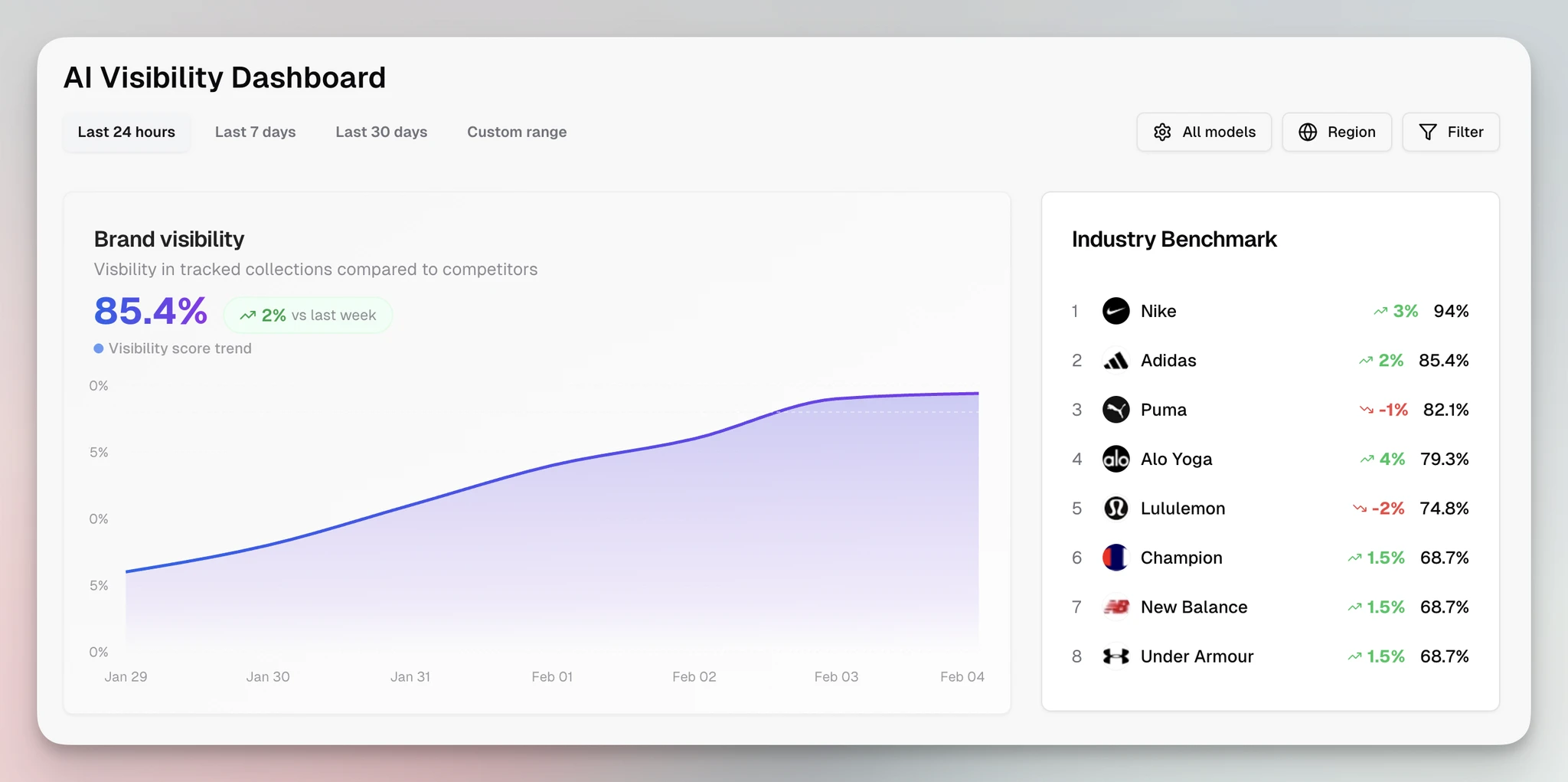
Erlin is a multi-agent AI visibility platform built specifically for brands that need to get discovered, cited, and recommended across AI platforms at scale.
It operates across three pillars: Insights (track AI visibility and coverage), Opportunities (find gaps and quick wins), and Action Center (deploy fixes that capture AI traffic).
For ecommerce teams, Erlin's approach is particularly well-suited. The platform tests purchase-intent prompts across ChatGPT, Claude, Gemini, and Perplexity, measures prompt coverage against competitors, tracks sentiment of brand mentions, and surfaces actionable recommendations rather than just reporting data.
The Action Center lets teams implement structured updates through automated workflows, cutting content refresh time from 18 to 20 hours per week to 2 to 3 hours.
Erlin's data infrastructure is built on 180-day continuous monitoring of 500-plus brands and 15,000-plus purchase-intent prompts, giving benchmark context that single-brand tools cannot provide.
Ecommerce clients using Erlin have achieved 2.4 million monthly AI impressions and a 37 percent conversion lift from AI-referred traffic compared to traditional organic.
Time to impact is meaningfully faster than manual approaches. With Erlin, brands typically appear in AI answers within 15 days of implementing recommendations, compared to 30 to 45 days using manual optimization methods.
Best for: Ecommerce brands that want a complete AI visibility operating system: monitoring, competitive benchmarking, and implementation support in a single platform.
2. Profound
Profound is widely considered the most comprehensive enterprise GEO platform available.
Its core strength is data depth:
AI results tracking across 10-plus generative engines, ChatGPT, Claude, Gemini, Perplexity, Grok, and DeepSeek, a Conversation Explorer drawing on 400 million real user prompts, and AI crawler analytics that reveal how bots actually access and process your site.
For ecommerce, Profound's Shopping Analysis is particularly relevant. It maps how products are discovered, described, and recommended inside AI shopping experiences.
The Query Fanouts feature shows how AI engines transform a user prompt into multiple sub-queries before generating a response, which helps brands optimize for what AI systems actually search rather than just surface-level keywords.
Profound is built for large organizations with dedicated analytics resources. The platform's depth is its advantage and its complexity.
Best for: Enterprise ecommerce brands with dedicated SEO and analytics teams that need maximum data depth across AI platforms.
3. AthenaHQ
AthenaHQ is a strong choice for ecommerce teams specifically because of its native Shopify integration.
The platform calculates a GEO score for brand visibility, tracks product recommendation patterns across AI engines, monitors how often the brand appears in "best of" and comparison responses, and provides competitor benchmarking.
Its Source Intelligence feature identifies which websites, such as reviews, press, and third-party content, are influencing AI answers about the brand.
For ecommerce, this is valuable: understanding that a competitor is being cited because of a strong presence on Wirecutter, Reddit, or a specific review platform points directly to where the brand needs to build presence.
The Shopify integration enables direct revenue attribution from AI search, a metric that matters to ecommerce teams that need to justify GEO investment to leadership.
Best for: Shopify-based ecommerce brands that need product recommendation tracking with direct revenue attribution.
4. Scrunch AI
Scrunch AI focuses on the competitive dimension of GEO.
Its standout feature for ecommerce is competitor replacement detection:
It alerts teams when AI platforms start recommending a competitor where they previously recommended the brand. This early warning function prevents slow, invisible erosion of AI share of voice.
Scrunch also provides entity strengthening recommendations to reinforce the brand's knowledge graph signals, a technical lever that matters for AI discoverability.
For teams that want to monitor the competitive landscape in AI responses without managing a complex enterprise platform, Scrunch is a practical, focused option.
Best for: Ecommerce brands primarily concerned with competitive monitoring and protecting AI share of voice.
5. Relixir
Relixir operates as an autonomous layer on top of an existing CMS.
Rather than requiring teams to manually implement recommendations, Relixir deploys specialized agents that monitor keyword movement, AI citations, competitor gaps, social signals, and product changes, then automatically refreshes CMS content to keep it current.
For ecommerce brands managing large, frequently updated catalogs, content staleness is a persistent GEO problem. Erlin's data shows that content older than 12 months typically loses 20-plus coverage points compared to freshly updated content.
Relixir's automation addresses this at scale, making it practical for teams selling hundreds or thousands of SKUs.
Backed by Y Combinator and deployed at companies including Airwallex and Rippling, Relixir has demonstrated credibility in high-velocity content environments.
Best for: Large ecommerce operations with high SKU counts that need automated content freshness at scale.
6. Otterly.AI
Otterly.AI offers prompt-specific brand mention tracking at a price point accessible to growth-stage brands.
The platform monitors how the brand appears across AI platforms in response to specific prompts, provides share of voice metrics, and surfaces competitor gaps, queries where competitors appear in AI responses but the brand does not.
Otterly is simpler than enterprise platforms but delivers the core GEO monitoring function clearly.
For ecommerce teams that are earlier in their GEO journey and need a starting point for measuring AI visibility before investing in more comprehensive tooling, Otterly is a practical entry point.
Best for: Growth-stage ecommerce brands starting their GEO practice and needing accessible, focused AI citation monitoring.
7. Zoovu
Zoovu approaches GEO from the product data layer rather than the visibility monitoring layer.
The platform cleans, standardizes, and enriches product catalogs so every SKU has complete attributes, structured data, and natural-language descriptions that AI systems can understand and cite.
For ecommerce brands whose GEO problem is fundamentally a structured data problem (incomplete specs, inconsistent attribute names, missing comparison information), Zoovu solves at the root.
Enriched product data powers not just AI discoverability but also on-site search and guided selling experiences.
Zoovu is not a visibility monitoring tool. It is a product data enrichment platform with strong GEO implications. Brands typically use it in combination with a monitoring tool like Erlin or Profound.
Best for: Ecommerce brands with large, unstructured product catalogs where incomplete data is the primary barrier to AI citation.
How to Build a GEO Stack for Ecommerce
Most ecommerce teams do not need every tool in this list. The right stack depends on where the biggest gap currently sits.
If the brand has no AI visibility data at all, start with a platform that gives clear prompt coverage metrics across the major AI engines. Erlin, Profound, and AthenaHQ all do this well.
The goal in the first 30 days is establishing a baseline, which prompts trigger the brand, which do not, and where competitors are being cited instead.
If product data is the blocker, the monitoring data will quickly show that the brand is absent even from categories where it should logically appear. This signals a structured data problem.
Adding Zoovu to enrich the catalog, or running Erlin's content recommendations to add fact density to product pages, addresses this before monitoring improvements can take effect.
If the team is managing a large catalog with hundreds of SKUs that need regular content updates to maintain AI freshness, Relixir's automation reduces the operational burden significantly.
Manual content refresh at scale is not sustainable; the right automation layer makes GEO a continuous process rather than a one-time project.
If competitive displacement is a concern, Scrunch AI's alert system provides early warning when AI engines start substituting competitor brands. This is particularly important in categories with intense competition, where the share of voice in AI responses is actively contested.
The most effective GEO stacks pair a monitoring and action platform like Erlin with whatever specialized tool addresses the brand's specific gap, whether that is product data quality, content automation, or competitive intelligence.
What GEO Actually Delivers for Ecommerce
The commercial case for GEO investment is no longer theoretical.
Erlin client data shows that AI-referred traffic converts at 3 times the rate of traditional organic traffic. Visitors arriving from AI citations are 4.4 times more likely to convert than visitors from other channels, because AI engines pre-qualify intent.
A shopper who arrived because ChatGPT recommended the brand in response to a specific purchase query already trusts the recommendation. The consideration work happened inside the AI interface.
Sales conversions from ChatGPT referrals specifically run 436 percent higher than baseline, according to Erlin client data across ecommerce brands. The qualified traffic growth from AI visibility investment reaches 40 percent on average.
The brands achieving these results share a common pattern. They have optimized product pages for fact density; pricing, specifications, shipping, and comparison information are all clearly structured and current.
They monitor AI citations continuously rather than reacting to visibility changes after the fact. Monitored brands detect AI errors in 14 days. Unmonitored brands take 67 days on average, 79 percent slower.
And they treat GEO as an ongoing operation, not a one-time project. AI engines update their citation patterns continuously. Brands that fall out of regular optimization cycles lose coverage points within weeks.
Frequently Asked Questions
What is generative engine optimization for ecommerce?
Generative engine optimization (GEO) for ecommerce is the practice of structuring product data, content, and brand information so AI engines, such as ChatGPT, Perplexity, Gemini, Google AI Overviews, and Amazon Rufus, cite and recommend your products in their generated answers. It focuses on prompt coverage and share of voice in AI responses rather than traditional search rankings.
Which GEO tools work best for Shopify stores?
AthenaHQ offers a native Shopify integration for direct revenue attribution from AI search. Erlin's Action Center supports content deployment for Shopify-based brands and provides structured recommendations that Shopify teams can implement directly. For catalog data enrichment, Zoovu integrates with ecommerce platforms including Shopify.
How long does it take to see results from GEO optimization?
Results vary by brand and approach. With a structured GEO tool and clear recommendations, brands typically see measurable citation rate improvement within 30 to 45 days. Erlin's data shows that brands working from automated recommendations appear in AI answers within approximately 15 days of implementing structured updates.
Do I need a different GEO strategy for Amazon Rufus vs ChatGPT?
Yes. Amazon Rufus prioritizes product listing completeness, review volume, and recency, and structured catalog attributes. ChatGPT, Perplexity, and Gemini weigh third-party citations, editorial content, and fact density more heavily. An effective ecommerce GEO strategy addresses both: enriched product data for marketplace AI engines and citation-worthy content for conversational AI platforms.
What is the most important GEO metric for ecommerce brands?
Prompt coverage, the percentage of high-intent purchase prompts in which the brand appears, is the core GEO metric for ecommerce. Share of voice against direct competitors in the same prompt category is the second most important metric, as it frames absolute coverage against what is competitively available.
The Bottom Line
Ecommerce discovery is shifting. The buyers who used to scroll through Google results are now asking AI engines for recommendations. The brands that appear in those recommendations are capturing purchase intent at the moment it forms, before a competitor's product page ever loads.
The tools in this guide give ecommerce teams the infrastructure to compete in that environment: monitoring where the brand stands, identifying what is blocking citation, and deploying the fixes that move coverage in the right direction.
Start by measuring where you are. The gap between your current AI visibility and what top performers in your category achieve is the number that tells you how urgent this is.
Get your AI Visibility Score and see how your brand appears across ChatGPT, Perplexity, Gemini, and Claude: Start Your Free Erlin Audit
Share
Related Posts
Generative Engine Optimization Trends for 2026
7 GEO trends reshaping AI search visibility in 2026, with data on citations, structured data, and what actually drives brand coverage.
15 Generative Engine Optimization Best Practices Backed by Latest Research
Generative engine optimization best practices backed by 2026 research. 15 tactics to get your brand cited by ChatGPT, Perplexity, and Google AI Overviews.

AI for Content Planning & Strategy: A Complete Guide
AI for content planning in 2026 means planning for AI search visibility, not just faster drafts. Five-layer workflow, what to automate, what stays human.