To find AI visibility gaps for free, write 15 to 20 buyer-intent prompts, run them in ChatGPT and Perplexity, and log whether you were mentioned or cited, your position, which competitors appeared and which sources were used. Prompts that name competitors but not you are your gaps, and domains Perplexity cites repeatedly show where you need coverage. Manual checks give a baseline but cannot track movement at scale.
Google says you exist. ChatGPT disagrees. That gap, invisible in your analytics, is where deals are starting to go.
According to Erlin's 2026 State of AI Search report, 67% of marketing leaders have no way to measure how their brand appears in AI-generated answers.
At the same time, the visitors AI does send arrive already pre-qualified by a recommendation, so they tend to convert better than traditional organic visitors.
So this isn't just a branding concern: the gap has a direct cost.
This guide walks through how to find your AI visibility gaps using free tools, what to look for at each step, and when it makes sense to move to a platform like Erlin that connects the analysis to actual fixes.
What is AI visibility, and why does the gap exist?
AI visibility is how often and accurately your brand appears when an AI system answers a question relevant to your business. It's less like an SEO ranking and more like a yes/no question per prompt: either you're in the answer, or you're not.
When someone types "best CRM for managing a mid-sized team" into Perplexity, that AI doesn't return ten blue links. It names three to five brands in a paragraph. If you're not one of them, you don't exist for that user at that moment, regardless of where you rank on Google.
This is where most brands are confused about why the gap exists. They assume good Google rankings should translate. They don't. Google rewards keywords, backlinks, and authority.
AI systems evaluate something different: fact density, how easily your content can be extracted and cited, third-party validation signals, and how recently your information was updated. A brand can sit at position one in organic search and still not appear in ChatGPT's answer to the same question.
Erlin's analysis of 500+ brands found that brands implementing structured data, such as comparison tables, FAQ schema, llm.txt files, etc., saw 28 to 34% higher AI coverage within two to three weeks. The gap exists because most brands haven't built for AI retrieval. They've built for Google.
How to understand the AI visibility gap
Before jumping into how to find your gaps, it helps to understand what you're actually measuring.
Mention rate is how often your brand name appears in AI responses to relevant prompts.
Citation rate is more specific: it measures how often AI responses link back to your website as a source. Perplexity shows citations explicitly (numbered links in every response). ChatGPT does it selectively, mainly when it pulls from live web results.
Research shows ChatGPT mentions brands roughly 3x more often than it actually links to them. Tracking only citations gives you an incomplete picture. You want both.
Share of voice compares your mention rate against competitors across the same set of prompts. That's what actually tells you whether you have a gap, not your mention count in isolation, but how it stacks up.
The Erlin 2026 report found that AI typically cites only 2 to 3 brands per query. It's a winner-take-most situation. If you're in the answer, you capture nearly all of that user's attention. If you're not, you're invisible for that query regardless of how well you rank elsewhere.
How to find AI visibility gaps using free tools
Run a manual AI search audit
A manual audit takes about an hour and gives you a real baseline. It won't scale, but it tells you where you stand right now.
Step 1: build your prompt list
Write 15 to 20 questions that a buyer at your stage of the funnel would actually ask. The goal is to mirror real research behavior, not test whether AI knows your brand name.
Good prompts look like:
- "What are the best [your category] tools for [use case]?"
- "How do I [solve the problem your product solves]?"
- "What should I look for in a [your product category]?"
- "[Your product type] vs [competitor product type]: which is better?"
- "Does [specific feature your brand offers] make a difference?"
Avoid prompts like "Tell me about [your brand name]." Those test brand awareness, not buyer intent. The real question is whether you show up when buyers are comparing options, not whether AI knows you exist.
Step 2: run the audit in ChatGPT
Go to chat.openai.com. Use the default GPT-4o model. For each prompt:
- Paste your question exactly as written
- Screenshot or paste the full response into a tracking doc
- Note: Was your brand mentioned? Was it cited with a link? What position were you (first, second, mentioned in passing)?
- Note: Which competitors were named?
Run all 15 to 20 prompts. Don't regenerate if you don't like the answer. AI responses vary, and you're documenting what a first-time user would see.
Step 3: run the same prompts in Perplexity
Perplexity is particularly useful for this audit because it shows its sources. Go to perplexity.ai (no account needed for basic testing). Run your same prompts and document the same thing. Plus one extra step: note which URLs appear in the citation list.
Those URLs tell you which sites AI trusts for your category. If a competitor's blog is cited repeatedly, you know where to focus your third-party coverage efforts.
Step 4: document what you find
Use a simple spreadsheet. Columns: prompt, ChatGPT result (yes/no/mentioned briefly), Perplexity result, competitors mentioned, sources cited, notes.
When you're done, look for patterns:
- Which prompts return your brand consistently? That's where you're already winning.
- Which prompts mention competitors but not you? Those are your clearest gaps.
- Which third-party sources keep appearing in Perplexity's citation list? Those are the sites you need coverage on.
A brand showing up in fewer than 30% of relevant prompts has meaningful AI visibility gaps. Top brands in competitive categories often hit 30% or higher after optimization.
Use Perplexity to find visibility gaps
Perplexity deserves its own section because it's arguably the most useful free tool for this kind of analysis. Unlike ChatGPT, it shows you exactly where it got its information.
Every Perplexity response includes numbered citations: actual URLs. This transparency lets you reverse-engineer who's winning in your category and why.
Here's how to use it specifically for gap analysis:
Search for your category, not your brand. Use queries like:
- "Best tools for [your category] in 2026"
- "Compare [your category] options for [specific use case]"
- "What do users say about [competitor name]?"
For each result, document the sources. Run 10 to 15 category queries and tally which domains appear most often. The sites that show up repeatedly are the ones AI trusts for your topic area.
If your website doesn't appear, but three competitors' blogs do, along with a G2 review page, a Reddit thread, and a Wikipedia article, you've just mapped your gap. You need coverage on those platforms, not just better SEO on your own site.
One more thing worth testing in Perplexity: search your brand name directly. What does AI say about you? Is the description accurate? Is it outdated?
Erlin's research found that monitored brands catch content accuracy errors in about 14 days versus 67 days for unmonitored brands. The longer a gap goes undetected, the longer competitors are filling that space.
Why manual AI Overview gap analysis doesn't scale
The manual audit above is genuinely useful, but it has real limits worth being upfront about.
Responses vary
AI outputs aren't static. Run the same ChatGPT prompt twice, and you may get different brands in the answer. The results change based on model version, browsing status, and factors you can't see. A one-time audit is a snapshot of one moment, not a trend.
The volume problem
A serious gap analysis requires testing dozens to hundreds of prompts, across multiple platforms (ChatGPT, Perplexity, Claude, Gemini, Google AI Overviews), against a competitor set. That's hundreds of manual queries per week. Most marketing teams can't sustain that.
You can't track movement
Knowing you appeared in 4 out of 10 prompts last Tuesday tells you almost nothing. Knowing you went from 4/10 to 8/10 over six weeks, and which content changes drove that, is actionable. Manual audits can't give you that without enormous effort.
Attribution is missing
Manual audits tell you whether you appear in AI answers. They don't connect those appearances to website traffic, and they can't tell you whether AI-referred visitors are converting. AI traffic from ChatGPT and Perplexity often lands in Google Analytics as Direct or Referral, making it invisible without proper integration.
How to find your brand gaps in AI search at scale
Once you've run the manual audit and have a sense of where your gaps are, the next step is setting up ongoing tracking. Before diving into the full setup, you can start by checking your AI visibility in Erlin:
It automatically runs prompt tracking, shows your AI Visibility Rank, and benchmarks your results against competitors, giving you a structured baseline from the start.
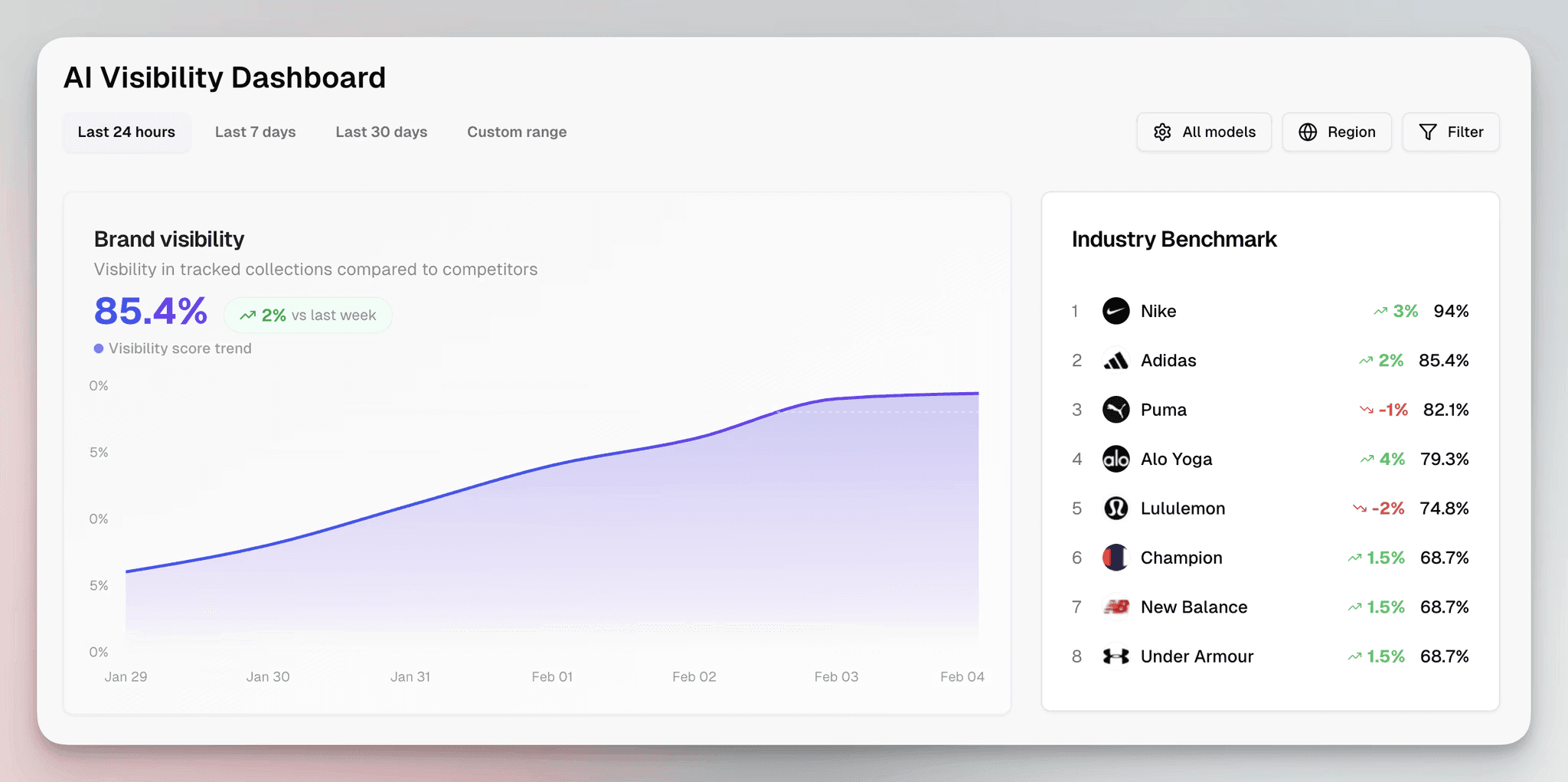
For continuous monitoring, Erlin is built specifically for this. It connects visibility monitoring to content action rather than just surfacing data. Here's how the setup works:
Step 1: Sign up and enter your domain
Go to app.erlin.ai/get-started. Once you enter your domain, Erlin automatically captures brand context, pulls social signals, and prepares baseline insights. You don't start from scratch.
Step 2: Select competitors
Erlin suggests up to five competitors based on your domain and category. You can accept, remove, or add manually. Your AI visibility score means more when read against competitors than as a standalone number, which is why the competitive baseline matters from day one.
Step 3: Choose prompts to track
Erlin suggests high-intent prompts relevant to your category. These are the queries AI platforms actually process when buyers are in research mode. You're not guessing what to track; the system informs the prompt library.
Step 4: View your initial snapshot
After setup, you get an instant baseline: your AI Visibility Rank, Traffic Rank, and competitor comparison. This is your starting point and the number you measure all future changes against.
Step 5: Connect Google Analytics and Search Console
This step is what separates monitoring from measurement. Linking GA and GSC unlocks AI vs. non-AI traffic breakdowns, conversion rate comparisons, and AI source distribution by platform. This is where the difference between AI traffic and everything else becomes visible for your brand specifically.
Step 6: Explore the Prompts section
Under AI Visibility → Prompts, you see visibility trends and competitor comparisons at the individual prompt level. The Answer History tab shows actual text from recent ChatGPT or Perplexity responses: whether your brand was mentioned, whether it was cited, and what sources were referenced. This is the gap analysis, not just a score, but the specific prompts where competitors are showing up and you're not.
A real-world AI visibility gap analysis example
How jify.co fixed a measurement problem before an optimization problem

Jify.co had consistent inbound demand but a distorted picture from third-party SEO tools. External estimates suggested minimal organic reach. First-party data told a different story.
By connecting Google Analytics and Search Console through Erlin, they replaced estimated metrics with verified data. They found that Perplexity and ChatGPT were splitting AI referral traffic roughly evenly, which suggested a research-oriented audience using citation-based AI for verification, not just discovery.
The real insight wasn't about growing traffic. It was about understanding traffic that already existed, and adjusting content strategy based on what their audience was actually doing.
Common AI visibility gaps (and how to fix them)
| AI Visibility Gap | Why It Happens | How to Fix It |
|---|---|---|
| Brand not mentioned in category queries | Low fact density; AI can't confidently extract what you do | Add structured FAQ pages, comparison tables, and explicit feature/use-case descriptions |
| Mentioned but not cited | Content exists, but isn't in machine-readable formats | Implement llm.txt, FAQ schema markup, and static HTML for key pages |
| Competitors mentioned more often | Stronger third-party validation signals | Build presence on Reddit, G2, review platforms; pursue editorial mentions |
| Outdated information in AI answers | Content hasn't been refreshed; AI confidence scores decay | Update cornerstone pages monthly; monitor for stale citations |
| Correct info on your site, wrong info in AI | AI pulling from third-party sources that haven't been updated | Audit and correct G2, Crunchbase, LinkedIn, directory profiles |
| Visible in ChatGPT but not Perplexity | Different source indexing across platforms | Build content that appears in sources Perplexity relies on (recent editorial, Reddit) |
| No AI traffic showing in Analytics | AI referrals miscategorized as Direct or Referral | Connect GA4 and GSC to properly attribute and segment AI traffic |
How to get started today
The manual audit described here is the right starting point if you've never done this before. Run your 15-20 prompts in ChatGPT and Perplexity, document what you find, and look for the pattern of who's getting cited instead of you.
If you find meaningful gaps (most brands do), the next question is whether you want to track and close them systematically or continue with periodic manual checks. Manual audits are fine for a one-time baseline. They don't work for ongoing optimization.
Checking your AI visibility in Erlin gives you an instant snapshot of your AI Visibility Rank and competitor positioning without requiring manual query-running.
It's a faster way to see where you actually stand and a starting point for building the tracking that turns gap analysis into growth. The brands that close their AI visibility gaps now will compound an advantage that gets harder to replicate over time.