The best ChatGPT prompts for ecommerce give the model four parts: a role, business context, a specific instruction with constraints, and an output format. Use that structure for product descriptions, abandoned cart and welcome emails, customer service templates, SEO keywords and meta copy, competitor and pricing analysis, and operations like demand forecasting, then save the winners in a shared team prompt library.
Most e-commerce teams using ChatGPT are leaving most of the value on the table. They paste in a one-line request, get something generic, and conclude that AI isn't as useful as the hype promised. The problem isn't ChatGPT. The problem is the prompt.
64% of shoppers say they're likely to use AI when making purchase decisions, rising to 84% among shoppers aged 18 to 24. (Shopify 2025 Global Holiday Report)
The brands those shoppers discover aren't lucky; they're run by operators who know how to get precise, actionable output from AI tools.
This guide gives you that. Not a list of vague suggestions, but ready-to-use prompts for the tasks that move the needle in ecommerce: product copy, email flows, customer service, SEO, competitor analysis, and operational automation. Each prompt includes the context structure that makes it work.
Why most E-commerce ChatGPT prompts fail
A weak prompt produces a weak response. That's not the model's failure; it's a context problem.
ChatGPT doesn't know your brand, your customer, your price point, or your competitive position unless you tell it. Ask it to "write a product description", and you'll get a passable template that could belong to any store in any category.
Give it a role, the product details, the target customer, and the format you need, and you get something you can actually use.
Every high-performing ecommerce prompt shares four components:
Role: who ChatGPT is in this task ("You are a senior DTC copywriter who specializes in skincare")
Context: the specific business details it needs ("We sell a vitamin C serum at $48, targeting women 28-45 who've tried luxury brands")
Instruction: the exact task and constraints ("Write a 150-word product description that leads with the skin outcome, handles the price objection, and ends with a clear reason to buy")
Format: what the output should look like ("Return as headline + two short paragraphs + three bullet points")
Operators who apply this structure consistently report cutting content creation time by 30-50%. (DesignRush / industry analysis, 2025) The prompts below are all built on this anatomy.
ChatGPT prompts for product descriptions that convert
Product copy is the highest-leverage place to start. A DealNews survey found that 31% of customers return products due to inaccurate or unhelpful descriptions, meaning poor copy costs money twice, once on acquisition and again on returns.
ChatGPT writes excellent first drafts. The key is giving it enough specificity to produce copy that leads with benefits, handles the primary objection, and matches your brand voice.
The core product description prompt:
You are a senior ecommerce copywriter. Write a product description for [product name] sold on [platform]. Target customer: [describe in 2-3 sentences]. Key features: [list 3-5]. Price: [price]. The description should lead with the main outcome the customer wants, include sensory or emotional language, address the top objection which is [objection], and end with a clear reason to buy now. Under 200 words. Format: compelling headline, two short paragraphs, and four bullet points for scanability.
For Amazon specifically:
You are an Amazon listing specialist. Rewrite this product description for Amazon buyers, who scan for specs before reading narrative. Prioritize: [spec 1], [spec 2], [spec 3]. Add relevant search keywords naturally. Keep the title under 200 characters. Format as: title, five bullet points (each under 250 characters), and a 200-word description.
For SEO-optimized pages:
You are an ecommerce SEO specialist. Write a product page description for [product] targeting the keyword '[primary keyword]'. Secondary keywords to include naturally: [keywords]. The copy should be 300 words, lead with the search intent, cover the key benefits in the first paragraph, and include a clear call to action. Avoid keyword stuffing.
A useful principle from Josh Kian, COO of Linq Kitchen: focus prompts on benefits over features. Instead of asking ChatGPT to describe cabinet dimensions, prompt it to explain how those cabinets maximize storage in small spaces. The underlying mechanism is the same; your prompt steers the output.
Each platform also has a different buyer psychology. Amazon buyers scan for specs. Etsy buyers want the story behind the product. Shopify buyers want a brand experience. Use the platform adaptation prompt to start from one master description and rewrite for each marketplace.
ChatGPT prompts for email marketing and abandoned cart flows
Email remains the highest-ROI channel in e-commerce. Personalized AI email campaigns see up to 40% higher open rates than non-personalized campaigns. (Citrusbug / multiple industry sources, 2025) The bottleneck for most teams isn't the strategy; it's the volume of copy required to run segmented flows well.
These prompts cover the sequences that drive the most revenue.
Abandoned cart recovery email:
You are an ecommerce email copywriter. Write an abandoned cart recovery email for a customer who left [product name] in their cart. The email should: open with a brief, non-pushy reminder of what they left behind; highlight [key benefit 1] and [key benefit 2]; offer [incentive: discount/free shipping/urgency]; include a single clear CTA linking to checkout. Tone: [conversational/professional/playful]. Under 150 words plus subject line.
Post-purchase follow-up (review request):
Write a post-purchase email asking for a review from a customer who bought [product]. Thank them for their purchase, mention [specific product detail] to show the message is genuine, and ask for a 2-3 sentence review. Provide a direct link to the review page. Keep it under 100 words. Tone: warm and appreciative, not transactional.
Product launch announcement:
You are a DTC brand email strategist. Write a product launch email for our new [product]. Our audience is [describe segment]. The email should: open with the problem this product solves; introduce the product with one key differentiator; include social proof ([number] customers tested it / [result]); end with a strong CTA. Subject line variants: provide 3 options with different angles (curiosity, benefit, urgency).
Welcome series (email 1):
Write the first email in a welcome series for new subscribers to [brand name], a [brief description of what you sell]. This email should: welcome them warmly; set expectations for what they'll receive; highlight the single most compelling reason to shop with us which is [USP]; and include a soft CTA to browse bestsellers. No discount codes in this email. Under 120 words.
For seasonal campaigns, give ChatGPT a merchandising context prompt before asking for copy. Feed it your bestsellers, your key dates, and last year's results, and ask it to build the campaign logic before writing a single subject line. The sequencing matters; strategy prompts first, copy second.
ChatGPT prompts for customer service automation
By 2030, AI is projected to manage 80% of customer interactions in e-commerce. (Shopify AI Statistics, 2025) That transition is already underway for the brands running lean support teams.
ChatGPT can draft response templates, triage scripts, and chatbot flows, but only if you give it the brand voice and scenario constraints it needs.
Customer service template library prompt:
You are the head of customer experience at [brand name]. Write a set of customer service email templates in our brand voice, which is [describe: friendly and direct / empathetic and reassuring / etc.]. Create templates for the following scenarios: (1) shipping delay response, (2) damaged item with replacement offer, (3) refund request for an item outside our return window where we're making an exception, (4) response to a negative review asking for resolution. Each template should be under 100 words, include a subject line, and leave clear placeholders for personalization.
Chatbot script for FAQs:
Create a chatbot conversation script for handling these common inquiries on our ecommerce website: (1) 'Where is my order?', (2) 'What is your return policy?', (3) 'Do you offer free shipping?', (4) 'How do I apply a discount code?'. For each, write: the opening detection phrase, a clear response under 60 words, and a follow-up question to keep the conversation useful. Use a [friendly / professional] tone.
Sentiment triage prompt:
Analyze these [number] customer reviews and categorize each as: positive (no action needed), neutral (flag for marketing), negative-product (escalate to product team), negative-service (escalate to support). For each negative review, provide a suggested response in under 75 words. Here are the reviews: [paste reviews]
The last prompt turns a task that takes an hour into a five-minute exercise. It also catches patterns in complaints that single-review responses miss entirely.
One thing worth noting: be transparent with customers when they're interacting with an AI rather than a human agent. Consumer trust in AI-powered interactions is still building, and transparency protects it.
ChatGPT prompts for SEO and content strategy
77% of ecommerce professionals now use AI daily as part of their standard workflows. (industry data, 2025) Content production is where that daily usage shows up most clearly.
These prompts handle keyword research, blog ideation, and meta copy; the unglamorous work that search visibility depends on.
Keyword research and intent mapping:
You are an ecommerce SEO specialist. My store sells [product category] on [platform]. Generate a table of 30 keywords targeting this category. The table should have four columns: keyword, estimated search intent (informational / commercial / transactional), suggested content format (blog post / product page / collection page / FAQ), and a brief content angle in one sentence. Prioritize keywords that indicate purchase readiness.
Blog post ideation for SEO:
Generate 15 blog post ideas for an ecommerce store that sells [product category]. For each idea, include: working title, target keyword, search intent, and a one-sentence hook that explains why a buyer would read it. Prioritize topics that are informational and move readers toward a purchase decision.
Meta title and description batch:
Write meta titles and descriptions for these [number] product pages. For each: meta title under 60 characters with the primary keyword near the front, meta description under 155 characters written as a hook not a summary, and one suggested internal link anchor text. Products: [list products with brief description and primary keyword for each]
Content gap analysis using competitor framing:
I sell [product category]. My top three competitors are [Competitor A], [Competitor B], [Competitor C]. Based on common ecommerce content strategies for this category, identify: (1) three content types my competitors likely publish that I should compete with directly, (2) two content angles they've probably missed where I could own the space. Return as a table with content type, target audience, recommended format, and why it creates a competitive advantage.
One practical note on AI-generated content for SEO: Google does not penalize AI-generated content. It penalizes unhelpful content regardless of how it was produced.
Edit ChatGPT output to add product-specific details, customer language, and use cases that only you know. The goal is helpful content for buyers, which is also what search rewards.
ChatGPT prompts for competitor analysis and pricing strategy
Knowing what competitors are doing is table stakes. Using that knowledge to sharpen your own positioning is the actual work.
Competitor positioning audit:
You are a senior ecommerce strategist. Analyze my competitive position in the [product category] market. My competitors are: [list with URLs or descriptions]. For each competitor, assess: (1) who they're targeting and their main value proposition, (2) how they price relative to the category, (3) their strongest and weakest content angle, (4) one thing they're doing well I should learn from, (5) one gap in their positioning I could own. Synthesize into: three market gaps available to me and one recommended positioning statement.
Pricing strategy pressure-test:
Before recommending a pricing change for my [product], reason through step by step: (1) how my current price compares to direct competitors, (2) the margin impact of a [X]% increase or decrease, (3) how customers in my segment typically react to price changes based on the category, (4) the risk to conversion rate. Return a recommendation with the tradeoffs clearly stated.
Seasonal campaign planning:
You are a seasoned ecommerce merchandising strategist for a [brand type / category]. Build a campaign calendar for our [Black Friday / Q4 / summer] period. We sell [product category] and last year's top performers were [bestsellers]. We typically [loyalty rule or business context]. Return as a table with: date range, hero product or category, channel focus, primary message, and rationale for each week.
The pricing pressure-test prompt uses Chain-of-Thought prompting, asking the model to reason step by step before answering. For anything strategic, this technique produces noticeably more rigorous output than a direct question.
ChatGPT prompts for store operations and automation
Beyond marketing, ChatGPT handles operational tasks that consume hours every week.
Inventory demand forecasting briefing:
I'm preparing for our [seasonal period] buying cycle. Based on these sales patterns from last year: [paste data or describe trends], help me think through: (1) which product categories to overbuy, (2) which to hold flat, (3) which to reduce, and (4) what lead time risk I should flag with suppliers. Return as a prioritized action list with brief rationale for each.
Supplier communication drafts:
Write a professional email to a supplier requesting a [X]% price reduction on [product] for orders over [quantity]. Include: our order history context ([number] units over [period]), the competitive context without naming competitors, a proposed new unit price, and a closing that keeps the relationship constructive. Tone: direct but respectful.
Returns policy optimization:
Review this returns policy copy and rewrite it to: reduce customer anxiety at the point of purchase, be scannable in under 30 seconds, pre-answer the top three return questions to reduce support contacts, and remain legally accurate. Current policy: [paste policy text].
30-day social media content calendar:
Build a 30-day social media content calendar for [brand name] on [Instagram/TikTok/both]. We sell [product category]. Apply the 80/20 rule: 80% educational, entertaining, or community-building content, 20% direct sales content. For each post: platform, content type (educational / behind-the-scenes / UGC prompt / problem-solution / soft sell), brief content description, and suggested hashtag set. Format as a table.
How to build a prompt library your whole team can use
One-off prompts are useful. A shared prompt library compounds over time.
The fastest way to build one: every time a prompt produces output good enough to use, save it with the context that made it work.
Within a month, you'll have 20-30 tested templates your team can pull from without starting from scratch. Label each with its use case, the platform it works best for, and any variables to customize.
Three prompt engineering techniques worth adding to your toolkit:
Few-shot prompting gives ChatGPT 2-3 examples of the output you want before asking for more. This is the fastest way to match a specific brand voice without writing a long style guide each time. Paste in two product descriptions that sound like your brand and ask it to write a third in the same style.
Chain-of-Thought prompting asks ChatGPT to reason step-by-step before giving a final answer. Use this for anything strategic: pricing decisions, positioning analysis, campaign logic. Adding "reason through this step by step before answering" to a complex prompt noticeably improves output quality.
Role-play prompting with seniority assigns a specific role with context and experience level. "You are the VP of Merchandising at a $100M DTC brand" produces more rigorous output than "You are a marketing expert." The seniority frame pushes the model toward reasoning at a higher level.
The principle across all three: clarity of intent produces clarity of output. The more specific the context you provide, the less the model has to guess, and the more it gives you something genuinely useful.
The piece most E-commerce operators are missing
Getting better output from ChatGPT is one side of the equation. The other side is knowing how your brand shows up when buyers use AI to research products in your category.
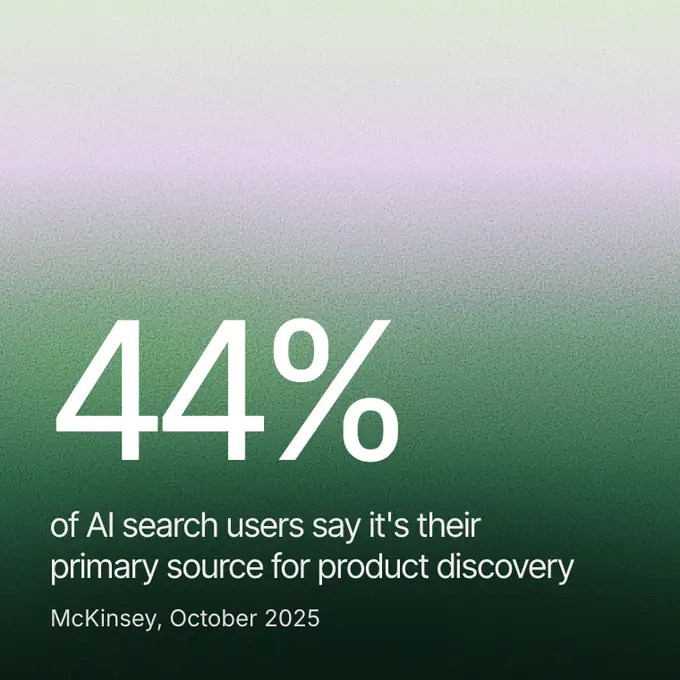
44% of AI search users say it's their primary source for product discovery, ahead of traditional search at 31%. (McKinsey, October 2025)
When a shopper asks ChatGPT to recommend the best [product in your category], the answer it gives depends entirely on what AI systems know about your brand. Your pricing, your reviews, your structured product data, and your third-party presence all factor into whether you get recommended or not.
Most e-commerce brands have no visibility into this. Only 16% of brands systematically track their AI search performance. (Erlin data, 2026)
The gap between brands that appear consistently in AI recommendations and those that don't is 9x, and it widens 3.2% every month. (Erlin data, 500+ brands, 2026)
ChatGPT prompts make your internal team faster. AI visibility work makes sure your brand shows up in the responses your customers see.