

An AI visibility checklist helps you answer:
Does AI recognize our brand?
Does it trust us enough to cite us?
Does it recommend us over competitors?
Because in AI search: You're either in the answer, or you don't exist.
There's no page two. There's no "buried in results." When someone asks ChatGPT for software recommendations, it gives them three to five names. If you're not one of them, you lost.
How to use this checklist
Score each item:
1 = Strong signal
0 = Missing / weak
Your score:
16–20 → Strong visibility
10–15 → Gaps exist
<10 → You're mostly invisible
Most B2B brands score between 7 and 12. They have some pieces in place, but no coherent strategy.
The good news: each point you fix compounds. Going from 8 to 12 isn't just better. It's exponentially better because AI systems weigh consistency.
The AI Visibility Checklist (20-Point Audit)
1. Are you clearly understood as an entity?
AI doesn't "browse." It resolves meaning. If your brand identity is fuzzy, AI moves on.
1. Do you have a clear, consistent brand description?
What to check:
Homepage tagline
Meta description
LinkedIn "About"
G2 / directory listings
What to fix:
Use the same 1–2 sentence definition everywhere
Avoid vague phrasing like "innovative platform"
Example:
Instead of "We help teams grow better", you can say, "AI visibility platform for tracking brand mentions in ChatGPT and Perplexity". The first one could describe a thousand SaaS products. The second is specific enough that AI can categorize you.
Action step this week:
Open your homepage, LinkedIn, and the top three directory listings in separate tabs. Copy the descriptions into a doc. Look for inconsistencies. Rewrite them all to match a single, specific definition.
2. Are you associated with a specific category?
AI needs category anchors.
If you're "a platform that does marketing and analytics and project management," AI can't confidently place you. You'll get skipped in favor of tools with clearer positioning.
What to do:
Pick one primary category
Repeat it across:
H1s
Schema markup
External listings
Action:
Add a "What we are" section above the fold.
Here's what works:
"[Brand] is a [category] that helps [audience] [outcome]."
Put it on your homepage. Put it in your meta description. Put it in your schema. Repeat it until it's boring to you. That's when AI starts to get it.
3. Do authoritative sources mention your brand?
AI places more weight on external validation than on your site.
You can say you're the best CRM for startups all day. But if TechCrunch, G2, and startup blogs never mention you, AI won't believe you.
What to do this week:
Pitch 3 "best tools" articles
Get listed on 2 review platforms
Secure 1 guest post with brand mention
This isn't about backlinks. It's about entity confirmation.
Specific tactic:
Search for "[your category] tools" articles published in the last six months. Email the authors. Offer updated data, a quote, or a case study they can reference. Make it easy to add you.
Half won't respond. A quarter will say no. But you only need a few yeses to start building the signal pattern AI looks for.
4. Do you use structured data?
Erlin found that extractable signals drive visibility.
Structured data is how you hand AI your identity on a platter.
Quick wins:
Add Organization schema
Add Product / Software schema
Add FAQ schema to key pages
How to check if you have it:
Go to Google's Rich Results Test. Paste your homepage URL. If you see schema markup, you're good. If not, you're invisible at the structured layer.
What to include in the Organization schema:
Name
Logo
Description
Social profiles
Same category definition you're using everywhere else
Copy the same description. Repeat it. Consistency is the entire game.
2. Does your content signal authority?
AI doesn't just read. It extracts. If your content can't be cleanly extracted and attributed, it doesn't matter how good it is.
5. Do you cover topics deeply?
Thin content gets skipped.
Fix this:
Expand thin articles into:
Definitions
Frameworks
Examples
Simple rule:
If your article can't answer "what, why, how," it won't get cited.
Here's what I mean:
A 300-word blog post that says "email marketing is important" won't get cited. A 1,500-word guide that defines email marketing, explains three approaches, and shows examples from real campaigns will.
AI needs substance to pull from. Give it frameworks, not fluff.
Action step:
Pull your top 10 blog posts by traffic. Read each one. Ask: "Could someone build something or make a decision based on this?" If no, rewrite it.
6. Is your content easy to extract?
Do this:
Add summary blocks
Use bullet points
Write 40–60-word direct answers
Example:
Heading: What is email deliverability?
Opening paragraph:
Email deliverability is the percentage of sent emails that reach the inbox instead of spam. It's determined by sender reputation, authentication (SPF, DKIM, DMARC), and engagement rates. Most senders see 85–95% deliverability; below 80% indicates a problem.
That's extractable. AI can pull that and cite you confidently.
Compare that to:
"Email deliverability is complex and depends on many factors that change over time."
Nothing to extract. Nothing to cite.
7. Do you avoid vague, hypey language?
Bad:
"Cutting-edge"
"Next-gen"
"Powerful solution"
Erlin observed that vague language reduces visibility.
Fix:
Replace with:
Specific features
Clear outcomes
Why this matters:
AI doesn't know what "next-gen" means. It's a marketing term with no referent. But "real-time sync" or "API rate limit of 10,000 requests/hour" is specific. AI can compare that to competitors.
Action step:
Search your site for "innovative," "powerful," "next-gen," and "cutting-edge." Replace every instance with something specific.
8. Is your content updated regularly?
Action plan:
Refresh the top 10 pages monthly
Update:
Stats
Examples
Screenshots
AI favors fresh, verifiable info.
What counts as an update:
Not just changing the publish date. AI can tell. Update actual substance:
Replace a 2023 statistic with a 2025 one
Add a new example from the last quarter
Revise a section based on product changes
Tip: Set a recurring calendar reminder. First Monday of each month: update one pillar page. It takes 20 minutes. Do it for a year, and you'll have systematically refreshed your whole site.
3. Do other sites confirm you matter?
This is where most teams fail. They optimize their own site and wonder why AI still ignores them.
AI doesn't just read your site. It cross-references. If no one else talks about you, you're not real to the algorithm.
9. Are you listed in key directories?
Start with:
G2
Capterra
Niche directories
How to do this right:
Don't just claim your profile and forget it. Fill out every field. Use the same brand description. Upload your logo. Add screenshots.
Then, and this is the part most teams skip, get reviews.
Five detailed reviews matter more than being listed on 50 directories with zero activity.
Tactic:
Email your ten happiest customers. Ask for a G2 review. Offer a $50 gift card. Half will do it. That's five reviews. That's enough to start showing up in AI comparisons.
10. Do you appear in "best tools" lists?
These are heavily cited by AI.
How to get in:
Search: "best [your category] tools"
Reach out to authors
Offer updated data or insights
Exact email template that works:
Subject: Quick update for your [category] tools article
Hi [Name],
I saw your article on the best [category] tools from [month/year]. We're [Brand], a [category] used by [specific type of customer].
Would it make sense to include us in an update? I can send over:
A brief description
Key differentiators vs [competitor you saw in their article]
2-3 customer examples
Let me know if that's useful.
[Your name]
Keep it short. Make it easy. You're not selling. You're offering to make their article better.
11. Are you mentioned in third-party blogs?
Not for backlinks. For entity reinforcement.
Here's the difference:
Old SEO thinking: Get a backlink from a high-DA site, pass PageRank, rank higher.
New AI visibility thinking: Get mentioned alongside competitors in a comparison post, reinforce your category association, and show up in AI answers.
The link itself almost doesn't matter. The mention does.
Where to get mentioned:
Industry roundups
Comparison posts
Use case walkthroughs
Customer case studies (published on their blog)
12. Are your brand mentions consistent?
Repeated signals are critical.
Fix inconsistencies:
Same product name
Same description
Same category
Common mistake:
Your site says "email marketing software."
G2 says "email automation platform."
A review says "email tool."
To you, those are the same. To AI, they're three different things. It can't confidently group them.
Fix:
Pick one primary phrase. Use it everywhere. Literally copy-paste it so there's zero variation.
4. How do AI systems position you?
This is where the truth shows up. You can optimize all you want. But if you run the actual prompts and you're not there, nothing else matters.
13. Do AI tools mention your brand?
Test prompts:
"Best [category] tools"
"[category] software comparison"
Track results manually first.
How to test:
Open ChatGPT, Claude, Gemini, and Perplexity. Run the same five prompts in each. Copy the results into a doc.
Questions to ask:
Are we mentioned?
What position?
How are we described?
Who else is mentioned?
Do this weekly for a month. You'll start to see patterns.
14. Are you grouped with the right competitors?
If AI associates you with the wrong category, you lose visibility.
Fix:
Update positioning everywhere
Get mentioned alongside the correct competitors
Example of this going wrong:
You're a project management tool for design teams. But AI keeps mentioning you alongside generic task managers like Asana and Monday.
Why? Because most of your content uses "task management" language instead of "design project management."
Fix: Rewrite your positioning to emphasize the design-specific angle. Get listed in "tools for designers" roundups instead of generic PM lists.
15. How often do you appear?
Visibility is relative.
Track:
Frequency
Ranking within answers
What to measure:
Out of ten prompts, how many mention you?
0-2: You're invisible
3-5: You're inconsistent
6-8: You're competitive
9-10: You're dominant
When you are mentioned, what position?
First mention: You're the default
Middle: You're an option
Last: You're an afterthought
16. Are you described correctly?
AI builds narratives.
Fix mispositioning:
Publish comparison pages
Clarify the category explicitly
Warning sign:
You run a prompt, and AI says: "[Your brand] is a [wrong category] that helps with [wrong use case]."
This happens when your messaging is inconsistent or when the only mentions of you come from sources that misunderstood your product.
How to fix it:
Write a comparison page for each major competitor. Be honest about differences. AI will extract these and use them to understand your positioning.
5. Are you tracking and improving?
Most teams audit once and forget.
That doesn't work. AI outputs change constantly.
17. Do you track AI mentions regularly?
Manual checks aren't enough.
You need patterns.
What weekly tracking looks like:
Monday morning: Run your core five prompts in each AI tool.
Log the results in a spreadsheet.
Track:
Mention (yes/no)
Position (1-5)
Description accuracy
Competitors mentioned
Do this for 12 weeks. You'll have data that shows whether your optimizations are working.
18. Are you measuring beyond traffic?
AI visibility = leading indicator.
Traffic = lagging.
What to track:
Standard analytics:
Referral traffic from AI tools (shows up as chatgpt.com, claude.ai, etc.)
Conversion rate from those sources
Advanced tracking:
Brand search volume (if AI mentions you, people search for you)
Demo requests that cite "found you through ChatGPT"
Sales call sources
19. Do you tie visibility to revenue?
AI traffic converts significantly higher (Erlin data, 2026)
This is pipeline, not just awareness.
How to make the business case:
Pull your last 20 closed deals. Ask:
"Where did you first hear about us?"
If even two or three say ChatGPT or Claude, you can calculate the value. Average deal size × number of AI-sourced deals = revenue you'd lose if you were invisible.
That's the number you show your CMO when you need budget for this.
20. Do you run this audit monthly?
AI outputs change constantly.
Treat this like performance tracking.
Monthly review structure:
Week 1: Run the 20-point audit. Score yourself.
Week 2: Pick the three lowest-scoring areas. Make a fix plan.
Week 3: Execute fixes.
Week 4: Re-run prompts. Measure change.
Repeat.
You're not trying to go from 5 to 20 in one month. You're trying to go from 5 to 8, then 8 to 11, then 11 to 15.
Small, consistent improvements compound.
What a good AI visibility score looks like
16–20 → Strong presence
10–15 → Inconsistent
<10 → Invisible
Most teams are stuck in the middle.
The teams scoring 16+ aren't doing magic. They're just consistent. Same description everywhere. Regular content updates. External mentions. Structured data.
It's boring work. But it compounds.
How to run a free AI visibility audit
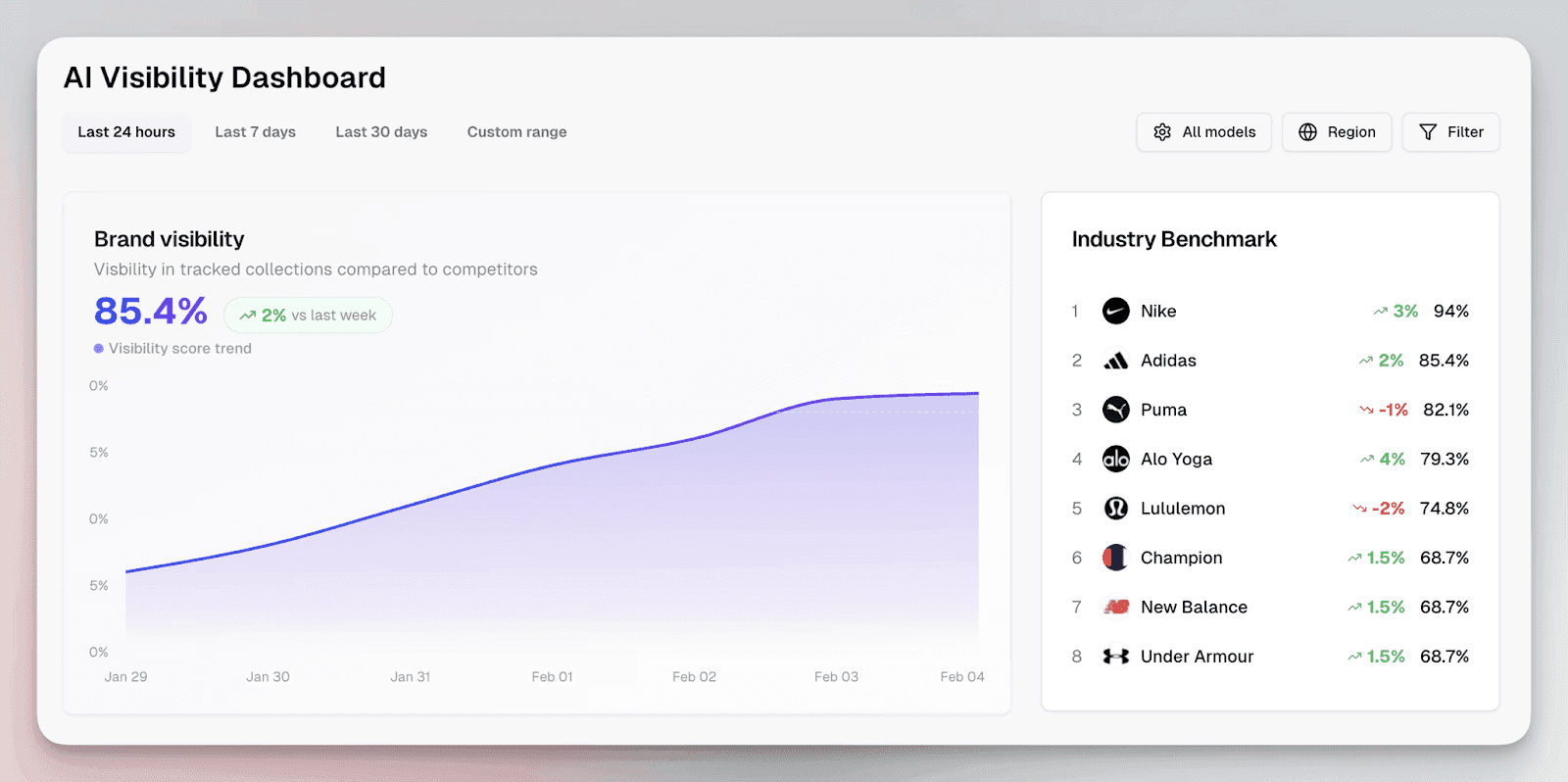
Erlin's free audit automatically runs prompt tracking, shows your AI Visibility Score, and benchmarks your results against competitors, giving you a structured baseline from the start.
Step 1: Sign up and enter your domain
Sign up and enter your domain.
What happens next:
Brand context is automatically captured
Social signals are pulled in
Baseline insights are generated
You're not starting from zero.
Step 2: Select competitors
Erlin suggests up to five competitors.
Why this matters:
Your visibility score means nothing in isolation.
It only matters relative to:
Who shows up instead of you
Who dominates prompts
Pick competitors you actually lose deals to. Not aspirational ones. Not category leaders you'll never compete with. The brands that prospects mention during sales calls.
Step 3: Choose prompts to track
Erlin suggests high-intent prompts based on your category.
These are not random keywords.
They're the queries buyers actually use during evaluation.
This aligns with our research analyzing 15,000+ purchase-intent prompts
What good prompts look like:
Not: "what is project management"
Yes: "best project management software for remote teams"
Not: "CRM definition"
Yes: "CRM for B2B SaaS companies under 50 employees"
The more specific, the better. You want the prompts that happen right before someone books a demo.
Step 4: View your initial snapshot
You'll see:
AI Visibility Rank
Traffic Rank
Competitor comparison
This is your baseline. Everything improves from here.
What to look at first:
The gap between your AI visibility rank and your traffic rank.
If your traffic rank is strong but AI visibility is weak, you're about to have a problem. Your current SEO performance is masking the fact that you're invisible in the channel that's growing.
Step 5: Connect Google Analytics and Search Console
This is where things get real.
You unlock:
AI vs non-AI traffic
Conversion rate differences
Source-level breakdown
What you'll learn:
Most teams discover their AI traffic is 10-20% of overall traffic, but 30-40% of demos booked. Higher intent. Better conversion.
That's the data point that gets the budget approved.
Step 6: Explore the Prompts section
This is the most important part.
Inside:
Visibility trends per prompt
Competitor comparison
Answer history
You can literally see:
Whether your brand was mentioned
How it was described
Which sources did AI use?
This is not a score. This is a gap analysis.
What to do when you find a gap:
Let's say you run "best CRM for SaaS startups" and you're not mentioned.
Click into the answer history. See who was mentioned. Look at what sources AI cited.
Then reverse-engineer:
Are those competitors listed on the same directories?
Do they have comparison pages you don't?
Are they mentioned in articles you're not in?
That's your roadmap.
FAQs
What is AI visibility?
AI visibility is about whether your brand shows up inside AI-generated answers when users ask relevant questions. Instead of competing for a position on a search results page, you’re competing to be included in a synthesized response where decisions often happen.
How can I check my AI visibility?
You can test this manually by running real, high-intent prompts in tools like ChatGPT or Perplexity and analyzing whether your brand appears, how often it appears, and how it’s described. Repeating this over time gives a clearer picture since AI responses can vary.
Does ranking #1 on Google still matter?
It still helps, but it’s no longer enough. AI systems rely on broader signals like brand clarity, external validation, and consistency across sources, so rankings alone don’t guarantee inclusion in AI answers.
How often should I run an AI visibility audit?
Once a month is a good baseline. AI-generated responses change frequently, and even small improvements in your content or external mentions can impact whether your brand appears.
Why does AI visibility matter for revenue?
Because AI-driven discovery often happens when users are already evaluating options. When someone asks for recommendations, they’re closer to making a decision, so being included at that stage directly influences pipeline and conversions.
What’s the biggest mistake teams make?
Most teams treat this like traditional SEO and try to fix it with more content. In reality, visibility gaps usually come from unclear positioning, weak external validation, or inconsistent signals that make it hard for AI systems to confidently recommend your brand.
Share
Related Posts
Generative Engine Optimization Trends for 2026
7 GEO trends reshaping AI search visibility in 2026, with data on citations, structured data, and what actually drives brand coverage.
15 Generative Engine Optimization Best Practices Backed by Latest Research
Generative engine optimization best practices backed by 2026 research. 15 tactics to get your brand cited by ChatGPT, Perplexity, and Google AI Overviews.
AI for Content Planning & Strategy: A Complete Guide
AI for content planning in 2026 means planning for AI search visibility, not just faster drafts. Five-layer workflow, what to automate, what stays human.