An AI visibility score is a single number, usually on a 0 to 100 scale, showing how often and how favorably your brand appears in AI-generated answers. It rolls up mention rate, citation rate, share of voice, average position and sentiment. To check yours, run high-intent prompts across AI platforms against chosen competitors, or use a tracker like Erlin to get an instant baseline.
According to Erlin's 2026 State of AI Search report, 67% of marketing leaders don't know how to measure their AI visibility, and 58% say no one on their team owns it.
Meanwhile, AI-referred visitors tend to convert better than traditional organic visitors, so this is a channel worth measuring properly. Every month without a baseline is a month of guessing.
This article explains what an AI visibility score is, how it's calculated, what affects it, and how to check yours.
What is an AI visibility score?
An AI visibility score is a composite metric that measures how consistently and favorably your brand appears in AI-generated answers.
When someone asks Perplexity, "Compare HubSpot vs Salesforce," the AI system pulls from a pool of sources and returns a small set of brands, usually two to four. Whether your brand makes that list, how often it does, and how it's described is what the AI visibility score tracks.
Unlike SEO rankings, which operate on a spectrum, AI visibility is closer to binary per query: you're either in the answer or you're not. Brands with high scores show up consistently. Brands with low scores appear occasionally or not at all.
What an AI visibility score looks like in practice
The screenshot below from Erlin's dashboard makes this concrete. The metrics across the top give you your headline numbers at a glance: Mention Rate (8.4%), Citation Rate (0.0%), Share of Voice (8.4%), Average Position (4.4), and Sentiment (70).
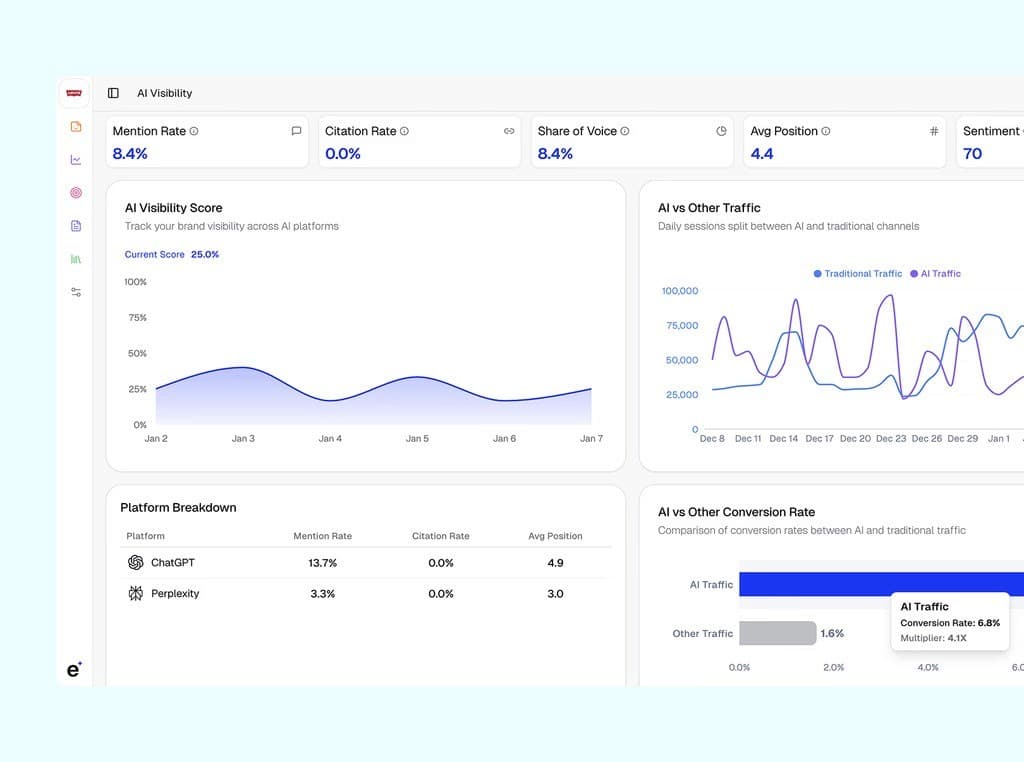
The AI Visibility Score chart shows the brand sitting at 25.0% over a week-long window, meaning it appeared in about one in four relevant AI-generated answers.
That's your baseline. The "AI vs Other Traffic" panel shows where sessions are actually coming from, and the Platform Breakdown table splits performance by platform: ChatGPT at 13.7% mention rate and 4.9 average position, Perplexity at 3.3% and 3.0.
What's useful about this view is how little you need to interpret. If your mention rate is 8% and a competitor's is 22%, you know where you stand.
The score doesn't explain why, that's what the platform's opportunity analysis is for, but it tells you clearly that there's a gap worth closing.
The metrics that matter now
The AI visibility score is an aggregate, which means it's worth understanding what goes into it. These are the individual metrics that matter in 2026.
- Mention rate tracks how often your brand appears by name in AI-generated answers. If you run 100 relevant queries and your brand shows up in 8 of the responses, your mention rate is 8%. It's the clearest signal of raw presence.
- Citation rate is narrower: it measures how often AI platforms link out to or explicitly source your content. A mention means the AI named you. A citation means it's treating your content as a reference. Citation rate tends to be lower, and it's often what separates brands that get traffic from AI search versus brands that just get mentioned.
- Share of voice puts your numbers in a competitive context. The formula is simple: your mentions divided by total industry mentions times 100. If your brand is mentioned 18 times across 100 relevant responses and competitors are mentioned a combined 82 times, your AI share of voice is 18%. This is arguably the most actionable metric because it tells you not just where you are, but who's winning the space you're competing for.
- Average position tracks where in the AI response your brand typically appears. First mention carries more weight than being buried in a list of six. Some tracking tools weight this into the overall score; others report it separately.
- Sentiment score captures how AI describes your brand when it does mention you. A brand mentioned frequently but described as "expensive" or "limited" has a different challenge than one with positive, specific framing. Sentiment gaps often reveal content or reputation issues that raw mention counts don't surface.
Together, these five metrics paint a complete picture of AI search performance. Tracking one in isolation gives you an incomplete view.
How the AI visibility score is measured
AI visibility trackers operate like rank trackers but for generative AI. These trackers query LLMs with relevant prompts to detect brand appearances. Here’s how the process looks like:
- Define target prompts based on user intents (e.g., "best [product] for [use case]") grouped by topics or buyer stages.
- Run prompts repeatedly across AI platforms (ChatGPT, Perplexity, Gemini, Copilot) to capture variability in responses.
- Analyze responses for metrics like mention frequency, position, citations, sentiment, and query breadth.
- Normalize and weight components into a composite score (often 0-100), then benchmark against competitors for share of voice.
- Update daily or weekly. Filter hallucinations via cross-validation and track trends over time.
Common score components
Most trackers use weighted factors normalized per industry.
| Component | Weight Example | Description |
|---|---|---|
| Mention Frequency | 40% | How often the brand appears across queries, adjusted for response length. |
| Position & Prominence | 25% | Placement (e.g., top recommendation scores higher than footnotes). |
| Citation Quality | 20% | Authority of sources cited (e.g., official sites over forums). |
| Query Coverage | 15% | Breadth across diverse prompts and intents. |
A tool like Erlin runs thousands of purchase-intent prompts across ChatGPT, Perplexity, Claude, Google AI Mode, Gemini, and Copilot. For each prompt, it captures: which brands were mentioned, in what order, with what framing, and whether content was linked or cited.
That raw data gets aggregated into scores for each metric, then rolled up into the overall AI visibility score.
The score itself is typically expressed on a 0 to 100 scale. Erlin's research defines the maturity tiers this way:
- AI Invisible (under 20%): minimal appearance in AI answers; limited structured data and weak citation signals
- AI Fragile (20 to 40%): inconsistent inclusion, concentrated in a narrow set of queries
- AI Present (40 to 60%): regular appearance in core category queries; structured content in place
- AI Preferred (60 to 80%): consistent inclusion in high-intent and comparison queries; strong authority signals
- AI Dominant (80%+): frequent top inclusion across core and adjacent categories; sustained citation authority
Most brands that have never optimized for AI search land in the Invisible or Fragile tier. The prompt library matters as much as the measurement itself.
Erlin's platform suggests high-intent prompts relevant to your category: queries that mirror what buyers actually type when they're in research mode, not generic brand awareness questions.
Factors that affect your AI visibility score
Content quality and fact density
AI systems don't evaluate brand holistically. They evaluate specific factual claims they can extract, verify, and reuse in an answer.
Erlin's analysis of 500+ brands found that brands with 9+ structured facts in their content coverage (pricing, features, use cases, technical specs, comparison data) achieve 78% AI coverage. Brands with 0 to 2 facts achieve just 9%.
Marketing language doesn't help. Claims like "industry-leading platform" or "the most innovative solution" give AI nothing to work with. Specific, extractable facts, such as integration counts, pricing tiers, setup time, customer outcomes, etc., are what get cited.
Entity coverage and clarity
AI systems need to understand who you are before they can recommend you. Entity coverage refers to how clearly and consistently your brand identity is defined across the web: your website, Wikipedia, third-party reviews, press mentions, and social profiles. Inconsistent or incomplete signals lead to omission.
This is different from SEO. You don't need the most backlinks. You need the clearest signal. Erlin's data found that smaller brands with strong entity context routinely outperform Fortune 500 companies in specific query categories. AI doesn't default to the biggest brand. It defaults to the clearest one.
Structured data and technical signals
How your content is formatted affects whether AI can read it at all. Erlin's research shows that static HTML with schema markup achieves a 94% AI parsing success rate. JavaScript-rendered content drops to 23%. PDFs land at 7%.
Three specific formats show consistent coverage lifts: comparison tables (about 34% higher coverage within two weeks), llm.txt files (32% lift), and FAQ schema markup (28% lift over three weeks). These aren't cosmetic improvements; they directly affect whether AI can extract your content as a citable source.
Citation history and momentum
Third-party validation is the biggest lever most brands aren't using. Erlin's research found that third-party sources drive 68% of all AI citations. Reddit discussions carry a 3.4x citation lift over owned content alone. Wikipedia articles carry 2.9x. Review platforms and affiliates come in at 2.6x.
Your own website content is the baseline. Third-party validation is what separates brands that appear occasionally from brands that appear consistently.
Content freshness
AI systems continuously re-evaluate brand information for recency. Brands that update content monthly maintain roughly 23% higher AI representation than those that don't. Content under 3 months old has 48% average coverage. Content older than 24 months drops to 18%.
The staleness penalty is estimated at about 1.8% AI coverage per month of inactivity. That's not catastrophic month to month, but it compounds.
Competitive landscape
AI typically cites 2 to 3 brands per response, which creates a winner-take-most dynamic. Your score isn't static. It shifts as competitors improve their visibility.
Monitoring share of voice against specific competitors matters because a rising competitor in your category can suppress your appearances even if your absolute content quality hasn't changed.
How to check your brand's AI visibility score
The process is quicker than you'd think. Here's how it works using Erlin, one of the few tools that ties visibility tracking directly to content action, rather than just monitoring.
Step 1: pick your tracking platform
Look for a tool that covers multiple AI platforms at once, supports competitor benchmarking, integrates with GA/GSC, and includes a prompt library for your category.
For teams that want to move from "here's where I'm falling short" to "here's how to fix it" without jumping between tools, Erlin is built exactly for that. The gap analysis flows straight into an action center.
Step 2: sign up and add your domain
Head to app.erlin.ai/get-started. Once you enter your domain, Erlin automatically pulls brand context, gathers social signals, and builds baseline insights in the background. No manual configuration needed.
Step 3: add your competitors
Erlin recommends up to five competitors based on your domain and category. Keep the suggestions, replace them, or add your own. Your AI visibility score is most useful in context: knowing you're at 25% hits differently when your closest competitor is sitting at 61%.
Step 4: select the prompts you want to track
Erlin surfaces high-intent prompts relevant to your category; the kinds of queries buyers actually use when they're actively researching. You can refine the list, add industry-specific terms, or zero in on the prompts where beating competitors matters most.
Step 5: review your baseline snapshot
Once setup is complete, you get an instant read: your AI Visibility Score, Traffic Rank, and a side-by-side competitor comparison. The dashboard breaks down platform-level data by mention rate, citation rate, and average position across AI platforms like ChatGPT and Perplexity.
The "AI vs Other Traffic" panel tracks how AI referral traffic stacks up against traditional sessions over time. The "AI vs Other Conversion Rate" panel tends to be where eyebrows go up. For many brands, AI traffic converts well above other channels, which is why this panel is worth watching.
This is your baseline. Every future change, whether it's a content update, schema fix, or citation campaign, gets measured against it.
How to improve your AI visibility score
1. Audit your current AI presence
Before optimizing anything, understand what AI is already saying about your brand. In Erlin, checking your AI visibility shows how AI platforms currently describe your brand, what they get wrong, and where you're absent from conversations where competitors appear.
Run the brand audit checklist from Erlin's report on:
- Fact density (pricing accessible? features in scannable formats? competitive positioning explicit?)
- Third-party validation (reviews on major platforms? Reddit presence? Wikipedia mentions?)
- Structured data (llm.txt file? FAQ schema? schema.org markup?)
Each "no" is a concrete gap with an estimated coverage impact.
2. Identify citation gaps
Pull your competitor comparison data and look for specific prompts where competitors appear and you don't. Those are your highest-priority gaps: the queries where buyer intent is high, and you're currently invisible.
Citation gaps usually fall into two buckets: content gaps (you don't have content that addresses this query) and structural gaps (you have content, but AI can't parse or surface it). They require different fixes.
3. Create entity-rich content
Rewrite key pages around extractable facts. Every page where AI might pull a response should have: specific pricing or pricing ranges, clear feature descriptions with technical details, use cases tied to real scenarios, and comparison information that makes your differentiation explicit.
If your homepage says "powerful, flexible platform," that's not extractable. If it says "integrates with 200+ tools, setup under 30 minutes, used by 5,000+ teams," that is.
4. Optimize technical signals
Implement FAQ schema on question-based pages. Add an llm.txt file that summarizes your brand's key facts in a format AI crawlers can read easily. Make sure your most important content, pricing, features, comparison pages, is available in static HTML, not JavaScript-rendered. Check that schema.org Product or Organization markup is in place on key pages.
Erlin's data suggests that addressing all five structural signals moves brands from 23 to 35% coverage to 60 to 80% coverage. That's not a marginal improvement.
5. Build authoritative third-party validation
This takes longer than the technical fixes, but it has the highest impact. Pursue verified reviews on G2, Capterra, and industry platforms. Get into relevant Reddit discussions, not promotional, genuinely helpful answers to questions in your category. Aim for coverage in industry publications and blogs that AI systems treat as authoritative sources.
Erlin tracks citation shifts across third-party sources and alerts teams when brand mentions or AI citation positions change, so you can see the impact of this work in near-real-time rather than waiting for quarterly reviews.
6. Monitor and iterate
AI visibility decays without maintenance. Brands that go silent lose roughly 1.8% AI coverage per month. Monitored brands catch errors in about 14 days; unmonitored brands take an average of 67 days, by which point the damage is compounding.
Erlin's platform runs continuous prompt tracking and flags when citation positions shift, content goes stale, or a competitor surges. That's the difference between managing AI visibility as a channel and discovering six months later that you've lost ground you can't easily recover.