Ignoring AI search costs brands their highest-converting traffic, a growing share of organic clicks, and control over how AI describes them. AI-referred visitors convert at 14.2% versus 2.8% for organic search, organic CTR drops 61% where AI Overviews appear, and Erlin data across 500+ brands puts the gap between AI-dominant and AI-invisible brands at 9x, widening 3.2% per month.
Somewhere today, a potential customer did not click to a comparison page. They did not scroll through ten search results. They took the AI's recommendation and moved on. You lost that deal before your sales team knew the lead existed.
This is not a hypothetical. It is happening thousands of times daily across every B2B category. And the brands watching it happen have one thing in common: they are measuring the wrong things.
This article breaks down the exact costs, in lost traffic, lost conversions, and lost pipeline, of treating AI search as a future concern rather than a present one.
How big is AI search, actually?
Before getting to cost, it helps to understand scale.
Google AI Overviews now appear in 25% of all Google searches, up from 13% in March 2025. (Conductor, 2026) ChatGPT reaches 810 million users daily. Gemini surpassed 2 billion monthly visits in January 2026. (Fortune, February 2026) AI referral traffic grew 796% year over year. (WebFX, 2026)
The buyers your content used to intercept with a top-three Google ranking are now asking AI engines for synthesized answers. And AI engines are providing them, with or without your brand in the response.
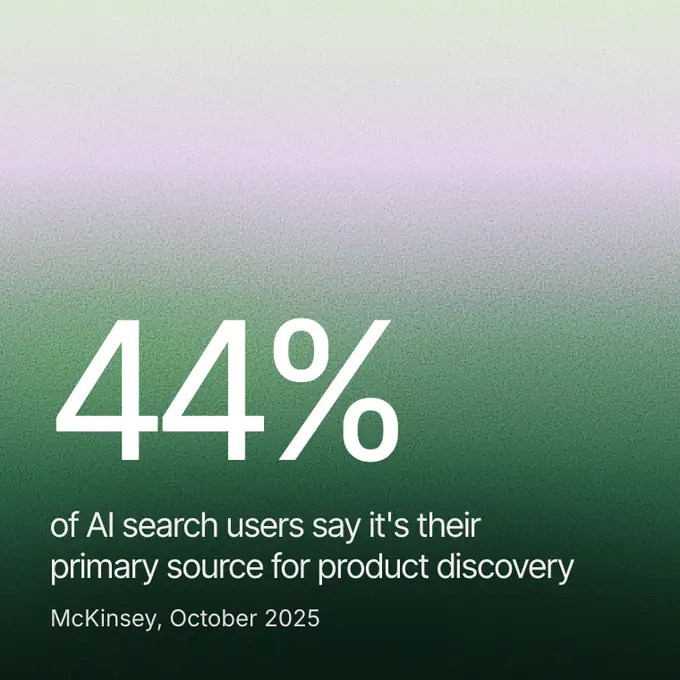
44% of AI search users say it is their primary source for product discovery, ahead of traditional search at 31%. (McKinsey, October 2025) Among Gen Z and Millennials, 70% now prefer AI search as their primary method. (Infront, November 2025) This is not an emerging trend. It is the current default for a significant and growing share of your buyers.
The question is not whether AI search matters. The data settled that in 2025. The question in 2026 is what it costs when your brand is not in it.
Cost #1: you lose traffic that converts 5x better
This is the number most marketing teams have not fully processed.
AI-referred visitors convert at 14.2% on average. Traditional organic search converts at 2.8%. That is a five-fold efficiency difference in the same funnel. (Opollo, 2026 AI Search Benchmark Report, 312 B2B technology firms)
In one data set from the same study, AI accounted for just 4% of total sessions, but 19% of the qualified inbound pipeline. Volume is still small. Commercial impact is not.
The reason for this gap is straightforward. By the time a buyer clicks through from an AI recommendation, they have already done their research. They have already compared options.
They arrive at your site in decision mode, not exploration mode. That is the kind of visitor you would pay significant CPCs to get from paid search, except these buyers came through your content for free, because an AI decided you were worth citing.
Every month you are not visible in AI search is a month that high-intent, high-converting traffic flows to competitors who are.
Cost #2: your traditional rankings are losing their value
Ranking on page one is no longer what it used to be.
Organic CTR drops 61% on queries where Google AI Overviews appear, from 1.76% to 0.61%. (Independent CTR study, Seer Interactive, September 2025) Position one now has only a 33% chance of also appearing in the AI Overview for that query. (Writesonic, August 2025)
Here is what that means in practice. If you rank first for a high-volume keyword and an AI Overview appears above your listing, you are likely still getting clicks from roughly one-third of users.
The other two-thirds are getting the answer from the AI and leaving. For informational and comparison queries, the queries that drive top-of-funnel traffic, the intercept rate is even higher.
Gartner predicted a 25% decline in traditional search engine volume by 2026 as AI chatbots handle more queries. That prediction is playing out now.
Brands cited in AI Overviews, by contrast, earn 35% more organic clicks and 91% more paid clicks than non-cited brands on the same queries. (Seer Interactive, 2025) The citation is now worth more than the ranking.
The cost of ignoring AI search is not just lost AI traffic. It is also accelerating the erosion of the traditional organic traffic you already have, as more of those queries get absorbed by AI summaries.
Cost #3: competitors are locking in category ownership
AI systems do not just recommend brands randomly. They build associations between brands and categories over time, and those associations compound.
Once a brand becomes established as an authoritative source, it gets cited more frequently, which reinforces its position as an authoritative source. Each citation strengthens the signal. Each strengthened signal makes the next citation more likely. (AirOps, 2026 State of AI Search)
The gap between brands that have established this position and those that have not is already 9x in AI coverage, and it is widening at 3.2% per month. (Erlin data, 500+ brands, 2026)
Only 30% of brands that appear in an AI-generated answer show up again in the very next response to the same query. Run that query five times, and just 20% of brands persist across all five. (AirOps and Kevin Indig, 2026 State of AI Search) Early movers are not just winning one query. They are establishing default citation status across a category of queries.
For B2B categories, the implications are severe. A potential customer opens ChatGPT and asks what the best tool is for their use case. The AI delivers a confident, detailed answer naming three options.
Your brand is not mentioned. The customer never clicks through to compare. They trust the recommendation and sign up for the tool the AI cited.
High-maturity organizations are already spending nearly twice as much as lower-maturity peers on AI visibility, widening a gap that will become increasingly difficult to close. (Conductor research, cited by MarTech, February 2026)
79% of high-maturity organizations have moved beyond manually checking what ChatGPT says about their brand. They are running systematic, multi-platform monitoring and acting on what they find. (Conductor, 2026)
Cost #4: AI may be misrepresenting your brand right now
There is another cost that rarely makes it into marketing reports: the cost of what AI is saying when it does mention your brand.
Unmonitored brands take 67 days on average to discover AI errors. Monitored brands detect them in 14 days. (Erlin data, 2026) In those 53 days of undetected error, AI systems are actively misinforming buyers about your product, pricing, capabilities, or positioning, and those buyers are making decisions based on incorrect information.
E-commerce brands carry an 18% factual error rate in AI responses. SaaS brands carry 12%. Financial services brands carry 11.3%. (Erlin data, 2026)
When owned content lacks clarity or consistency, AI engines fill the gap with third-party sources. Those sources may not represent your brand accurately or favorably. 68% of AI citations come from third-party sources: reviews, forums, and comparison sites.
Only 32% come from brand-owned content. (Erlin data, 500+ brands, 2026) The brands that do not control their narrative in owned content are handing that control to sources they cannot edit.
Negative sentiment from Reddit discussions takes 2 to 3 months to surface as cautionary language in AI responses. Authentic engagement can recover that sentiment in 45 days. Silence extends the damage to 120 days or more. (Erlin data, 2026)
Ignoring AI search does not mean AI is ignoring your brand. It means your brand is being described by AI without your input.
Cost #5: the measurement gap compounds every other cost
Most marketing teams cannot see any of this happening.
Only 27% of marketing professionals consistently track their brand's appearance in AI-generated answers. (Page One Power survey, 600 marketing professionals, March 2026) Standard tools, such as Google Search Console, Ahrefs, and SEMrush, were built for link-based search. They do not capture AI citation data by default.
67% of marketing leaders say they do not know how to measure AI visibility. 58% say no one in their organization owns it. Only 16% of brands systematically track AI search performance. (Erlin survey, 200+ marketing leaders, 2026)
Traditional metrics no longer tell the full story. A team can rank first for a target keyword, see flat traffic numbers in GA4, and conclude that nothing has changed, while losing two-thirds of the click-through on that keyword to AI summaries.
The pipeline shortfall shows up quarters later, attributed to market conditions or competitor activity, never traced back to the measurement blind spot.
The cost of the measurement gap is that every other cost listed in this article goes undetected until it shows up in revenue.
What separates brands that are winning right now
The research across multiple 2026 datasets points to four consistent factors that separate brands getting cited from brands getting skipped.
Structured facts: Brands with 8+ structured attributes get cited 4.3x more than brands with fewer than 3. Each additional structured attribute adds 8.3% median coverage. (Erlin data, 2026)
AI engines extract facts. Brands that give them clear, structured, machine-readable facts get cited. Brands that bury information in unstructured prose do not.
Third-party presence: 48% of AI citations come from community platforms like Reddit and YouTube. 85% of brand mentions originate from third-party pages. (AirOps, 2026 State of AI Search) A brand that only publishes on owned channels is invisible to the majority of the signals AI engines use to validate citations.
Content freshness: Pages not updated quarterly are 3x more likely to lose citations. More than 70% of all pages cited by AI have been updated within the past 12 months. (AirOps, 2026 State of AI Search) Erlin data shows brands updating content monthly see 23% higher AI coverage than those with stale content. (Erlin data, 2026)
Structured data and schema: 61% of cited pages use three or more schema types. Pages with 3+ schema types have a 13% higher likelihood of being cited.
The FAQ schema appears in 10.5% of cited pages. (AirOps, 2026 State of AI Search) Comparison tables drive a 34% coverage lift in 14 days. An llm.txt file drives 32% lift in the same window. (Erlin data, 2026)
Brands optimizing all four drivers achieve 78% average AI coverage. Brands that do not achieve 9%. (Erlin data, 100+ brands tested, 2026)
How to audit your current AI visibility
Before investing in optimization, you need a baseline.
Run 10 to 20 prompts across ChatGPT, Perplexity, Gemini, and Claude that your buyers would realistically ask at each stage of their journey: problem discovery, solution comparison, and vendor evaluation. Note whether your brand appears, where it appears, how it is described, and which competitors are cited instead.
Check whether your top content pages have FAQ schema, comparison tables, and a clear H1-to-H2-to-H3 heading structure. AI engines favor pages with sequential heading hierarchy; 68.7% of pages cited in ChatGPT follow a clean H1-to-H3 structure. (2026 State of AI Search)
Check whether your brand information is consistent across review platforms, Reddit, Wikipedia, and your own site. Inconsistent or missing information across those surfaces degrades AI citation confidence.
This baseline tells you where you stand on the AI Visibility Ladder, from AI Invisible (below 15% prompt coverage) to AI Dominant (above 80%). 50% of brands score below 35% prompt coverage across the four major AI platforms. (Erlin data, 2026) Most brands discover they are lower than expected.
Check your AI visibility with Erlin and see exactly where your brand stands across ChatGPT, Perplexity, Claude, Google AI Mode, Gemini, and Copilot.
The window is still open. Narrowing, but open.
The brands winning AI search right now are not winning because they had a head start on AI technology. They are winning because they started measuring, structured their content for machine readability, and built third-party presence while most competitors were still debating whether AI search mattered.
The gap between AI-Dominant brands and AI-Invisible brands is 9x and growing at 3.2% every month. (Erlin data, 2026) Every month of delay is another month of compounding disadvantage.
The buyers your sales team needs to reach are already using AI to decide who makes the shortlist. The brands being recommended are not necessarily the best products. They are the most citable ones, the ones whose content gave AI engines enough structured, verified, third-party-validated information to cite confidently.
Check your AI visibility and find out exactly where your brand stands across six AI engines.