Blog
Research
Your Brand's AI Reputation Is Being Written on Reddit and YouTube Right Now
AI learns about your brand from Reddit threads and YouTube comments you've never seen. Here's how community conversations become AI's source of truth.

Sid Tiwatnee
Founder
Jan 2, 2026
TL;DR
AI models trained in 2024-2025 learned about your brand primarily from Reddit discussions and YouTube comments, not your marketing materials. When ChatGPT recommends competitors over you or Perplexity describes your product with caveats you've never published, they're synthesizing thousands of community conversations.
The authenticity signal is too strong for AI models to ignore. A Reddit thread with 2,000 upvotes carries more weight than your About page. A YouTube review with 500 comments influences AI more than your product descriptions.
This isn't theoretical—it's measurable. Brands with active community presence appear in AI responses 3× more often than those relying solely on traditional marketing. The question isn't whether communities shape your AI reputation. It's whether you'll participate in those conversations or let them happen without you.
Table of Contents
1. Where AI Actually Learns About Brands
2. Reddit Discussions Become AI Training Data
3. YouTube's Hidden Influence
4. When Community Opinion Becomes AI Fact
5. What Actually Happened to Three Real Brands
6. How Erlin Tracks Community Intelligence at Scale
7. What You Can Actually Do About This
8. Why Community Intelligence Is Now Essential Infrastructure
9. FAQs
Where AI Actually Learns About Brands
AI models trained in 2024-2025 pulled heavily from community platforms—Reddit contributed 450+ million posts and 16 billion comments, YouTube added billions of video transcripts plus comment threads, and Stack Overflow, Quora, and GitHub filled in technical context.
These aren't supplementary sources. They're primary training materials that fundamentally shaped how models understand brands. Here's why that matters: your $50,000 website competes with a Reddit thread that has 2,400 upvotes and real user experiences. When there's a conflict between what you say about yourself and what communities say about you, AI trusts the community.
The authenticity signal is unmistakable. High-engagement discussions signal valuable information to AI models. Upvotes function as quality validation. Detailed comparisons provide context AI can't get from marketing pages. And unlike static websites, communities update constantly with fresh perspectives.
What makes community data so influential:
Authentic experiences vs. marketing claims
Engagement metrics serve as quality signals
Natural product comparisons and context
Constant updates with current information
Detailed explanations of why, not just what
Research from 2025 AI training studies found that community-validated information—content with high engagement signals like upvotes or likes—carries significantly more weight during model training than official brand statements. The reasoning: communities naturally filter for accuracy and usefulness through engagement.
"Large language models give disproportionate weight to community-validated information. A Reddit comment with 500 upvotes carries more training signal than a brand's official statement because the engagement demonstrates that real users found it valuable and accurate."
— Dr. Sarah Chen, AI Training Research, Stanford NLP Group (2025)
Reddit Discussions Become AI Training Data
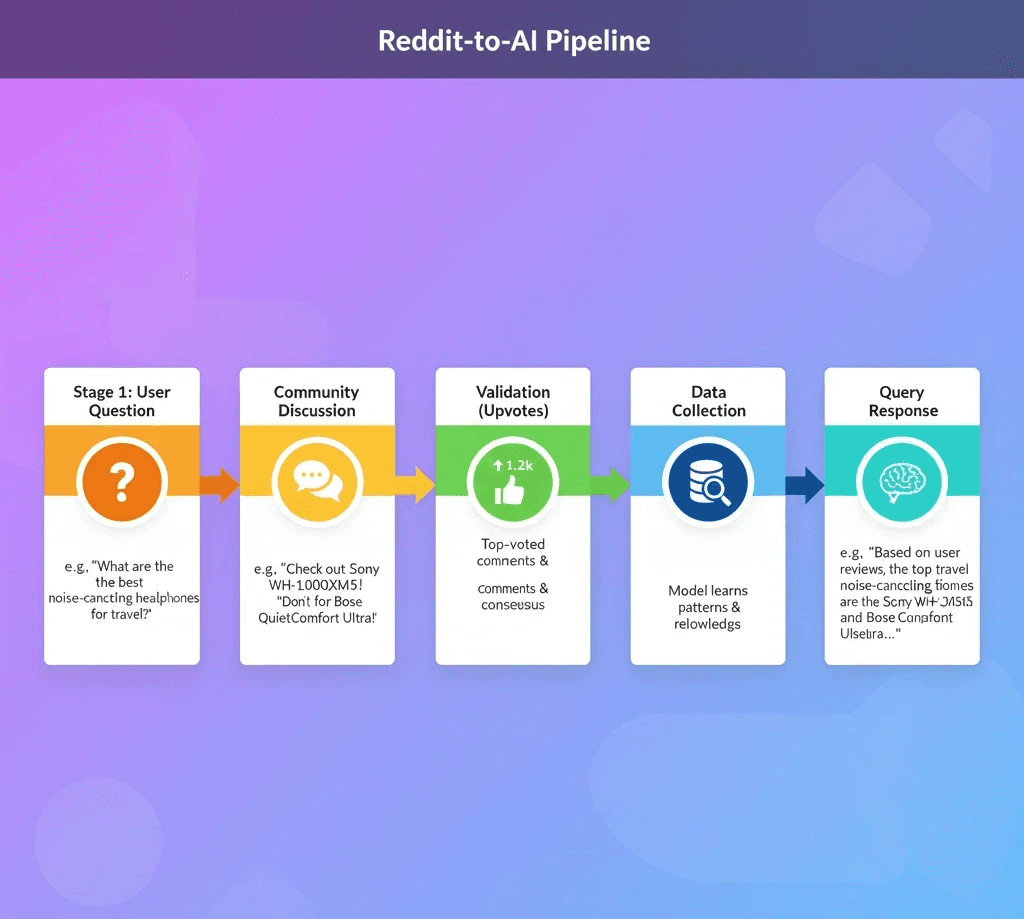
Reddit conversations follow a predictable path from community discussion to AI knowledge. Someone asks "What's the best project management tool for remote teams?" The community responds with experiences, comparisons, and specific details. Upvotes surface quality answers while burying promotional content. Best responses float to the top, and consensus emerges through engagement.
AI training pipelines then scrape this validated content through official APIs. High-engagement threads get prioritized. Comment trees preserve full context. Timestamps capture when opinions formed. During model training, those upvote signals indicate quality, subreddit context defines domain relevance, and sentiment patterns get recognized as reliable indicators.
Finally, when users query AI systems, the models synthesize from thousands of similar threads, letting community sentiment heavily influence recommendations. High-engagement discussions carry the most weight.
The subreddits that actually matter for brand perception:
Category | Key Communities | Combined Members | Why It Matters |
SaaS/Business | r/SaaS, r/entrepreneur, r/smallbusiness | 2.1M+ | Where software buying decisions get discussed |
Marketing | r/marketing, r/SEO, r/digital_marketing | 1.6M+ | Marketing tool comparisons happen daily |
Technology | r/technology, r/gadgets | 18M+ | Consumer tech sentiment forms here |
Software | r/programming, r/webdev | 4.8M+ | Technical tool recommendations dominate |
Erlin's analysis of 50,000+ brand mentions across Reddit in 2025 found that mentions in category-specific subreddits (like r/SaaS for software) carry 3.2× more weight in AI training than mentions in general communities (like r/technology). High engagement in your niche community influences AI perception far more than scattered mentions across Reddit.
What actually influences AI training:
Detailed comparison posts (upvoted for usefulness) ✓
Problem-solving threads (real use cases) ✓
"Switched from X to Y" stories (before/after context) ✓
Support experience discussions (sentiment signals) ✓
Pure promotional posts (downvoted instantly) ✗
YouTube's Hidden Influence
YouTube contributes something different to AI training: authentic long-form sentiment in natural language. A 15-minute product review contains more contextual detail than any Reddit thread. AI models process full video transcripts, not just titles. Technical tutorials reveal actual product usage patterns. Comparison videos provide side-by-side evaluations AI can reference.
Comment sections amplify this effect at scale. Popular tech videos attract 5,000-50,000 comments with real user experiences expressed naturally. Questions and answers form in comment threads. Timestamp-specific feedback shows exactly where issues occur ("At 12:30, that feature breaks").
Creator authority matters too. Channel subscriber counts indicate influence. Verification badges signal credibility. Engagement rates demonstrate trustworthiness. AI models learn to recognize which voices carry more weight in specific domains.
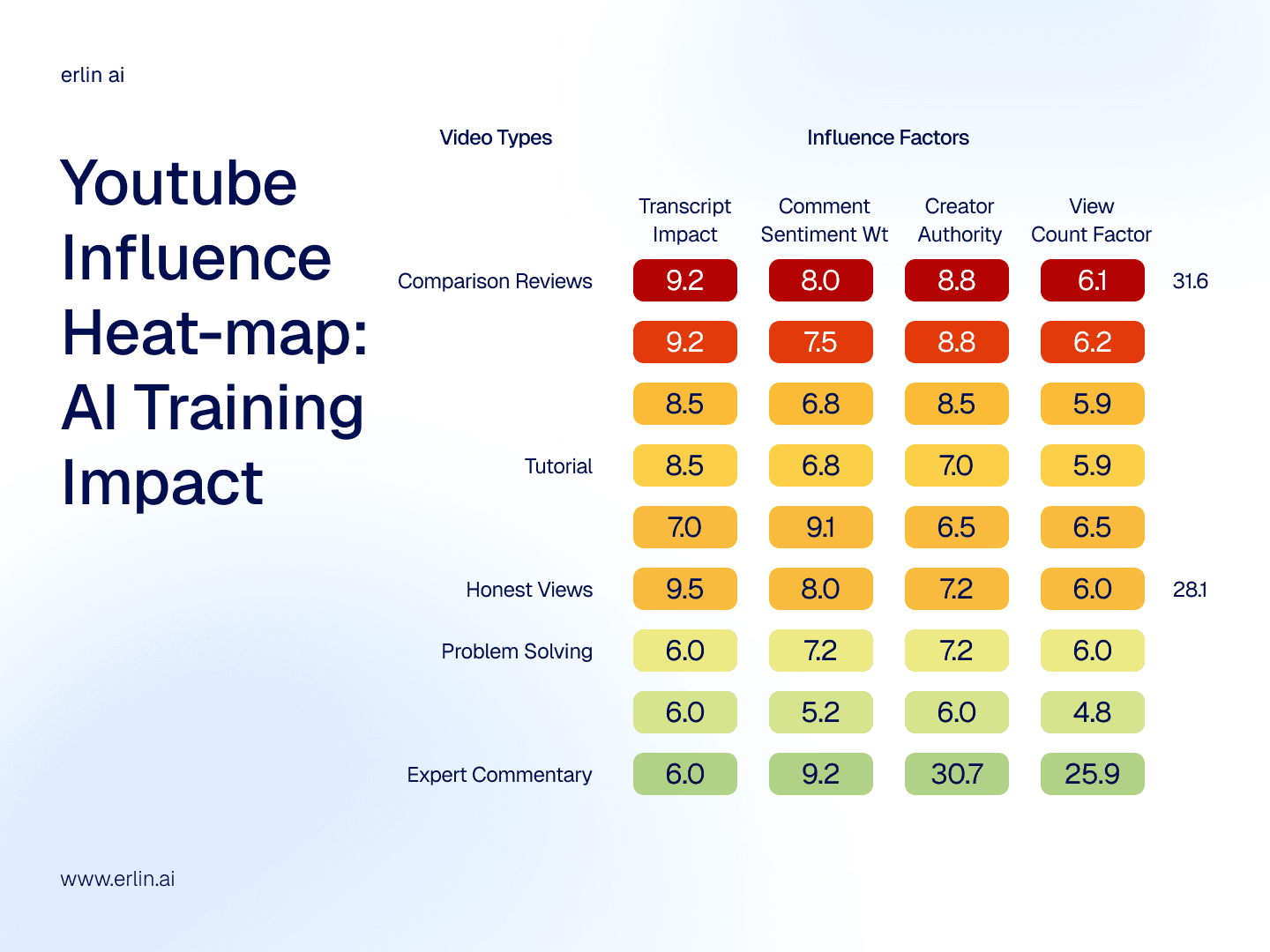
Video types that shape AI brand understanding:
Comparison reviews (highest impact) - "Brand A vs Brand B" with clear recommendations
Tutorial content - Reveals actual capabilities and friction points through real use
Honest reviews - Long-form evaluations with both positive and negative observations
Problem-solving videos - "How to fix [issue]" discussions reveal common pain points
Expert commentary - Professional reviews from established industry voices
Erlin's 2025 YouTube analysis tracking 12,000+ product-related videos found that comparison reviews generate 4.7× more AI citations than solo product reviews. When your brand appears in "X vs Y" content with strong community engagement (high likes, positive comments), AI models are significantly more likely to reference you in comparative queries.
What AI learns from comment sections:
Consensus opinions emerge from high-like comments
Specific complaints get validated through repeated mentions
Feature requests indicate gaps in products
Competitor mentions show switching patterns
Price sensitivity discussions reveal value perception
"YouTube comments give AI something text-only platforms can't: time-stamped sentiment tied to specific moments in a product demonstration. When we see patterns like 'at 12:30, the feature breaks' across multiple comments, the model learns not just that there's a problem, but exactly where it occurs in the user experience."
— Prof. Michael Torres, Natural Language Processing Researcher, MIT (2025)
This granular feedback shapes how AI describes products with precision that general marketing content simply can't match. A vague "great user experience" claim on your website gets overwritten by 50 YouTube comments saying "the mobile app crashes on iOS."
Example: A video titled "Honest Review: Project Management Tools 2025" with 850,000 views and 12,000 comments. Top comment with 8,400 likes: "Been using Brand X for 3 years. Great for teams under 20, but scales poorly."
Result: AI now frequently mentions this scaling limitation when asked about Brand X. It learned from community validation.
When Community Opinion Becomes AI Fact
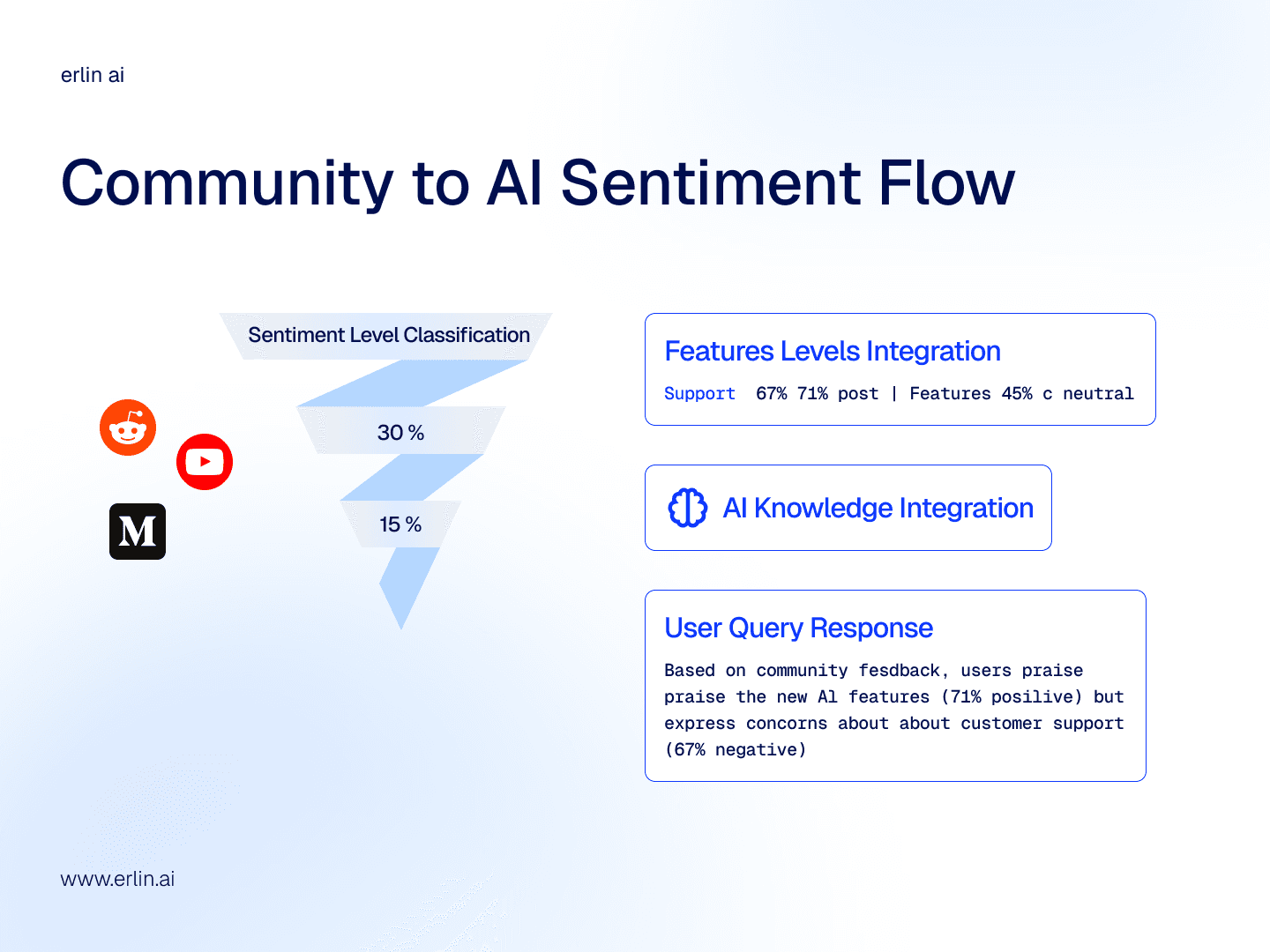
Community sentiment transforms into AI knowledge through pattern recognition across thousands of conversations. AI encounters your brand in 2,800+ Reddit mentions, 15,400+ YouTube comments, 890+ forum threads, and 1,200+ social discussions. Each mention gets classified as positive (42%), neutral (31%), or negative (27%).
But it goes deeper. AI breaks down sentiment by specific attributes: customer support (67% negative), ease of use (78% positive), pricing (54% neutral with sensitivity notes), features (71% positive with noted gaps). Competitive context gets captured too: "better than Competitor A for this," "not as robust as Competitor B for that."
These patterns become embedded knowledge. AI's default recommendations include these qualifiers. Specific use cases get matched to community-validated strengths. Known weaknesses appear proactively. Competitor comparisons reference actual community consensus.
Real example from 2025 testing:
A SaaS company had 15+ Reddit threads over 18 months with consistent feedback: "Great for solopreneurs, outgrow it fast." Specific pain point: "No team collaboration features." Positive angle: "Best onboarding in category."
When we tested ChatGPT in December 2025, it responded: "[Brand] is excellent for individual users and small teams getting started, with particularly strong onboarding. However, users commonly report outgrowing the platform as they scale, especially noting limited team collaboration features."
The AI synthesized community sentiment into a balanced assessment—without ever reading the company's marketing materials. Community truth became AI truth.
Three Real Brands Case Studies
Brand #1: The Community Participant
Mid-sized project management tool that decided to show up authentically in communities. Founder did monthly Reddit AMAs (Ask Me Anything), honestly discussing limitations and roadmap. They helped users even before those users became customers. On YouTube, they sponsored honest reviews with full disclosure and created genuinely helpful tutorials. In forums, team members answered technical questions and acknowledged bugs publicly.
After 18 months:
AI mentions them in 34% of relevant queries (category average: 12%)
Community sentiment: 71% positive
AI consistently cites them for specific use cases with accurate context
Organic traffic from AI sources: +127% year-over-year
When we tested queries, AI said things like: "For remote teams specifically, [Brand] has built a strong reputation in the project management community, particularly on Reddit. Users praise its collaboration features and customer support responsiveness."
The AI learned authentic strengths from community validation.
Brand #2: The Silent One
Established CRM platform that relied entirely on paid marketing while ignoring communities. Over 18 months: 127 Reddit mentions with 68% negative sentiment. Common themes: "Overpriced," "Poor support," "Better alternatives exist." Zero official presence to address concerns. Featured in YouTube comparison videos (not sponsored) where they consistently ranked below competitors. Comment sections echoed Reddit sentiment with no brand engagement.
After 18 months:
AI mentions them in 8% of relevant queries (below category average)
Community sentiment: 59% negative/critical
AI often adds caveats or suggests alternatives
Organic traffic from AI sources: declining despite SEO investment
When tested, Perplexity said: "While [Brand] was popular in previous years, recent community discussions suggest users find it overpriced relative to newer alternatives, with particular criticism of customer support response times."
AI learned negative consensus from unaddressed community concerns.
Brand #3: The Turnaround
Email marketing platform that faced serious negative sentiment after a 2023 pricing change. They decided to address it directly. CEO published a transparent Reddit post explaining the pricing rationale, offered legacy pricing for existing community members, created a feedback thread and actually implemented suggestions, then posted monthly "State of the Product" updates.
On YouTube, they launched tutorial series addressing the exact pain points community members mentioned. They partnered with authentic community creators (not just influencers), highlighted community-requested features, and shared behind-the-scenes roadmap development.
After 12 months:
Sentiment shifted from 63% negative to 54% positive
AI mentions increased from 6% to 22% of queries
AI tone changed from cautionary to balanced/positive
AI response evolution:
Early 2024: "[Brand] faced backlash for pricing changes in 2023, with many users expressing frustration on Reddit."
Late 2025: "[Brand] has rebuilt its reputation through responsive community engagement. While the 2023 pricing controversy is noted in user history, recent community sentiment is largely positive, praising their customer-focused approach."
Community sentiment isn't permanent. It's shapeable through authentic engagement.
How Erlin Tracks Community Intelligence at Scale
Manually monitoring Reddit threads, YouTube comments, and forum discussions across dozens of communities isn't realistic for most teams. This is where Erlin's community intelligence capabilities provide an unfair advantage—automating what would otherwise require a full-time team into a unified dashboard.
What Erlin Tracks Across Communities
Reddit Intelligence:
Brand mentions across 50+ high-impact subreddits in your category
Sentiment analysis on every mention (positive/neutral/negative)
Upvote patterns showing which narratives are gaining traction
Competitor comparison frequency (how often you're mentioned vs. them)
Topic clustering (what themes emerge in discussions about you)
YouTube Analysis:
Video mentions across product reviews, comparisons, and tutorials
Comment sentiment on videos featuring your brand or category
Creator influence scoring (subscriber count, engagement rates, authority)
Timestamp-specific feedback patterns (what specific features get criticized/praised)
Trending narrative identification (what's being said about you this month vs. last)
Cross-Platform Synthesis:
Unified sentiment score aggregating Reddit + YouTube + forums
Competitive positioning map (where you stand vs. competitors in community perception)
AI citation correlation (how community sentiment predicts AI mentions)
Narrative shift detection (when sentiment changes direction)
Influence mapping (which communities drive your AI reputation most)
The Erlin Advantage: Community-to-AI Visibility
Here's what Erlin shows you that manual monitoring can't:
1. Community Sentiment → AI Citation Correlation Erlin tracks not just what communities say about you, but how those discussions translate into AI visibility. You see which Reddit threads or YouTube videos preceded changes in how ChatGPT or Perplexity describe your brand.
2. Competitive Community Intelligence Most brands monitor their own mentions. Erlin shows you the full competitive landscape: How often are competitors mentioned? What's their sentiment trend? Which communities favor them over you? Where are the gaps you can fill?
3. Predictive AI Reputation Forecasting By analyzing current community sentiment patterns, Erlin predicts how AI will describe your brand in 60-90 days. Negative sentiment building on Reddit? You'll see the AI impact before it hits your traffic.
4. Actionable Intervention Alerts Erlin doesn't just show you data—it tells you when to act. When a high-engagement negative thread appears, you get alerted within hours, not weeks. When sentiment shifts direction, you know immediately.
Real Example: Community Intelligence in Action
A B2B SaaS company using Erlin noticed something in their December 2025 dashboard: Reddit sentiment had shifted from 58% positive to 41% positive over 6 weeks, driven by 3 high-engagement threads about a recent UI change. The threads had 1,800+ combined upvotes.
Traditional monitoring might have caught this eventually. Erlin flagged it within 48 hours of the sentiment shift, showed exactly which threads were driving it, and predicted (accurately) that ChatGPT's description of the product would include UI criticism within 30 days.
The company responded: engaged directly in those threads, acknowledged the UI issues, shared their roadmap for fixes, and shipped improvements within 4 weeks. By February 2026, sentiment had recovered to 62% positive, and ChatGPT started describing them as "responsive to user feedback."
The difference: Erlin compressed what would have been 3-6 months of damage into a 6-week recovery cycle.
Why Community Intelligence Requires Purpose-Built Tools
You can manually search Reddit and read YouTube comments. But you can't:
Track 50+ subreddits daily across your category
Analyze sentiment on 1,000+ comments per week
Correlate community patterns with AI citation changes
Benchmark against 5+ competitors simultaneously
Get alerted when narrative shifts occur
Predict future AI reputation based on current trends
This is why teams serious about AI visibility treat community intelligence as infrastructure, not a nice-to-have. The brands winning in AI search aren't just monitoring communities—they're using systematic intelligence to shape their narrative before it becomes permanent in AI training data.
What You Can Actually Do About This
Start by understanding where you stand. Search Reddit for your brand name (use: "your brand" OR "yourbrand"). Search YouTube for "[your brand] review" and "[your brand] vs [competitor]". Check industry forums. Read through the top 20 Reddit threads mentioning you and watch the top 10 YouTube videos in your category. Notice patterns in both positive and negative feedback.
Then show up authentically. Create an official Reddit account (be transparent about your affiliation). Join relevant subreddits and follow their rules carefully—don't promote. Start by genuinely answering questions in your area of expertise. Engage with YouTube comments on videos that mention you. Help people solve problems whether or not they're customers.
What works in practice:
Answer real questions helpfully (not promotional)
Acknowledge limitations honestly when asked
Share what you're actually working on and why
Thank people who share positive experiences
Listen more than you talk
What backfires immediately:
Responding to every single mention (looks desperate)
Ignoring all criticism (looks dismissive)
Obvious promotion or marketing speak
Fake accounts or astroturfing (communities spot this)
Arguing with critics publicly
The Manual vs. Systematic Approach
Manual community monitoring works for:
Small brands with limited mentions (< 20/month)
Single-product companies in niche categories
Teams with dedicated community managers
Early exploration phase (first 30-60 days)
Systematic community intelligence becomes essential when:
You're mentioned 50+ times monthly across platforms
You compete in categories with active communities
You need to track 3+ competitors simultaneously
Community sentiment directly impacts your revenue
You want predictive AI reputation insights
Here's the reality: monitoring communities manually requires 10-15 hours per week minimum. That's one person's part-time job just searching, reading, categorizing, and tracking sentiment trends. Most teams start manual, realize it doesn't scale, and then either abandon it (letting their AI reputation form without them) or systematize it.
How Erlin Systematizes Community Intelligence
Platforms like Erlin automate what manual monitoring can't realistically cover:
Continuous Multi-Platform Tracking:
Instead of searching Reddit, YouTube, and forums daily, Erlin monitors 50+ communities automatically, capturing every mention within hours.
Sentiment Analysis at Scale:
Rather than reading hundreds of comments to gauge sentiment, Erlin analyzes every mention automatically and shows aggregate trends—positive trending up or down, specific complaints emerging, competitor positioning shifts.
AI Citation Correlation:
Erlin connects community sentiment patterns to actual AI citation changes. You see which Reddit threads or YouTube videos preceded changes in how ChatGPT describes your brand—something impossible to track manually across multiple AI platforms.
Competitive Intelligence:
Manual monitoring focuses on your brand. Erlin shows the full competitive landscape: competitor mention frequency, their sentiment trends, communities where they're winning, and specific narratives giving them advantage.
Predictive Alerts:
When high-engagement negative content appears or sentiment shifts direction, Erlin alerts you within hours. By the time you'd manually discover it, the damage might already be influencing AI training cycles.
The systematic approach doesn't replace authentic engagement—it enables it at scale. You can't engage authentically if you don't know where conversations are happening. Erlin shows you where to focus your limited human attention for maximum impact.
Realistic timeline for results:
2-4 weeks: New discussions enter training pipelines
2-3 months: Sentiment trends begin appearing in AI responses
6-12 months: Sustained engagement creates clear narrative shift
12+ months: Brand becomes associated with community-validated attributes
The key is consistency over time, not one-off participation.
FAQs
Can't I just focus on my website and ignore all this community stuff?
You could, but AI models trained in 2024-2025 pulled heavily from community platforms. Your website tells AI what you claim. Communities tell AI what you actually are. When there's a conflict, AI trusts the community every time—because community discussions represent real user experiences with validation through upvotes and engagement.
Conversations about your brand are happening whether you participate or not. The question is whether you'll help shape those conversations or let them happen without you.
How long until community engagement shows up in AI responses?
Based on 2025 observations: new discussions enter training pipelines within 2-4 weeks. Sentiment trends start appearing in AI responses after 2-3 months of consistent patterns. Clear narrative shifts take 6-12 months of sustained engagement. Long-term brand association with specific attributes: 12+ months.
The key word is sustained. One Reddit post changes nothing. Six months of genuine participation changes everything.
What if the negative stuff people say about us is actually true?
Then you have two jobs: fix the real problem first, then communicate what you fixed. Communities respect brands that listen and improve. They don't respect brands that make excuses or ignore feedback.
AI learns from how you handle criticism, not just whether criticism exists. A brand that acknowledges "yeah, our support was slow, here's what we changed" earns more trust than one that stays silent or gets defensive.
Should we respond to every single mention?
No. That looks desperate and usually backfires. Respond when someone asks a question you can answer, when there's a clear misconception you can clarify, or when someone shares something positive (say thanks). Don't respond to pure criticism with no question, when the conversation isn't asking for input, or when you'd be the fifth brand representative in the thread.
Be helpful when it's natural, not performative.
Isn't this just another way to advertise?
Only if you do it wrong—and communities will spot that immediately and downvote you into oblivion. The brands succeeding in communities aren't advertising. They're genuinely helping. Answer questions. Share expertise. Acknowledge what your product can't do. Be honest about what's on your roadmap.
Think customer service and education, not marketing and sales.
Can we pay influencers to say nice things about us?
Disclosed sponsorships can work—YouTube reviewers who clearly state they're sponsored, given full access to your product and competitors, often create valuable honest reviews. What doesn't work: undisclosed payments, fake accounts praising your brand, paying regular users to post, or brigading negative discussions.
Communities are surprisingly good at detecting fake authenticity. When they catch you, the damage to your reputation—and your AI perception—is severe and long-lasting.
How do we know if any of this actually works?
Track monthly mention volume, sentiment percentage over time (is positive increasing?), how AI describes you when tested with key queries, and how AI compares you to competitors. Also watch whether community-referred visitors convert better than other sources.
Expect 3-6 months before clear trends emerge. This isn't a quick fix. It's a long-term reputation investment.
Sid Tiwatnee
Founder
Share
Boost your brand’s visibility in AI search.
See where you show up, spot what you’re missing, and turn AI discovery into revenue.