LLM SEO is the practice of getting your brand accurately cited, summarized and recommended inside AI answers from ChatGPT, Perplexity, Gemini and Claude, instead of only ranking a page in Google. It layers on traditional SEO and optimizes your whole entity around four drivers: fact density, third-party source authority, structured data and content recency. Success is measured by prompt coverage, share of voice, citation quality and sentiment.
Search has expanded beyond Google, and large language models now decide which brands get seen. From ChatGPT to Perplexity, Gemini, and Claude, visibility depends on how well your content aligns with how LLMs retrieve and cite information.
This guide explains how LLM SEO works, what separates cited brands from ignored ones, and the specific actions that lead to measurable gains, backed by data from Erlin’s tracking of 500+ brands.
What is LLM SEO?
LLM SEO stands for large language model search engine optimization. It is also called LLMO (large language model optimization), GEO (generative engine optimization), or AEO (answer engine optimization). These terms describe overlapping disciplines with a shared goal: getting your content into AI-generated answers.
The distinction from traditional SEO is fundamental. Traditional SEO optimizes for ranking: your page appears at position one for a keyword, and a user clicks through. LLM SEO optimizes for representation. The goal shifts from appearing in a list to being accurately cited, summarized, and recommended in the answer itself.
A user who arrives from an AI citation has already received a recommendation. They arrive more informed and closer to a decision. As a result, they tend to convert better than traditional organic visitors, and that conversion difference is the business case for LLM SEO.
How LLMs decide what to cite
Understanding LLM citation mechanics is the foundation of any effective optimization strategy. Large language models generate responses through two pathways, and each requires a different approach.
Training data: Some responses are generated from what the model learned during training. If your brand was covered in authoritative sources, Wikipedia, major publications, and industry reports before the model's training cutoff, that familiarity is baked in. This pathway builds long-term brand recognition inside the model and cannot be optimized quickly.
Retrieval Augmented Generation (RAG): Perplexity is primarily driven by RAG. Google AI Overviews use real-time retrieval. ChatGPT with search enabled pulls live web results, primarily from Bing.
In RAG systems, the model searches for content that matches the user's query, retrieves the most relevant passages, and synthesizes a response. This is where content structure, freshness, and technical accessibility have immediate, measurable impact.
Most LLM SEO guides focus only on RAG. Both pathways matter. Training data builds the baseline. RAG optimization produces faster wins.
When a user asks a complex question, LLMs don't search for the full query; they break it into shorter sub-queries. Someone asking "what's the best AI visibility tool for a 50-person B2B SaaS team" might trigger separate sub-queries for "AI visibility tools 2026," "AI visibility SaaS pricing," and "AI visibility platform reviews." Your content needs to rank for these sub-queries individually, not just the full question.
LLM SEO vs. traditional SEO: what actually changes
The shift from traditional SEO to LLM SEO is not a replacement. It's a layering decision. 76% of AI-cited URLs rank in Google's top 10, which means strong traditional SEO is still the foundation AI systems draw from. But SEO alone no longer determines whether you appear in AI answers.
| Dimension | Traditional SEO | LLM SEO |
|---|---|---|
| Goal | Rank in search results | Be cited in AI-generated answers |
| Unit of optimization | Page | Entity (brand presence across the web) |
| Authority signals | Backlinks, domain authority | Third-party mentions, entity consistency |
| Content goal | Match keyword intent | Provide extractable, verifiable answers |
| Success metric | Rankings, organic traffic | Citation frequency, share of voice |
| Timeframe for results | Weeks to months | 14 to 21 days for structural changes |
The most consequential difference is the unit of optimization. Traditional SEO optimizes a URL for a keyword. LLM SEO optimizes your entire web presence, so AI models consider you an authoritative source when generating answers about your category. The target shifts from a page to an entity.
Entity presence means every mention of your brand in a positive, authoritative context (a LinkedIn post, a G2 review, a Reddit thread, a press mention, a Wikipedia entry) strengthens your representation inside the model's knowledge, whether or not it includes a hyperlink. Backlinks build domain authority for Google. Mentions build entity confidence for LLMs.
The four drivers of LLM citation
Erlin's analysis of 500+ brands across ChatGPT, Perplexity, Gemini, and Claude identifies four factors that explain 89% of AI visibility variance. (Erlin data, 500+ brands, 2026)
1. Fact density
LLMs cite what they can verify. Brands with 8+ structured attributes get cited 4.3x more than brands with fewer than 3 attributes. (Erlin data, 2026) Each additional structured attribute adds ~8.3% median coverage.
Structured attributes are specific, machine-readable facts: pricing tiers, integration lists, use cases, customer segments, key differentiators, and deployment options.
A homepage that says "we help teams work better" gives an LLM nothing to anchor. A homepage that says "workflow automation for operations teams, from $49/seat, integrates with Slack, Jira, and Salesforce, used by 4,000+ companies" gives the model five verifiable facts it can cite with confidence.
The coverage by fact count:
| Fact Count | AI Coverage |
|---|---|
| 0 to 2 facts | 9% |
| 3 to 4 facts | 23% |
| 5 to 6 facts | 41% |
| 7 to 8 facts | 58% |
| 9+ facts | 78% |
(Erlin data, 500+ brands, 2026)
2. Source authority (third-party validation)
68% of AI citations come from third-party sources. Only 32% come from brand-owned websites. (Erlin data, 2026) You cannot compensate for weak third-party presence with great owned content; AI models are calibrated to favor sources they didn't receive from the brand itself.
Reddit drives the highest citation lift at 3.4x the baseline. Wikipedia drives 2.9x. Review platforms like G2 and Capterra drive 2.6x. (Erlin data, 2026) Q&A Reddit threads account for over 50% of AI citations from Reddit specifically: the format that maps most directly to how LLMs construct answers. (Erlin data + third-party analysis, ~250,000 Reddit posts, 2026)
Brands with five or more independent citation sources achieve 78% average AI coverage. Brands with owned content only achieve 18%. (Erlin data, 2026)
3. Structured data
Machine-readable formats are the fastest lever in LLM optimization. Comparison tables drive +34% coverage lift in 14 days. An llm.txt file drives +32% in the same window. FAQ schema drives +28% in 21 days. (Erlin data, 2026)
AI parsing success by format:
- Static HTML with schema markup: 94% success rate
- Plain HTML without schema: 68%
- JavaScript-rendered content: 23%
- PDF documents: 7%
(Erlin data, 2026)
If your key product and pricing pages are JavaScript-rendered, AI crawlers miss most of your content. That alone can represent a 6 to 8% coverage gap per missing structural element. (Erlin data, 2026)
4. Content recency
AI platforms explicitly weight freshness. Brands updating content monthly see ~23% higher AI coverage than brands with stale content. (Erlin data, 2026) Coverage decays at approximately 1.8% per month when content isn't refreshed.
Content under 3 months old averages 48% AI coverage. Content over 24 months old averages 18%. (Erlin data, 2026) The window matters: a page that was well-cited six months ago may be losing ground today without a single change to its content.
How to write content LLMs will actually cite
Content structure is where most brands lose citations to better-optimized competitors. LLMs do not scan content the way humans do. They parse it for extractable passages: short, self-contained sections that answer a specific question clearly enough to quote without modification.
Lead every section with the answer: Every section under an H2 must contain a sentence in the first two sentences that directly answers the implied question of that heading. LLMs read the first 1 to 3 sentences of a section and decide whether to cite it. If the answer is buried in paragraph five, the section gets skipped.
Write declarative statements: LLMs cite facts they can lift cleanly. Subject → verb → specific fact. "Brands with 8+ structured attributes get cited 4.3x more" is citable. "Brands with more structured attributes may see higher citation rates" is not. Remove all hedging. State things directly.
Structure content in retrievable chunks: Each paragraph should be self-contained and 2 to 4 sentences. If a paragraph can only be understood in the context of the surrounding three paragraphs, it will not be extracted. Write as if each paragraph will be pulled out of context and quoted on its own.
Use FAQ sections for every definition and how-to article: FAQ content maps directly to how LLMs construct responses. Each question should be an H3, phrased as a real user would ask it. Each answer should be 2 to 5 sentences, self-contained, and include at least one specific data point. Pages with FAQ schema are cited significantly more frequently in AI responses than pages without.
Use lists for parallel items, not narrative: Nearly 80% of pages cited by ChatGPT use lists to structure key information. (2026 State of AI Search) Each list item must be a complete sentence. Fragments are not extractable. Use numbered lists for sequences and steps; use bullet lists for parallel items without a natural order.
The technical foundations most brands miss
Technical setup is the prerequisite for everything else. Content and authority work cannot compensate for AI crawlers that cannot read your site.
Check your robots.txt: Many sites block AI crawlers without realizing it. Cloudflare changed its default configuration to block AI bots automatically. If you use Cloudflare, check your settings. The crawlers to allow include GPTBot and ChatGPT-User (OpenAI), PerplexityBot (Perplexity), Google-Extended (Gemini), ClaudeBot (Anthropic), and Applebot-Extended (Apple Intelligence).
Deploy server-side rendering for key pages: JavaScript-rendered content has a 23% AI parsing success rate, versus 94% for static HTML with schema. (Erlin data, 2026) Product pages, pricing pages, and FAQ pages that load content via JavaScript are effectively invisible to most AI crawlers.
Create an llm.txt file: The llm.txt standard provides a structured way to tell AI systems what your site contains and how to navigate it. Deployment drives a +32% coverage lift in 14 days across Erlin's dataset. (Erlin data, 2026) This is one of the fastest purely technical wins available.
Implement schema markup on every key page: Article schema, FAQ schema, Author schema, and HowTo schema are the baselines for citation-ready content. Pages with 3+ schema types have a 13% higher likelihood of being cited by LLMs. (2026 State of AI Search) Flag schema requirements in your content briefs before drafting, not after.
Add visible "last updated" timestamps: AI platforms explicitly check lastModified dates. Pages updated within the last 6 months get cited 2.5x more often than older content, even when the older content ranks higher in Google. (Wellows, 2026) Timestamps are both a content freshness signal and a trust signal.
How to build third-party authority for LLM visibility
The source authority driver is the one most brands underinvest in, because the work happens off your own website. 68% of AI citations come from third-party sources. Building those sources is not optional. (Erlin data, 2026)
Reddit: Q&A threads on Reddit account for over 50% of Reddit AI citations. (Erlin data + third-party analysis, 2026) Authentic participation in relevant subreddits, answering real questions with detailed, accurate responses, builds the kind of Reddit presence LLMs weigh most heavily. Promotional posts don't produce the same result. Genuine expertise does.
Review platforms: G2, Capterra, Trustpilot, and similar platforms drive 2.6x higher citation rates than owned content. (Erlin data, 2026) Each review is a third-party validation signal that the model can cite independently of your brand. Brands with 50+ reviews on major platforms see measurably higher AI coverage than brands with fewer than 25.
Wikipedia: Wikipedia drives 2.9x higher citation rates and has persistent value regardless of content age. (Erlin data, 2026) A factual, verifiable Wikipedia entry, where one is warranted, is one of the highest-ROI investments in LLM authority building.
Original research and data: Perplexity is a citation machine with a strong preference for primary data sources. Publishing proprietary research with a clear methodology significantly increases citation probability on that platform. When the only source for a specific statistic is your brand's research, LLMs have to cite you or skip the data point entirely.
Press coverage and industry mentions: Every mention in a trusted publication, industry blog, analyst report, podcast transcript, or partner case study strengthens your entity representation. Nick Eubanks, VP of Owned Media at Semrush, puts it plainly: LLMs source from Wikipedia, GitHub, Reddit, analyst reports, and product docs far more than they source from brand domains.
How to measure your LLM SEO performance
Traditional SEO metrics (rankings, organic traffic, and click-through rates) cannot capture AI visibility. A brand can rank number one on Google for its primary category keyword and still be absent from every ChatGPT response on the same topic. The measurement framework needs to change.
Citation frequency (prompt coverage): How often does your brand appear when relevant queries are run across the major AI platforms? This is the foundational AI visibility metric.
Erlin tracks 500+ brands using this methodology, runs a representative set of 250 to 500 high-intent prompts across ChatGPT, Perplexity, Claude, Google AI Mode, Gemini, and Copilot, and measures how often the brand appears. If you test 20 prompts and appear in 12 responses, your prompt coverage is 60%.
Share of voice: When buyers ask AI for help in your category, which brands appear most often? Share of voice in AI search is the competitive equivalent of rank tracking in traditional SEO. Calculate it as: (your brand's mentions / total mentions for all brands in the query set) × 100.
Citation quality: Not all mentions are equal. A named source citation with a link is more valuable than a paraphrase without attribution. Track whether citations include a link back to your domain, what language the AI uses to describe your brand, and whether the description is accurate.
Sentiment: AI can mention your brand negatively. Monitoring the sentiment of citations (positive, neutral, or negative) is essential for brands where reputation risk is a concern.
Negative Reddit discussions take 2 to 3 months to surface as cautionary language in AI responses. Catching it early is the difference between a 45-day recovery and a 120+ day problem. (Erlin data, 2026)
Only 16% of brands systematically track AI search performance. (Erlin data, 2026) That gap is a competitive opportunity for brands that start now.
The AI visibility ladder: where does your brand stand?
Erlin's analysis of 500+ brands produces five tiers of AI visibility maturity. Knowing your tier determines where to focus optimization work first. (Erlin data, 500+ brands, 2026)
| Tier | Coverage | What It Looks Like |
|---|---|---|
| AI Invisible | 0 to 15% | Fewer than 3 verifiable facts, no structured data, content older than 18 months |
| AI Fragile | 15 to 35% | 3 to 4 detectable facts, fewer than 25 reviews, sporadic Reddit mentions |
| AI Present | 35 to 60% | 5 to 7 structured facts, 25 to 75 reviews, regular citations |
| AI Preferred | 60 to 80% | 8+ structured facts, 50+ reviews, active Reddit presence, llm.txt deployed |
| AI Dominant | 80%+ | 10+ structured facts, Wikipedia presence, 100+ reviews, daily Reddit engagement |
50% of brands score below 35% prompt coverage across the four major AI platforms. (Erlin data, 2026) The gap between the AI-Dominant tier and the AI-Invisible tier is 9x today, and widening 3.2% every month as AI-first brands accelerate their advantage.
A brand moving from AI Fragile to AI Present sees measurable citation improvement within 30 to 45 days when structural changes are made across all four drivers. Tackling one driver in isolation produces partial results. The brands reaching AI Preferred and AI Dominant status address all four simultaneously.
The bottom line
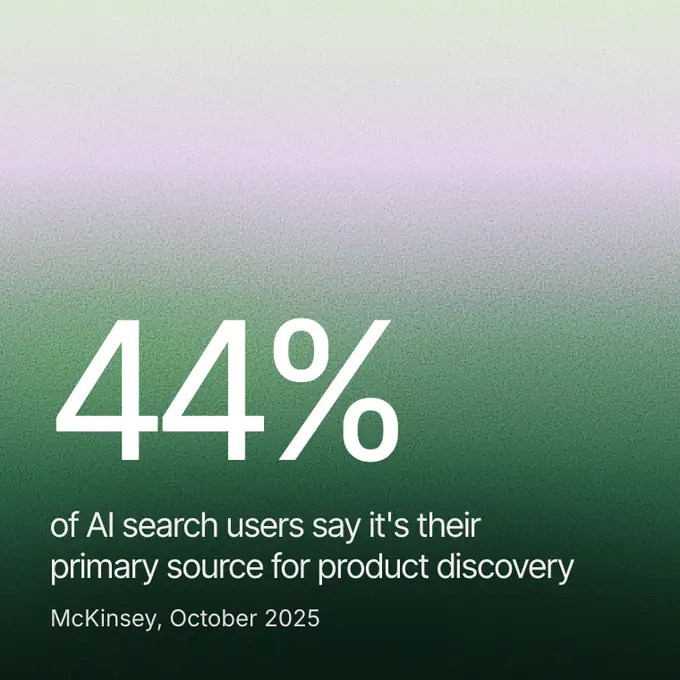
LLM SEO is not a trend to monitor; it is the primary discovery channel for a growing share of B2B buyers. 44% of AI search users say AI is their primary source for product discovery, ahead of traditional search at 31%. (McKinsey, October 2025)
The four drivers of citation (fact density, source authority, structured data, and content recency) are measurable, addressable, and produce results within weeks when tackled systematically. Brands that address all four achieve 78% AI coverage. Brands that don't achieve 9%. (Erlin data, 500+ brands, 2026)
Only 18% of brands have an active AI visibility strategy. (Erlin survey, 200+ marketing leaders, 2026) The window to build a durable AI search presence before your category consolidates is narrow, and it's closing 3.2% every month.
Check your AI visibility: see where your brand stands across ChatGPT, Perplexity, Claude, Google AI Mode, Gemini, and Copilot.