AI for content planning means using AI tools to handle research, brief construction, and calendar scheduling, while keeping topic selection, brand point of view, and quality standards as human decisions. In 2026 this also means planning for AI search visibility on platforms like ChatGPT, Perplexity, Gemini, and Claude, not just for Google rankings.
Content teams now use AI for almost every part of the workflow. Drafts move faster. Briefs come together in minutes. Calendars get populated in a single session.
And yet, most teams report that the planning still feels reactive. The output is higher. The strategy underneath is no clearer than it was a year ago.
The reason is structural. Most AI content planning advice still treats AI as a faster way to do the old job: brainstorm topics, fill a calendar, draft a blog post. That job has changed.
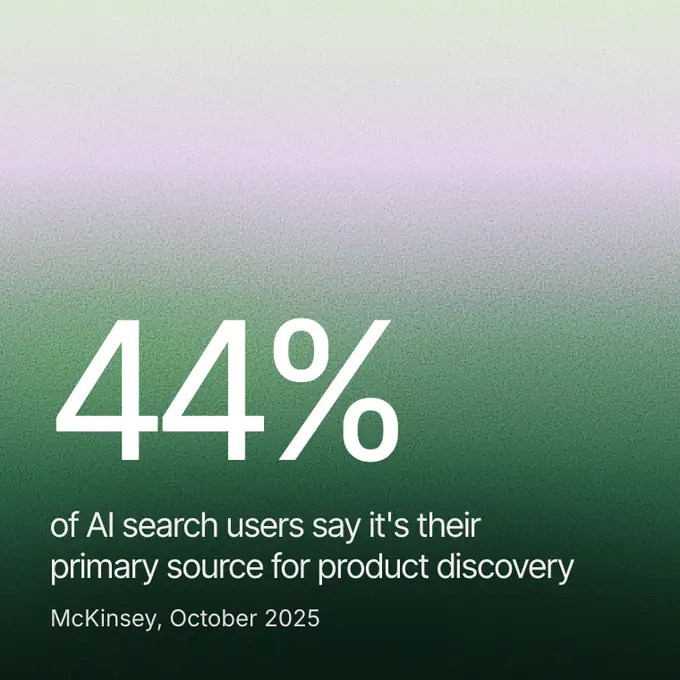
Your buyers are now researching inside ChatGPT, Perplexity, Gemini, and Claude before they ever land on a search result. 44% of AI search users say AI is their primary and preferred source for product discovery, exceeding traditional search (31%), retailer websites (9%), and review sites (6%). (McKinsey, October 2025)
If your content plan does not account for that shift, you will publish more, faster, and still lose ground.
This guide covers how to actually use AI for content planning and strategy in 2026. What AI does well. What it does badly. How to build a planning workflow that produces content optimized for both Google ranking and AI citation. And how to prioritize so the work you do compounds instead of accumulating.
What "AI for content planning" actually means in 2026
AI for content planning is the use of AI tools and AI-derived insights to decide what content to create, who it is for, when to publish it, and how to measure whether it worked.
It covers everything before the writing starts: research, audience mapping, topic prioritization, brief building, and calendar construction.
The category has split into two distinct functions that most marketers conflate.
The first is AI as a content production accelerator. This is what most articles on the topic still describe. Use ChatGPT or Claude to brainstorm topic ideas. Use a tool like Notion AI or Jasper to draft an outline.
Use Surfer or Frase to map a SERP. Use a calendar generator to fill four weeks of social posts. The output is a faster execution of the same planning process you ran before AI existed.
The second is AI as a discovery layer. Buyers now research inside answer engines. Your content needs to be plannable, writable, and measurable for that environment, not just for Google.
This is where AEO (Answer Engine Optimization) and GEO (Generative Engine Optimization) sit. Gartner predicts traditional search volume will drop 25% by 2026 as people move to AI chatbots and virtual agents.
The teams getting compounding results in 2026 are doing both. They are using AI to compress the planning workflow, and they are planning with AI search as a first-class destination, not an afterthought.
Most teams are still doing only the first half. Only 18% of brands have an active AI visibility strategy. (Erlin survey, 200+ marketing leaders, 2026) The rest are accelerating a plan that no longer matches how their buyers research.
Why traditional content planning breaks in an AI-first landscape
The old content planning workflow assumed one thing: rankings translate to traffic, and traffic translates to revenue. AI search broke both halves of that equation.
Search is becoming zero-click. AI Overviews now appear in roughly half of all Google searches. Ahrefs reported that AI Overviews reduced click-through rates for top-ranking content by 58%, up from 34.5% the previous year.
When a buyer asks ChatGPT, "What's the best CRM for a 50-person sales team?", they do not see ten blue links. They see a paragraph that names two or three brands. AI typically cites only 2 to 3 brands per query. Your brand is either in that paragraph or it is not.
This collapses the ranking-position model. There is no "page 2 of ChatGPT." On a given prompt, you are cited, or you are excluded.
The second break is in how AI weighs content. Traditional SEO planning revolves around keyword density, internal linking, and matching search intent. AI search engines weigh different signals.
Goodie's AI search visibility study across thousands of prompts found that Content Relevance leads with an average impact score of 93 across six models, followed by Content Quality and Depth at 90, and Credibility and Trust at 88. Social signals ranked last at 56. SERP ranking ranked just above that at 62.
Translation: AI rewards facts, structure, and authority. It does not reward keyword volume or backlink quantity the way Google has historically. Brands with 9 or more discrete facts per entity profile achieve 78% AI coverage. Brands with 0 to 2 facts achieve 9% coverage. (Erlin data, 500+ brands tracked across ChatGPT, Perplexity, Gemini, and Claude, 2026)
The third break is timing. AI systems re-evaluate content for recency on a rolling basis. Brands updating content monthly see ~23% higher AI coverage than brands with stale content.
The staleness penalty compounds at -1.8% coverage lost per month. (Erlin data, 2026) A traditional quarterly content calendar built around "evergreen pillar pages" actually loses ground.
If your planning framework was built before any of this was true, your AI is helping you ship the wrong plan faster.
How to use AI for content planning: the five-layer workflow
AI is most useful in content planning when each layer has a defined input, a defined output, and a defined human-in-the-loop decision. Without those boundaries, AI accelerates incoherence. The framework below is what works across the 500+ brands Erlin tracks.
Layer 1: audience and demand discovery
This is where you replace gut-feel topic selection with evidence. AI tools that work here include Perplexity for live web research, Claude or ChatGPT for synthesizing customer interviews and call transcripts, and SE Ranking or Ahrefs for search demand.
Internal data matters more than external data. Paste your GA segments, GSC top queries, and CRM win-loss notes into an AI workspace and ask for patterns you missed.
The output you want from this layer: a written audience definition, a list of jobs your buyer is trying to do, and the questions they ask at each stage. Not a persona deck. A working document a writer can use.
The AI search addition: prompt ChatGPT, Perplexity, and Gemini with the questions your buyers ask. Record which brands get cited. The brands that show up are your real competitive set in 2026. They may not match the competitor list your CEO gives you.
Layer 2: topic prioritization and cluster mapping
This is where most teams over-rely on AI and burn months on the wrong topics. AI is excellent at expanding a seed list into hundreds of related topics. It is unreliable at deciding which 20 of those 200 topics will move pipeline.
Run AI for the expansion. Use a tool like MarketMuse, Frase, or Sight to cluster topics into authority maps. Then apply a human prioritization filter. Three questions matter:
- Does this topic match a buyer job, not just a search query?
- Does it have AI-citation potential, not just a Google ranking opportunity?
- Does it connect to an existing or planned cluster of related content?
A topic that fails any of those should drop, no matter how high the search volume looks. Content teams that prioritize by buyer job rather than search volume see 3x higher AI citation rates within 90 days. (Erlin client data, 2026)
Layer 3: brief construction
A good brief is the single highest-leverage planning artefact you produce. AI compresses brief production from two hours to twenty minutes when you give it the right inputs.
Feed the AI: the primary keyword, the search intent, the buyer job, three competitor URLs that currently rank, the ChatGPT/Perplexity/Gemini response to the same query, and your brand's data hooks.
Ask it to produce a draft outline, identify gaps in the competing content, and propose a point of view that differentiates.
The non-negotiable: a human reviews and approves the brief before any draft begins. AI is poor at judging which point of view is defensible for your brand. It is good at surfacing options.
Layer 4: calendar and cadence planning
AI handles the operational layer well. It schedules, sequences, and balances content types. It does not decide cadence; that is a business decision tied to publishing capacity and the staleness penalty above.
Two cadence rules to encode in the calendar, regardless of which AI tool you use:
- Refresh existing content monthly. The 23% coverage lift from monthly updates compounds. Bake refreshes into the calendar before adding new pieces.
- Plan in clusters, not individual pieces. Topic clusters are how LLMs recognize authority. A pillar plus six supporting articles published over a quarter outperforms 28 disconnected blog posts.
Layer 5: performance loop
This is where AI for content planning becomes self-correcting. AI can read your GA4 events, GSC clicks, and CRM influenced revenue. It cannot read your AI visibility data unless you instrument for it.
Track three things weekly: traditional rankings, AI citation frequency across the four major platforms, and AI referral conversion rate. Visitors from AI answers arrive pre-qualified and tend to convert better than traditional organic visitors. If you are not measuring AI referrals separately, you are under-attributing the channel that has the highest intent.
The output of Layer 5 is a feedback signal that updates Layers 1 and 2 every month, not every quarter.
Planning for AI search: what most AI content strategies miss
Most published frameworks for AI content strategy stop at production speed. The teams that win on AI visibility plan for a separate set of variables. Three are doing the heavy lifting.
Fact density over word count
AI engines extract facts. They do not extract narratives. A 2,000-word article with three facts performs worse than a 1,200-word article with twelve facts.
When planning a piece, count the discrete, verifiable facts you intend to include. Numbers, percentages, dates, named methodologies, attributed quotes, and comparison data.
A planning template that ends with "8+ facts minimum" produces consistently better AI coverage than one that ends with "target 2,000 words." The 9-facts-equals-78%-coverage finding is not a soft pattern. It holds across e-commerce, SaaS, and financial services in Erlin's dataset.
Structured data as a first-class planning input
Schema markup is usually treated as a technical SEO concern, handled by engineering after publication. For AI search, it is a planning input.
Comparison tables drive +34% coverage lift in 14 days. FAQ schema drives +28% in 21 days. An llm.txt file drives +32% in 14 days. (Erlin data, 2026) Plan these in.
A pillar page brief should specify the comparison table, the FAQ block, and the data points that will be schema-marked before drafting begins. AI parsing success rates: static HTML with schema 94%, plain HTML without schema 68%, JavaScript-rendered content 23%, PDFs 7%. (Erlin data, 2026) If your content management system renders client-side, your planning needs an engineering line item.
Third-party signal planning
The most underplanned element in 2026. 68% of AI citations come from third-party sources. Only 32% from brand-owned websites. (Erlin data, 2026)
That number rearranges the planning conversation. If two-thirds of your AI visibility is being driven by mentions on Reddit, G2, industry publications, podcasts, and review sites, your content plan needs to include those surfaces.
Not as a "distribution" afterthought, but as planned assets: a Reddit AMA, a guest post pitch list, a podcast appearance schedule, a review platform refresh cadence.
A useful test: review your last quarter's content plan and circle every item that exists outside your own website. If that section is empty, you are planning for roughly one-third of the AI citation surface.
Where AI should not make planning decisions
Three decisions stay human. Documenting this boundary explicitly is what separates teams that scale AI usefully from teams that scale incoherence.
What topics to pursue? AI surfaces opportunities. It does not know which subjects your brand should be associated with, which conversations to enter, and which to skip. A topic that ranks well and converts poorly is worse than no topic at all.
What is your brand's point of view? A good content plan picks fights: opinions, contrarian takes, original frameworks. AI defaults to the consensus position. If you outsource POV to AI, you publish the same article that every other AI-using brand is publishing.
What "quality" means for this team. Editorial standards, fact-checking depth, and source threshold. AI scales whatever standard you start with. If your standard is unstated, you scale inconsistency.
The pattern across the brands Erlin tracks: teams that codify these three boundaries in writing produce content that gets cited. Teams that leave them implicit produce content that fills a calendar.
How to measure whether your AI content plan is working
Three metrics, weekly cadence.
Citation rate by platform: What percentage of your priority prompts return a citation for your brand on each of ChatGPT, Perplexity, Gemini, and Claude? Track each platform separately. They weigh signals differently, and a citation on one does not predict citations on the others.
Citation share against competitors: For each priority prompt, how often does your brand appear vs. your top three competitors? This is the share of voice in the AI era.
The gap between AI visibility winners and losers is 9x today and widening 3.2% every month. (Erlin data, 500+ brands, 2026) Knowing where you stand in the gap is the difference between catching up and falling behind.
AI referral conversion rate: AI traffic from ChatGPT, Perplexity, and similar sources usually converts better than traditional organic, because it arrives with a recommendation behind it. Tag it in GA4 with UTM parameters or referrer rules. If you cannot see this segment, you cannot make the ROI case for AI content investment.
Traditional metrics still matter: rankings, organic clicks, time on page, assisted conversions. Add the three above. The combined view tells you whether your AI planning is producing AI visibility, not just AI-generated content.
A 30-day AI content planning reset
If you are starting from a calendar that has not been audited against the AI-search shift, this is the sequence that works.
Week 1: Baseline. Run your top 20 buyer-intent prompts through ChatGPT, Perplexity, Gemini, and Claude. Note which brands get cited. Compare against your assumed competitive set. Calculate your starting citation rate.
Week 2: Audit. Pull every piece of content you have published in the last 12 months. Score each one for fact density, schema presence, content age, and AI-citation status. Identify the bottom quartile.
Week 3: Prioritize. Pick five pieces to refresh and one new cluster topic to add. Build briefs for all six using the five-layer workflow above.
Week 4: Instrument. Set up weekly tracking on the three metrics. Define the human-owned decisions. Document the AI-in-the-loop boundaries. Brief the team.
By day 45, you should see the first measurable citation rate change on the refreshed pieces. A brand moving from AI Fragile to AI Present sees measurable citation rate improvement within 30 to 45 days. (Erlin data, 2026)
Frequently asked questions
What is AI for content planning?
AI for content planning is the use of AI tools to decide what content to create, who it is for, when to publish, and how to measure performance. It covers research, audience mapping, topic prioritization, brief construction, and calendar planning. In 2026, it also covers planning for AI search visibility on platforms like ChatGPT, Perplexity, Gemini, and Claude, not just for Google ranking.
What is the best AI tool for content planning?
There is no single best tool. The strongest planning stacks combine three layers: a research tool (Perplexity, Claude, or ChatGPT) for demand discovery, a topic mapping tool (MarketMuse, Frase, or Sight) for cluster and gap analysis, and an AI visibility tool (Erlin) for tracking citation performance across AI platforms. Tools like StoryChief, HubSpot, and Notion AI sit on top for calendar and workflow management. Start with the layer where your current planning is weakest.
How is AI changing content strategy in 2026?
AI is changing content strategy in three structural ways. Buyers now research inside answer engines, which collapses the ranking-position model. AI typically cites only 2 to 3 brands per query. The signals AI weights are different from Google's, prioritizing fact density, structured data, and third-party citations. And AI re-evaluates content for recency on a rolling basis, penalizing stale content at -1.8% coverage per month. Strategies built before any of these shifts need to be updated, not just accelerated.
Should I use AI to write my content plan or just to research it?
Use AI for research, expansion, brief construction, and operational scheduling. Keep the three core decisions human: which topics to pursue, what point of view to take, and what quality bar to enforce. The brands that get the most consistent results from AI are investing more in upfront strategic thinking, not less. AI compresses execution time. It does not replace strategic judgment.
How do I plan content for both Google and AI search?
Plan for both with one set of assets, not two. Strong AI-search content is also strong SEO content: clear structure, factual depth, schema markup, topic clusters, and fresh updates. The additions for AI search are higher fact density (target 8+ facts per piece), comparison tables and FAQ schema in the brief, an explicit third-party amplification plan (Reddit, G2, podcasts, guest posts), and a monthly refresh cadence. Roughly 40% of Google's AI Overviews rank in the top 10 organic results, so SEO foundations still feed AI visibility.
How long does it take to see results from AI-optimized content planning?
The first signals appear in 14 to 21 days for structured-data improvements. Comparison tables drive +34% coverage lift in 14 days. FAQ schema drives +28% in 21 days. (Erlin data, 2026) Full citation-rate improvements at the brand level typically take 30 to 90 days, with SaaS brands seeing citation rate improvements of +75% in 90 days when all four AI visibility drivers are addressed. Plan for a quarterly review cycle, not a weekly one, when judging whether the plan itself is working.
Stop planning for the search world you used to live in.
Buyers are researching inside AI. Your competitors are showing up there, or they are not. 50% of brands score below 35% prompt coverage across the four major AI platforms. (Erlin data, 2026) The half above that line is doing one thing differently. They plan for AI visibility as a primary input, not a downstream concern.
Erlin pulls keyword data, AI prompt data, and competitor citation data into one view. Planning that took a day takes fifteen minutes. Be The Brand AI Recommends.
Check your AI visibility and see your starting citation rate across ChatGPT, Perplexity, Claude, Google AI Mode, Gemini, and Copilot.