Generative engine optimization for ecommerce makes your products easy for AI engines like ChatGPT and Perplexity to parse, trust and recommend. Work across four layers: complete Product, Offer and FAQ schema with specific attributes; category pages and guides that answer buyer questions first; crawlable static HTML with AI bots allowed in robots.txt; and third-party validation through reviews, Reddit, YouTube and editorial coverage.
Your product ranks on Google. Your ads are converting. And yet, when a shopper asks ChatGPT for a recommendation in your category, your brand never comes up. That is a GEO problem, and it is becoming the most expensive gap in e-commerce marketing.
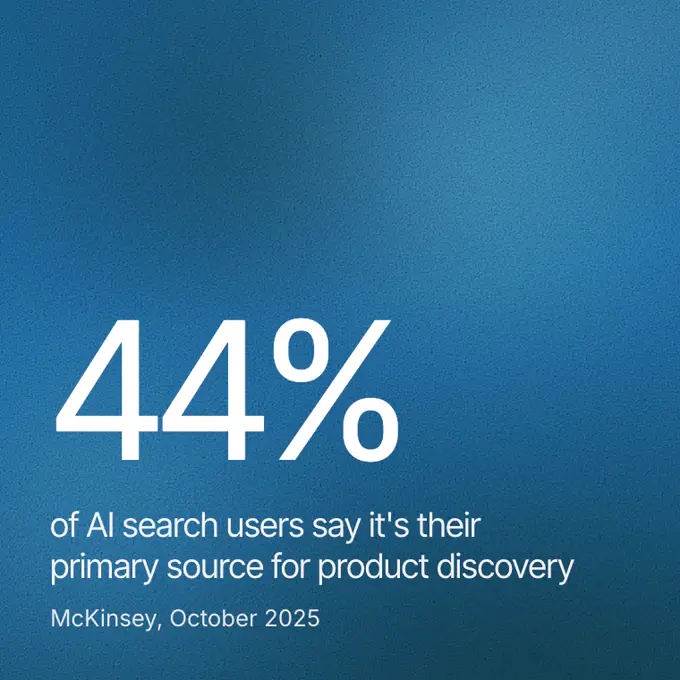
AI-driven traffic to US retail websites grew 693% during the 2025 holiday season, according to Adobe Analytics. That traffic converts 31% better than non-branded organic search.
The shoppers arriving from ChatGPT or Perplexity have already read a summary of your reviews, confirmed your product fits their needs, and built trust in your brand before they click. They arrive pre-sold.
What follows is a practical breakdown of how generative engine optimization works for e-commerce: why standard SEO tactics fall short, what your product pages need to change, how off-site signals drive the majority of AI citations, and how to actually measure what is working.
What is generative engine optimization for E-commerce?
Generative engine optimization (GEO) is the practice of structuring your product data, content, and brand presence so that AI-powered search engines can extract, verify, and recommend your products when shoppers ask for buying advice.
The difference from SEO is not subtle. Traditional search ranks your pages. Generative search synthesizes an answer. When a shopper types "best running shoes for flat feet under $150" into ChatGPT or Perplexity, the AI does not return a list of links.
It builds a recommendation from structured product data, third-party reviews, editorial coverage, and community discussions. If your brand is not clearly represented across those sources, you are not in the answer.
Only 17 to 38% of AI Overview citations come from top-10 Google organic results, according to Ahrefs and BrightEdge research from February 2026. A first-page Google ranking does not get you into AI recommendations. GEO requires a different approach.
For e-commerce, GEO operates across four layers. The first is product data structure: whether AI can parse your product attributes, pricing, and availability with confidence.
The second is on-site content: whether your category pages and guides answer the questions AI is actually being asked. The third is technical foundation: whether AI crawlers can access and read your site efficiently.
The fourth is off-site validation: whether third-party sources confirm your brand as credible and relevant.
All four layers matter. Brands that only address one or two still get passed over.
Why AI traffic converts better than organic search
Before getting into tactics, the data on why this matters for ecommerce teams.
AI-referred shoppers arrive with higher purchase intent than almost any other traffic source. The reason is simple: the AI has already done the shortlisting.
A shopper who clicks through from ChatGPT has seen your product's specs, read a summary of customer reviews, and confirmed your item fits their criteria. They are not browsing. They are deciding.
ChatGPT referral traffic converted 31% higher than non-branded organic search across 94 seven- and eight-figure ecommerce brands in 2025, according to a Visibility Labs study covering 9.46 million organic sessions.
Adobe's holiday data from the same period found AI conversions were 54% higher than non-AI sources on Thanksgiving specifically.
For major retailers, this channel is already material. ChatGPT accounted for 20% of Walmart's total referral traffic and up to 16% of Zara's inbound traffic between June and August 2025, according to Digiday.
For most brands, AI referral volume is still relatively small, roughly 0.2% of ecommerce sessions as of Q1 2026, growing at 1,079% annually in the stores where it shows up.
That growth rate is the reason to act now, not later. Brands building GEO visibility today are establishing a position before the rest of the market recognizes the channel.
How to optimize product pages for AI discovery
Product pages are the core of e-commerce GEO. AI engines evaluate them for completeness, clarity, and verifiability. A product description written for human persuasion often fails AI extraction entirely.
Complete product schema is the starting point
Implement Schema.org Product markup on every product page, including all attributes: name, brand, SKU, price, availability, condition, and description.
Add Offer schema for pricing and AggregateRating schema if you have customer reviews. Pages with a complete Product schema are 3.7 times more likely to be cited by AI systems compared to pages without it, according to research on AI ecommerce schema optimization.
Write descriptions for machine questions, not marketing copy
A description that says "premium quality, industry-leading design" gives AI nothing to work with. Specify materials, dimensions, compatibility, and use cases instead.
"Designed specifically for apartments under 800 square feet" or "compatible with all major kitchen systems" gives AI the contextual information it needs to match your product to a specific query.
FAQ schema on product pages
AI engines frequently pull from FAQ sections when generating recommendations because the content is already formatted as question-answer pairs. Add real questions from customer reviews, support tickets, and competitor analysis. Keep answers direct and factual.
"How long does shipping take?" should be answered with "2-3 business days for standard shipping," not marketing language about fast fulfillment. Each FAQ answer needs its own FAQ schema markup.
Include comparison language naturally
AI handles comparison queries constantly: "best X vs Y," "which is better for Z." Build comparison language into product copy. "This model includes a built-in timer, unlike the basic version", or "30% lighter than the previous generation" gives AI engines material to use when users ask comparison questions.
These phrases do not read as forced. They read as useful product details, which is what they are.
Catalog consistency is a trust signal
Generative engines cross-reference product information from multiple sources to reduce uncertainty. Inconsistent product names, pricing, or specs between your site, your Google Merchant feed, and your marketplace listings create ambiguity.
AI engines cite sources they can verify with confidence. Ambiguity means you get left out.
How to structure category pages and supporting content for GEO
Product pages get your SKUs into AI recommendations. Category pages and content clusters determine whether your brand gets cited as an authority in your space.
Category pages need direct answers, not browse experiences
A shopper asking "best running shoes for flat feet" is asking a question. Your running shoes category page should answer it within the first two sentences. AI engines read the opening of a section and decide whether to cite it. Content that buries the answer in a preamble gets skipped.
Build content clusters around buyer questions
For every major product category, map out the questions buyers actually ask: what to look for, how to compare options, which features matter for specific use cases.
Create dedicated pages for each. These are the pages that earn citations for discovery-stage queries, the moments when a shopper is building their consideration set.
Brands with structured, interconnected content covering all stages of the buyer journey earn citations on a broader range of prompts. AI engines assess topical authority across a whole cluster, not individual pages.
A single optimized product page rarely earns a citation if it is surrounded by thin, unstructured content.
Structure matters as much as substance
Content featuring clear formatting, hierarchical headings, bullet points, numbered lists, and comparison tables is 28-40% more likely to be cited by large language models, according to ecommerce citation research.
Write category introductions that answer the query immediately. Use comparison tables for competitive queries. When shoppers ask AI engines to compare products, the AI needs structured data to build its answer.
Content freshness is a direct signal
AI engines weigh recency when selecting sources. A category guide published in 2024 with no updates will lose ground to a 2026 page on the same topic. Refresh category introductions and buying guides regularly. A visible "last updated" timestamp is a trust signal for both AI engines and shoppers.
Technical foundations: making your E-commerce site AI-crawlable
Technical setup is where a lot of e-commerce brands quietly lose ground without realizing it.
JavaScript rendering kills AI discoverability
JavaScript-rendered content achieves only 23% AI parsing success compared to 94% for static HTML with schema, according to Erlin data tracking 500+ brands.
If your product pages rely heavily on JavaScript to display content, AI crawlers may not see your descriptions, prices, or reviews at all. Platforms like Shopify use server-side rendering by default, which handles this automatically. Custom-built stores need an explicit audit.
Check your robots.txt file
Review your robots.txt to confirm you are not inadvertently blocking the major AI crawlers: GPTBot (OpenAI), ClaudeBot (Anthropic), Google-Extended, and PerplexityBot.
This is a fast fix with immediate impact. Blocking these bots makes your site invisible to the platforms generating your highest-converting traffic.
Add an llm.txt file
An llm.txt file tells AI systems which pages contain your most important product and brand information. Think of it as a sitemap written for large language models. Brands that have added this file see faster citation pickup, particularly on new product launches and seasonal content updates.
Core technical fundamentals still apply
Clean site architecture and fast load times improve crawlability for AI systems just as they do for traditional search. Everything that makes a page easier for Google to index also makes it easier for AI to read. These are not separate disciplines.
Off-site GEO: building the third-party validation AI trusts
This is the part most ecommerce teams ignore, and the part that drives the most citation decisions.
About 85% of brand mentions in AI-generated answers originate from third-party pages, not your own website, according to multiple sources tracking AI citation behavior.
Your own domain shows up in roughly 25% of AI-generated answers, and mostly later in the buyer journey. For discovery-stage queries, when a shopper is still building their consideration set, AI pulls almost entirely from external sources.
A product page with perfect schema markup but thin review coverage and no third-party validation will lose to a competitor with stronger off-site signals every time.
Reviews are the highest-leverage off-site signal
Encourage customers to leave detailed reviews on Google, Trustpilot, and any industry-specific review platforms relevant to your category. Detailed reviews describing specific use cases are more useful to AI than "5 stars, great product."
The specificity is what makes them citable. Responding to reviews signals an active, engaged brand, which AI engines pick up as a trust indicator.
Reddit discussions drive a significant share of AI citations
Reddit accounts for 46.7% of top Perplexity citations, according to citation analysis data. Participating authentically in subreddits relevant to your product category builds a presence on one of the most-cited sources across all major AI platforms. This is not a tactic to fake. Authentic answers to genuine product questions in the right communities create durable citations. Manufactured sentiment gets detected.
YouTube is the fastest-rising citation source
YouTube overtook Reddit as the top social citation source in AI responses in early 2026, appearing in 16% of LLM outputs compared to 10% for Reddit, according to citation analysis data.
Product reviews, how-to videos, and comparison content on YouTube create transcripts that AI engines extract and cite. If you have products with instructional use cases or visible results, YouTube is a high-return channel for GEO.
Editorial coverage creates authority AI can verify
Getting mentioned in industry publications, niche buying guides, and editorial roundups places your brand in sources that AI engines already trust.
A mention in a credible publication is worth significantly more than a brand-owned blog post making the same claim. Industry research shows third-party media coverage makes a brand 5x more likely to be cited by AI.
Entity consistency is a GEO signal
Inconsistent brand data across listings, directories, and platforms reduces AI output accuracy by an estimated 30-40%. Your brand name, product descriptions, pricing, and attributes should be identical everywhere AI might look.
Inconsistency creates ambiguity, and ambiguity means you get left out of the answer.
Platform-specific optimization for E-commerce
Different AI platforms pull from different sources and prioritize different signals. A single playbook covers the basics, but brands competing seriously for AI visibility need to understand the platform differences.
ChatGPT holds 77.97% of all AI referral traffic globally and processes approximately 50 million shopping queries daily. It is selective with citations and front-loaded in its reading behavior: the first sentences of each section carry the most weight.
For e-commerce specifically, ChatGPT pulls heavily from Google Shopping product data. A clean, complete product feed matters more here than it does anywhere else.
Perplexity drives 15% of AI traffic globally, climbing to nearly 20% in the US. It rewards fresh, citable snippets and pulls heavily from Reddit and review platforms.
Perplexity users tend toward focused, lower-funnel visits. They are closer to a purchase decision than the average ChatGPT user. Getting cited by Perplexity on product comparison queries translates directly to conversion-ready traffic.
Google AI Mode and Google AI Overviews favor semantic completeness and well-established domain authority. For e-commerce, Google's AI surfaces pull heavily from your Google Merchant Center feed and structured product data.
Brands already investing in Google Shopping optimization have a meaningful head start.
Shopify Catalog and Agentic Storefronts represent a different layer entirely. Shopify's catalog syndication makes product listings discoverable across AI shopping channels automatically for merchants on the platform.
Agentic Storefronts enable in-chat checkout, so shoppers can buy directly within ChatGPT or Google AI Mode without visiting your site. AI-attributed orders on Shopify grew 11x between January 2025 and March 2026.
For Shopify merchants, the platform handles much of the technical integration. The remaining work is data quality and content strategy.
How to measure GEO performance for E-commerce
Measurement is the biggest gap in most GEO strategies. Most e-commerce teams have no equivalent to their SEO dashboards for AI search performance.
Track AI citation frequency
Run your highest-value product queries and category questions in ChatGPT, Perplexity, and Google AI Overviews manually, or use a dedicated AI visibility tracking tool. Note whether your brand appears, how it is described, and whether that description is accurate. Do this monthly for your top product categories.
Set up proper GA4 attribution for AI traffic
GA4 does not create a default channel grouping for AI traffic. Create a custom channel definition that classifies sessions from ChatGPT, Perplexity, Claude, and Gemini as a distinct AI Referral channel.
Without this, most AI-influenced visits are misattributed to Direct traffic. Industry estimates suggest 60-70% of AI referrals are lost this way.
The attribution gap requires post-purchase surveys
Many AI-influenced purchases show up as branded organic search in standard analytics because shoppers research in ChatGPT and then type your brand name into Google before buying. Post-purchase surveys that ask "how did you first discover us?" capture this journey in a way that click data alone cannot.
Track page-level citations and assisted revenue
Identify which product pages, category guides, and supporting content are being cited in AI responses. This shows you which content formats and structures are working.
GEO often impacts early-stage discovery rather than last-click purchase, so measure add-to-cart lift, average order value from AI-referred sessions, and influenced revenue alongside last-click conversions to get an honest picture of the channel's contribution.
Only 16% of brands systematically track AI search performance, according to Erlin's data from 500+ brands. That gap will close. Brands building measurement infrastructure now will have 12-18 months of baseline data before the competition catches up.
Frequently asked questions
What is generative engine optimization for e-commerce?
Generative engine optimization for e-commerce is the practice of structuring product data, on-site content, technical foundations, and off-site brand signals so that AI-powered search platforms like ChatGPT, Perplexity, and Google AI Mode recommend your products when shoppers ask for buying advice. Where SEO targets keyword rankings, GEO focuses on making your brand easy for AI to extract, verify, and cite.
How is GEO different from SEO for e-commerce brands?
SEO optimizes for ranking position in a list of links. GEO optimizes for inclusion in a synthesized AI answer. The tactics overlap in some areas (clean site structure, strong content, and authoritative backlinks), which help both, but GEO places much greater weight on structured product data, off-site third-party validation, and brand entity consistency across the web. Fewer than 10% of sources cited in AI answers rank in the top-10 Google results for the same query. A strong SEO position does not automatically translate to AI visibility.
Does schema markup help e-commerce products get recommended by AI?
Product schema helps AI engines parse product attributes, pricing, availability, and reviews with confidence. Pages with a complete Product schema are 3.7 times more likely to be cited by AI systems compared to unstructured pages. Schema alone is not enough. It works alongside quality content, off-site validation, and technical accessibility. But for e-commerce specifically, Product and FAQ schema are high-return implementations.
Which AI platforms matter most for e-commerce discovery?
ChatGPT drives approximately 78% of all AI referral traffic and processes 50 million shopping queries daily, making it the highest-priority platform for most brands. Perplexity is the second-largest platform and drives particularly conversion-ready traffic. Google AI Mode matters for brands already invested in Google Shopping. The right prioritization depends on your category and audience. Run discovery audits across all major platforms to understand where your brand is and is not appearing.
How long does it take to see results from GEO optimization?
Brands optimizing all four GEO layers (product data, on-site content, technical foundations, and off-site signals) typically see measurable improvement in citation frequency within 30-60 days for on-site changes. Off-site citation building through reviews, editorial coverage, and community presence compounds over 90-180 days. FAQ schema and comparison tables show the fastest citation lifts. Tracking setup should be in place before any optimizations go live, so you can measure what is working.
What should e-commerce brands prioritize first in a GEO strategy?
Start with the four things AI needs to confidently recommend a product: complete attributes (price, sizing, compatibility), consistent availability signals, credible reviews across trusted platforms, and structured data that makes those attributes machine-readable. Fix inventory and price consistency across all platforms before layering in content strategy. Brands that start with high-margin product clusters and fix data quality first see the fastest impact.
Check your AI visibility
See exactly where your brand appears in ChatGPT, Perplexity, Claude, Google AI Mode, Gemini, and Copilot, and what it would take to move up the AI Visibility Ladder. Check your AI visibility