

Content optimization platforms show you exactly what's missing: the related terms you didn't cover, the questions you skipped, the structural signals that tell Google (and increasingly, AI search engines) whether your article actually deserves to rank.
But the market has exploded. Dozens of tools now claim to do this. Most overlap significantly. A few are genuinely different from each other, and that difference matters depending on what kind of writer or team you are.
This guide covers eight platforms that are worth your time in 2026: what each one actually does, what it costs, who it's built for, and where it falls short. No rankings for the sake of rankings. The right pick depends on your workflow.
All 8 Content Optimization Tools at a Glance
Tool | Best for | Starting price |
Surfer SEO | On-page optimization at scale | $99/month |
Clearscope | Content quality and team simplicity | ~$170/month |
Frase | Research-to-draft workflow on a budget | $49/month |
MarketMuse | Topical authority strategy at scale | $149/month |
Semrush Writing Assistant | Teams already in the Semrush ecosystem | $249.95/month (Guru plan) |
Scalenut | All-in-one platform for teams scaling output | $39/month |
NeuronWriter | Best budget option for serious SEO writers | $19/month |
Dashword | Simple briefs and scoring, no complexity | ~$99/month |
What a Content Optimization Platform Actually Does
A content optimization platform analyzes the top-ranking pages for your target keyword, extracts the patterns that correlate with high rankings (term usage, content length, heading structure, topic coverage) and scores your content against those benchmarks as you write.
The better tools go further. They build content briefs before you start writing, track your existing content for decay, map topic clusters across your entire site, and in 2026, a growing number track how AI search engines like ChatGPT, Perplexity, and Gemini are representing your brand.
Two things have changed significantly this year. First, AI search has become a real traffic source, not a novelty. Brands that get cited in ChatGPT responses see conversion rates roughly 3x higher than from traditional organic traffic, according to data from Erlin's benchmark dataset of 500+ brands.
Second, the tools themselves have gotten better at detecting whether content will get cited by large language models, not just ranked by Google. These are related but different optimization problems, and the best platforms address both.
That said: no tool writes the article for you. They give you the blueprint. The writing still requires judgment.
The 8 Best Content Optimization Platforms for Writers in 2026
1. Surfer SEO: Best for on-page optimization at scale
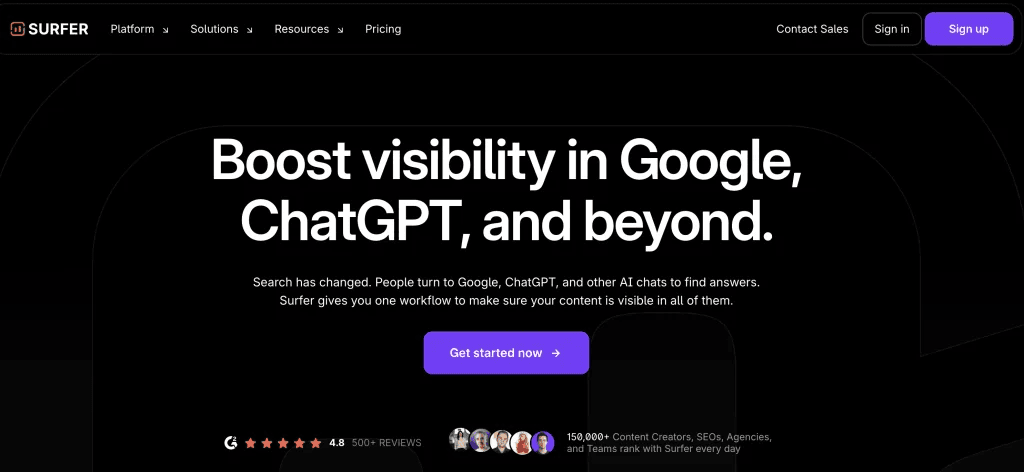
Surfer is the most widely-used content optimization platform on the market. Over 150,000 professionals use it across 159 countries, and it's earned that position by doing one thing exceptionally well: real-time content scoring against what's already ranking.
The Content Editor analyzes 500+ on-page signals from top-ranking pages and turns them into a live score as you write. You can see exactly which terms you're missing, how long your article should be, how many headings to include, and which questions from Google's "People Also Ask" box you should answer.
The score updates as you type. When terms turn green, you've hit the right density. It sounds gamified because it is, and it works.
The Facts & Coverage Booster is the feature that's gotten the most attention in 2026. It detects factual and entity gaps in your draft and lets you inject credible, SERP-sourced statements with one click. For AI visibility specifically, entity coverage is one of the clearest signals that an LLM can extract and cite your content.
The Topical Map answers the editorial calendar question: not "how do I write this article," but "what should I write next." It maps content clusters based on your domain's existing authority, so you're building interconnected topic coverage rather than random one-off pieces.
What users say: Surfer gets consistently strong reviews for SERP analysis and its audit tool (for refreshing old content). The criticism is pricing and the credit system, where unused credits expire monthly unless you're on an annual plan. Some users also note it's less useful for keywords with mixed or unclear search intent, where the SERP itself is too varied to produce clean signals.
Pricing: Essential plan starts at $99/month (or $79/month billed annually) for 30 content editor credits. Scale plan is $219/month for 100 credits. An AI Tracker add-on for monitoring AI search visibility costs an additional $95/month.
Best for: SEO agencies, in-house content teams publishing 10+ articles per month, anyone with an existing content library to audit and refresh.
Not ideal for: Beginners, teams on tight budgets, or keywords with genuinely ambiguous search intent.
2. Clearscope: Best for content quality and team simplicity
Clearscope does less than Surfer, and for many teams that's the point.
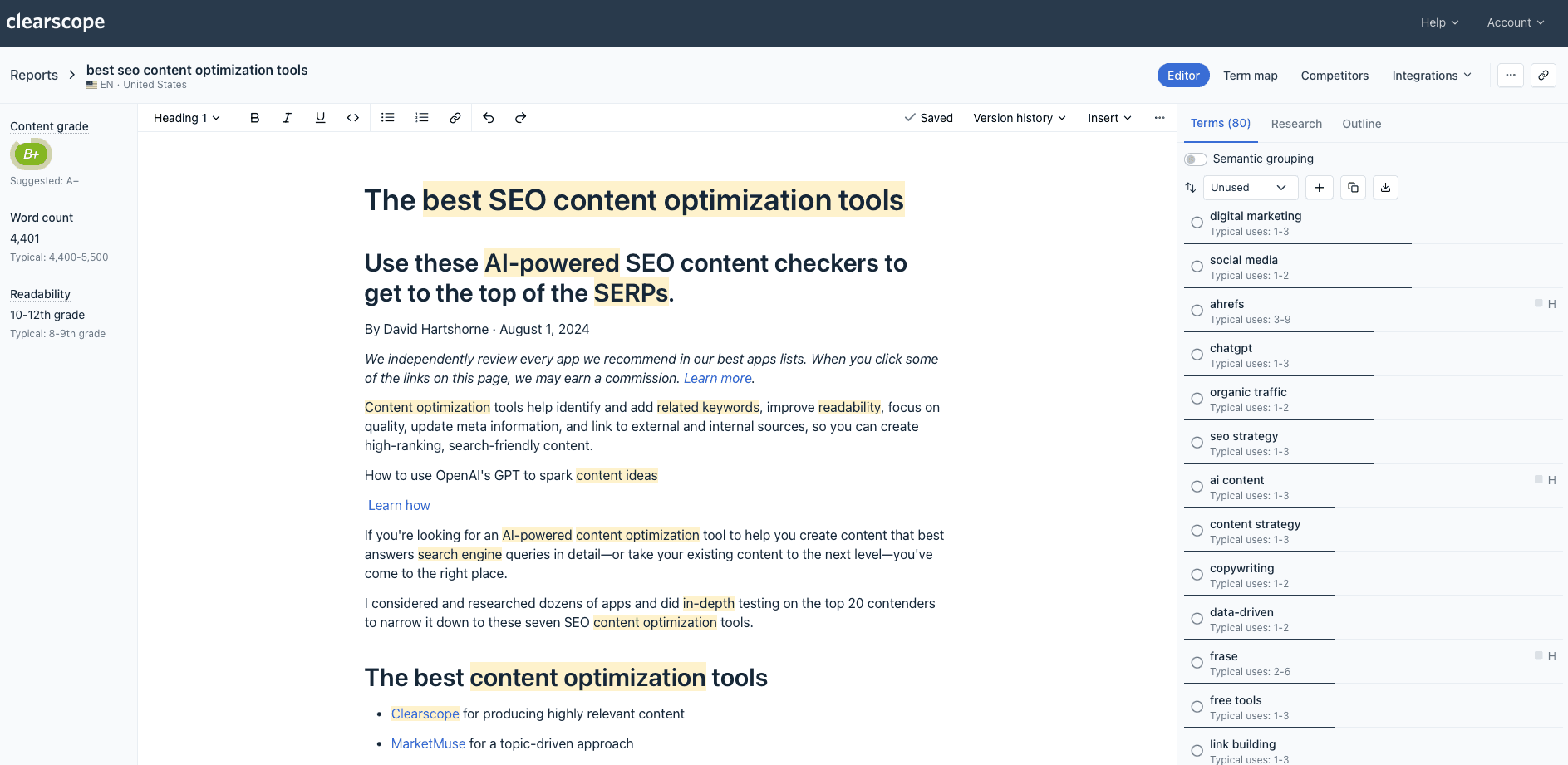
Its focus is a single workflow: enter a keyword, get a list of recommended terms and questions, and write in the live editor that grades your content from A++ to F. No complex dashboards. No feature sprawl.
The grade turns green as your content improves, and even writers with zero SEO knowledge can use it independently within a couple of hours.
The NLP engine, powered by IBM Watson, is considered best-in-class for term accuracy. Users consistently praise the quality of its keyword recommendations, specific, relevant, not cluttered with noise.
Where tools like Surfer can suggest terms that feel like keyword stuffing if followed too closely, Clearscope's recommendations tend to improve readability alongside SEO coverage.
The Google Docs add-on is where Clearscope earns its loyalty from editorial teams. Writers stay in their native environment and get real-time Clearscope feedback in the sidebar. No context-switching, no copy-pasting between tabs.
In 2026, Clearscope added AI Tracked Topics, which shows you how your brand is appearing in AI chatbot responses for your target keywords. It's not as deep as dedicated AI visibility tools, but it's a meaningful addition for content teams who want a single platform.
What users say: The praise is near-universal for ease of use and recommendation quality. The complaints are also consistent: it's expensive for what it does, and it lacks content brief generation, AI writing features, and a built-in research workflow. You need other tools upstream.
Pricing: Essentials plan starts at approximately $170–199/month (Clearscope doesn't publish pricing publicly; estimates from multiple sources place it here). Unlimited users per plan; the per-report model means cost scales with output volume, not team size.
Best for: Mid-market and enterprise teams with dedicated writers who need a simple, reliable optimization tool. Agencies where freelancers need to follow consistent quality standards without a steep learning curve.
Not ideal for: Solo creators or small teams on a budget. Teams that also need brief generation and content strategy on the same platform.
3. Frase: Best for research-to-draft workflow on a budget
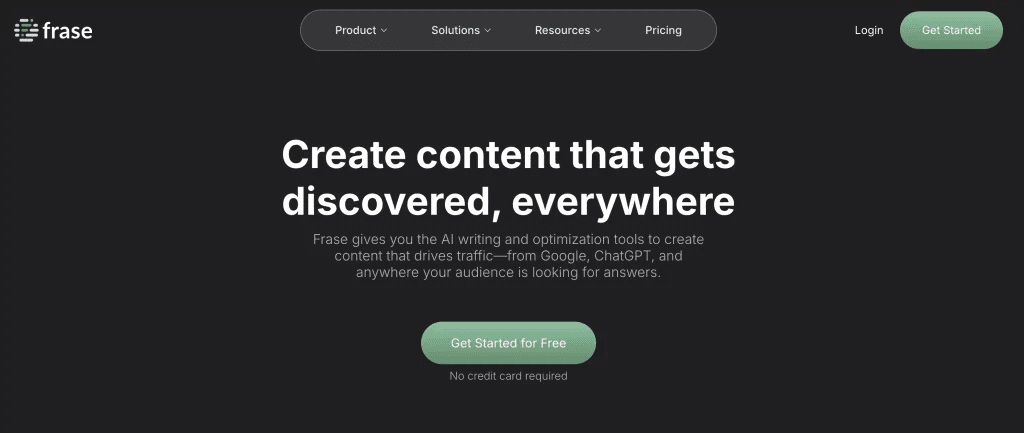
Frase does more than most tools at its price point, which starts at $49/month. It combines SERP research, automated brief generation, content optimization, and AI writing in one platform, covering the full journey from keyword to publishable draft without switching tools.
The brief generation is where Frase genuinely earns its reputation. Enter a keyword and Frase pulls the top-ranking pages, extracts their headings, main topics, key statistics, and "People Also Ask" questions, and builds a structured brief in minutes. For content teams that spend hours on manual research before writing, this is where the time savings are real.
The Content Optimizer scores your article against competitors as you write, surfacing terms and topics you're missing. It's not as sophisticated as Surfer's SERP analysis, and Surfer's own correlation data shows Frase's content score has a lower correlation with rankings (0.10) compared to Surfer's (0.28). That gap has narrowed in 2026 but hasn't closed.
Frase's AI writing tools (outline generator, paragraph rewriter, introduction generator) are practical without being transformative. They're useful for getting past a blank page, not for replacing thoughtful writing.
In 2026, Frase added dedicated AI visibility tracking: it monitors your content across ChatGPT, Perplexity, Claude, Gemini, and Google AI Overviews by plan tier, and builds a Content-to-Citation workflow that identifies where AI isn't citing you and generates a brief to fix the gap. This is the most integrated AI search feature at this price point in the market.
What users say: Teams that use Frase for research and brief generation are very positive. The criticism is that keyword recommendations lack the precision of Surfer or Clearscope, and AI-generated content often needs substantial editing.
Pricing: $49/month (Basic), $129/month (Team), $299/month (Enterprise) with a 7-day free trial and transparent pricing. Annual plans reduce the monthly cost.
Best for: Small businesses, solo creators, startups that need a complete research-to-optimization workflow without a large budget. Teams that want GEO and AI visibility built into a content platform.
Not ideal for: Teams that need enterprise-grade content scoring precision or deep topical authority analysis.
4. MarketMuse: Best for topical authority strategy at scale
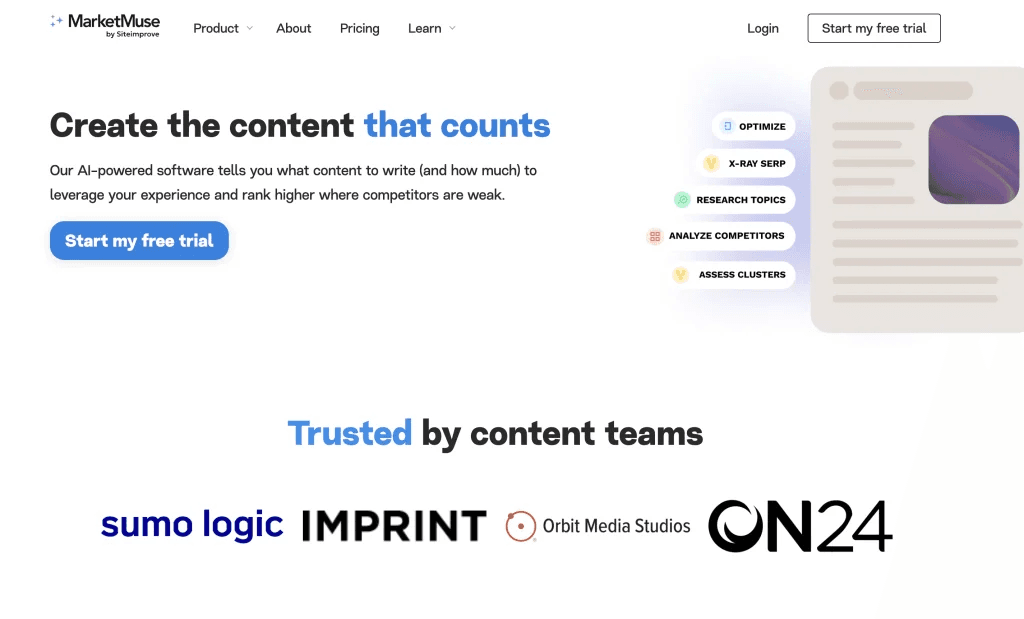
MarketMuse doesn't optimize individual articles. It optimizes your entire content strategy.
The platform crawls your domain, maps every existing page to topics, identifies gaps where competitors have depth you don't, and tells you, based on your site's actual authority, what to write next and how comprehensively to cover it.
Its Personalized Difficulty score is unique: instead of showing how hard a keyword is generically, it shows how hard that keyword is specifically for your site, given your existing topical coverage.
This is a strategic-level value. For a content leader managing a large library, hundreds or thousands of articles, MarketMuse answers the question "what should we prioritize?" with data rather than guesswork. Deciding between refreshing three existing articles versus writing two new ones becomes a data-backed decision.
One notable development: Siteimprove acquired MarketMuse in October 2024. MarketMuse retains its branding and pricing and continues operating independently, but the long-term product direction under Siteimprove, whose core focus is web accessibility and compliance, is worth watching for teams making a multi-year platform commitment.
What users say: Praised for strategic depth and topic modeling. Criticized for complexity, the interface is data-heavy and requires investment to learn, and for lacking built-in AI writing, which means you need separate tools for the actual writing workflow.
Pricing: Free plan with 10 queries/month. Standard plan at $149/month. Team and Premium plans at custom pricing. The free tier is enough to test the concept before committing.
Best for: Enterprise content teams and SEO strategists planning large-scale content programs, building topical authority, and needing to make prioritization decisions across a large existing library.
Not ideal for: Small teams or individual creators. Anyone who needs AI writing built into the same platform. Teams that want transparent, fixed pricing.
5. Semrush Writing Assistant: Best for teams already in the Semrush ecosystem
Semrush's Writing Assistant doesn't make much sense as a standalone purchase. At $249.95/month for the full feature set, it costs more than most dedicated content optimization platforms.
But for teams already using Semrush for keyword research, rank tracking, and competitive analysis, it's a compelling add-on that removes the need for a second tool.
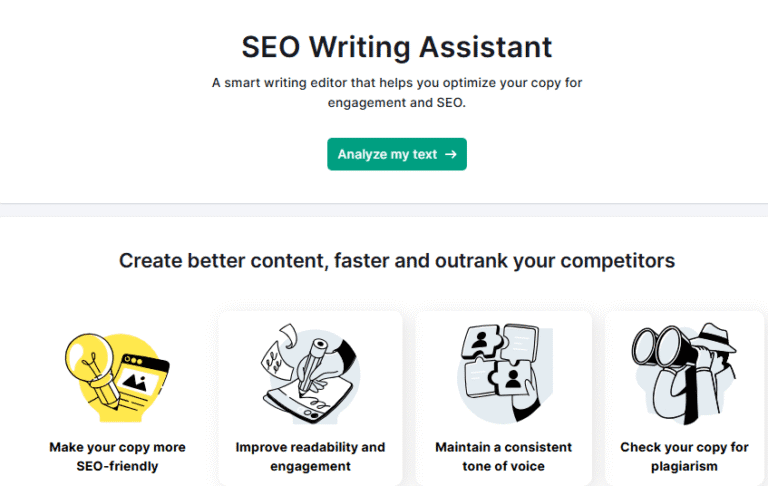
The Writing Assistant provides real-time feedback on four dimensions as you write: SEO (keyword usage and coverage), readability, tone of voice, and originality. It lives in Google Docs and WordPress natively, so there's no workflow disruption.
And because it draws on Semrush's keyword database (one of the largest in the industry) its term suggestions are grounded in deep competitive data.
The content calendar, SEO writing recommendations, and content audit features are tightly integrated. A team working on a keyword research project in Semrush can push directly to a Writing Assistant task without switching contexts. For consolidated tech stacks, that integration has real value.
What users say: Reviews are mixed outside of existing Semrush users. Positive: easy to use, solid keyword recommendations for Semrush users, strong integrations. Negative: inconsistent ranking outcomes reported on Reddit, lacks content brief generation, and weak non-English support compared to competitors.
Pricing: The SEO Writing Assistant is included in Semrush's Guru plan ($249.95/month) and above. It's not available as a standalone purchase. The full Semrush suite starts at $139.95/month for Pro.
Best for: Marketing teams already on Semrush who want content optimization without adding a separate tool to their stack. Teams working heavily in Google Docs who want native integration.
Not ideal for: Anyone not already using Semrush. Teams that need best-in-class content scoring rather than adequate content scoring alongside broader SEO data.
6. Scalenut: Best all-in-one platform for content teams scaling output
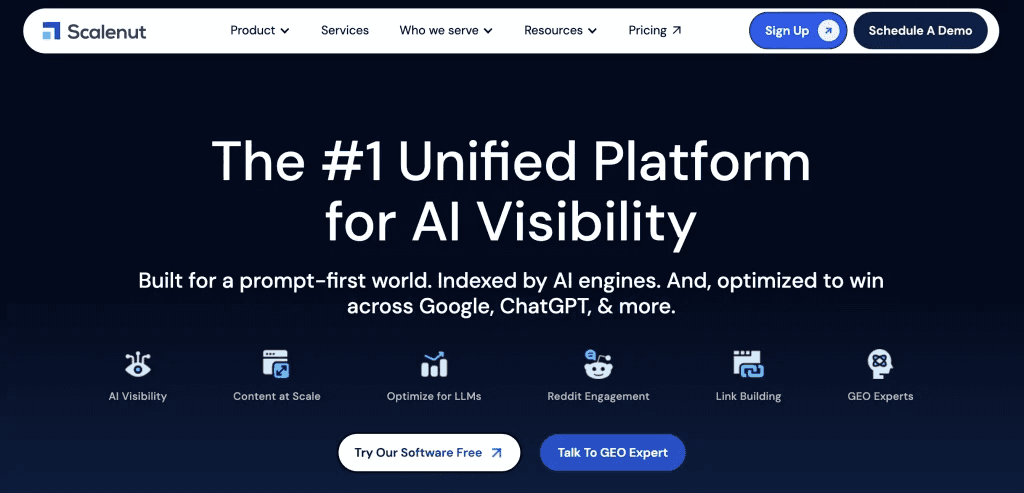
Scalenut targets teams that want to manage the entire content lifecycle, from keyword clustering to draft creation to optimization to performance monitoring, in a single platform, at a price point below the enterprise tools.
Cruise Mode is the feature that makes Scalenut worth considering. Enter a keyword, select your audience and tone, and Scalenut builds a full content outline with keyword recommendations and then generates a long-form article draft. It walks you through each step.
For teams that need to scale content velocity (8+ articles per week) without hiring a larger writing team, Cruise Mode is a genuine workflow accelerator.
The Content Optimizer and SERP analysis use NLP recommendations that are solid without being exceptional. The keyword clustering feature, which groups related keywords into topic clusters, is useful for planning hub-and-spoke content strategies. The auto-fix capabilities in the Content Optimizer can resolve gaps in older content with minimal manual effort.
Scalenut integrates with Semrush and Ahrefs for keyword data, and has a Chrome extension for on-the-go research.
What users say: Well-reviewed for content automation and ease of use. The criticism: AI-generated content can be repetitive and requires editing, and the tool can feel overwhelming for new users given its breadth of features.
Pricing: Essentials at $39/month, Growth at $79/month, Pro at $149/month. Aggressive discounts on annual plans and occasional promotional pricing.
Best for: Marketing teams and agencies that want an end-to-end content platform without paying enterprise prices. Teams focused on increasing output velocity without sacrificing topical coherence.
Not ideal for: Users who want best-in-class optimization scoring over all-in-one convenience. Teams that need the depth of dedicated tools like Clearscope for the optimization step.
7. NeuronWriter: Best budget option for serious SEO writers
NeuronWriter is the best-value dedicated content optimization tool in the market right now. The monthly plans start at $19 (Bronze tier), and the AppSumo lifetime deal ($109 for access equivalent to Surfer's $79/month plan) is the open secret among SEO writers who've been paying attention.
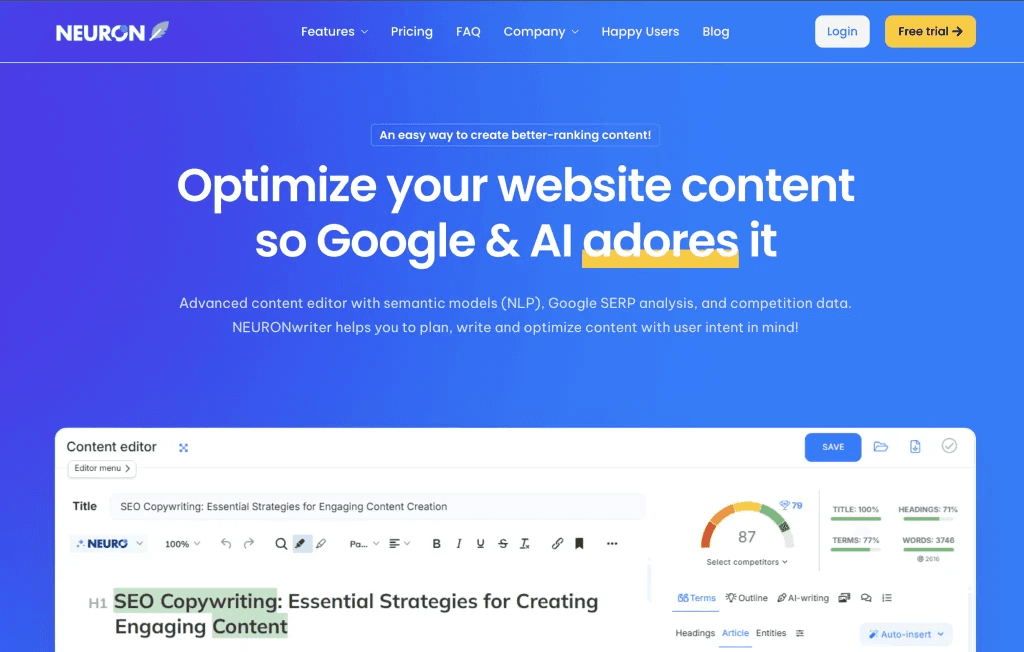
The core is a content editor powered by NLP analysis. Enter a keyword, and NeuronWriter analyzes the top-ranking pages to generate a content score with specific term suggestions, heading recommendations, and metadata guidance. The SERP analysis is detailed. The semantic suggestions are well-calibrated, focused on relevance, not keyword stuffing.
The internal linking recommendations are a standout feature not found at this price point elsewhere. NeuronWriter suggests internal links based on your existing content, helping build the structural interconnections that matter for both Google rankings and topical authority in AI search.
It integrates directly with Google Search Console, which means optimization recommendations are based on your site's actual performance data, not just SERP averages. The WordPress integration is clean.
What users say: Users who've switched from Surfer report similar optimization outcomes at a fraction of the price. Ratings are high across platforms (4.9/5 on Capterra and AppSumo). The main complaints are a steeper learning curve than Clearscope, interface polish that trails premium competitors, and AI-generated content that still needs heavy editing before publishing.
Pricing: Bronze at $19/month, Silver at $37/month, Gold at $57/month, Platinum at $77/month. Lifetime deal on AppSumo at $109 (availability varies).
Best for: Solo content creators, small businesses, freelancers, and agencies who want robust semantic optimization without paying Surfer or Clearscope prices.
Not ideal for: Large teams that need centralized collaboration features. Users who prioritize interface polish and onboarding simplicity.
8. Dashword: Dashword for lean teams
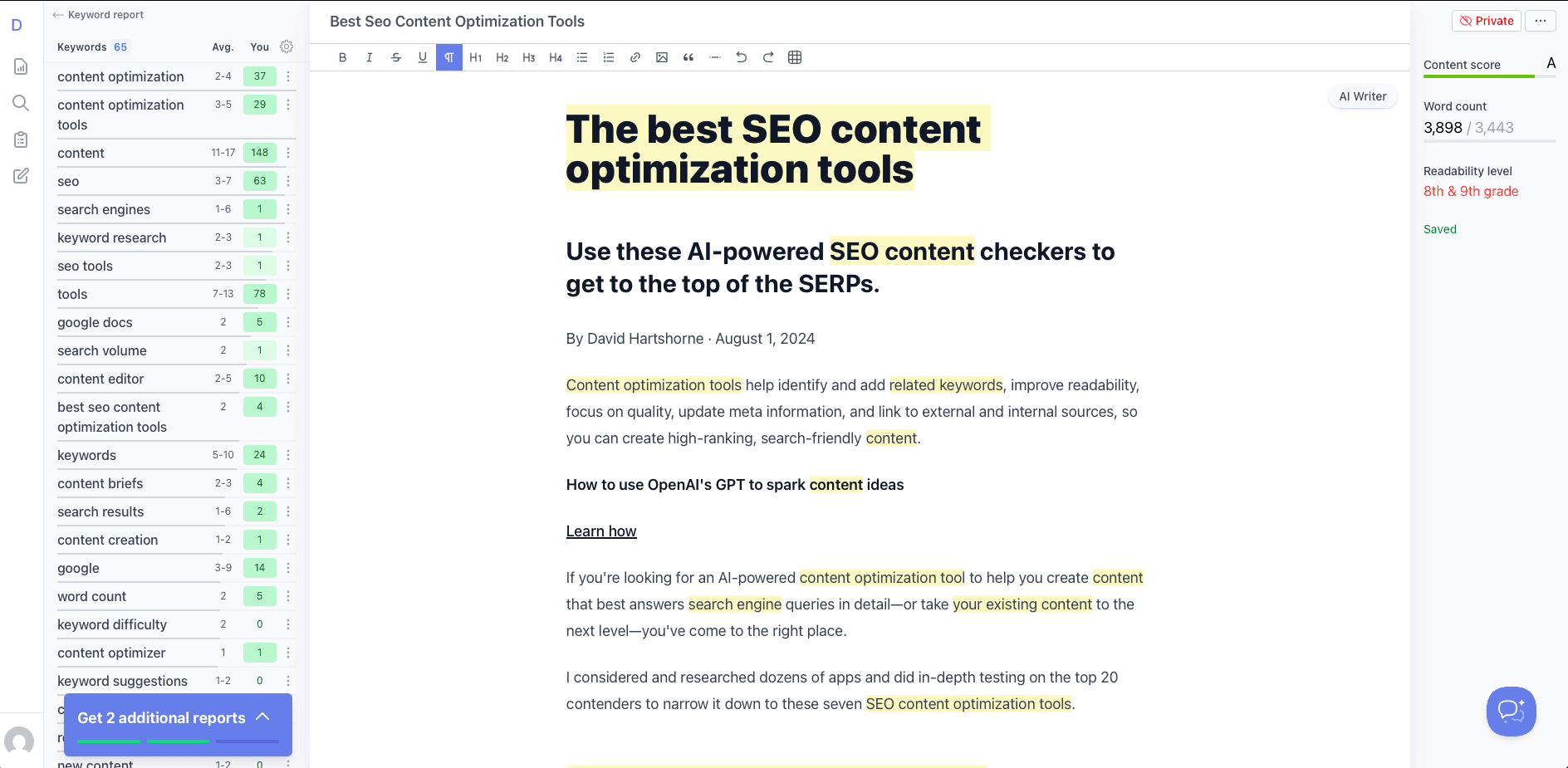
Dashword deserves a mention for teams that want a single, focused tool without the complexity of Surfer, Clearscope, or Frase. It does two things: generates content briefs and provides a real-time optimization editor with content scoring. That's it.
The "first report free" model lets you test the full functionality before committing. The brief output is clean and usable. Pricing is predictable and straightforward, which matters for small teams that have been burned by tools where the cost grows with usage in unpredictable ways.
It's not the deepest tool on this list. It lacks AI writing, topical authority analysis, and advanced SERP analysis. But if your bottleneck is specifically the brief-generation and optimization steps, and you want a simple, low-friction interface, Dashword is worth testing before paying Clearscope or Surfer prices.
Pricing: Free first report. Paid plans start at approximately $99/month.
Best for: Small editorial teams and individual writers who need reliable briefs and content scoring without a learning curve.
How to Pick the Right Platform
The table below maps the key decision factors to the best fit:
Your situation | Best pick |
Scaling output and refreshing existing content | Surfer SEO |
Teams prioritizing quality, simplicity, large writer pools | Clearscope |
Budget-constrained, need full research-to-draft workflow | Frase |
Building topical authority across a large content library | MarketMuse |
Already using Semrush, want consolidated stack | Semrush Writing Assistant |
End-to-end platform under $80/month | Scalenut |
Best optimization quality per dollar spent | NeuronWriter |
Simple briefs and scoring, no complexity | Dashword |
One combination worth noting: many experienced content teams use two tools rather than one. Frase for research and brief generation. Surfer or Clearscope for final optimization before publishing. The upstream and downstream workflows are different enough that specialization in each pays off at scale.
The AI Visibility Dimension
A practical note before you choose: the optimization problem has two layers in 2026.
Google rankings and AI citations are related. Brands with 8+ structured attributes get cited in AI search responses 4.3x more than brands with fewer than 3 attributes. (Erlin data, 500+ brands, 2026)
Comprehensive content, clean structure, and fact density help both. In that sense, doing content optimization well for Google indirectly improves AI search presence.
But they're not identical. 68% of AI citations come from third-party sources (Reddit, review platforms, Wikipedia) not from your owned content. (Erlin data, 2026) Traditional content optimization platforms don't address that part of the equation at all.
If AI search visibility is a strategic priority, Frase's Content-to-Citation workflow and Clearscope's AI Tracked Topics are worth evaluating alongside your optimization pick.
If you want a dedicated AI visibility tool rather than an add-on feature, platforms like Erlin track brand presence across ChatGPT, Perplexity, Gemini, and Claude directly.
Frequently Asked Questions
What is a content optimization platform?
A content optimization platform analyzes top-ranking pages for your target keyword and provides data-driven recommendations (keyword terms to cover, topics to address, content length, heading structure) to help your content rank in search engines. Most modern platforms use NLP to score your content in real time as you write, comparing it against competitors and flagging gaps.
What's the difference between a content optimization tool and an AI writing tool?
Content optimization tools tell you what to write and how comprehensively to cover a topic. AI writing tools generate draft text. Many platforms in 2026 combine both features, but the optimization function is distinct: it's about SERP analysis and competitive benchmarking, not text generation. Tools like Surfer, Clearscope, and NeuronWriter are primarily optimization platforms that have added AI writing. Tools like Jasper started as AI writing platforms that have added optimization features.
Are these tools worth it if I'm a solo creator?
It depends on your publishing frequency. If you publish fewer than 5 articles per month, the ROI from a $99/month tool like Surfer is harder to justify. Frase at $49/month or NeuronWriter at $19/month are better starting points. The case strengthens significantly if you're targeting competitive keywords where unoptimized content has no realistic path to the first page.
Do content optimization platforms work for AI search as well as Google?
Increasingly, yes, but with important caveats. Comprehensive topic coverage, structured data, and fact density help AI systems like ChatGPT and Perplexity recognize and cite your content. However, AI citation also depends heavily on third-party signals (reviews, Reddit discussions, Wikipedia) that content optimization platforms don't influence. Treat them as complementary concerns, not the same problem.
Which platform is best for an agency managing multiple clients?
Surfer's Scale plan and Clearscope's unlimited-users model are both strong choices for agencies. Surfer offers white-labeling on Enterprise. Scalenut and NeuronWriter offer good per-project organization at lower price points for agencies that prioritize cost efficiency over feature depth. The decision ultimately comes down to whether you prioritize reporting capabilities and collaboration features (Clearscope, Surfer) or output velocity (Scalenut) or cost per client (NeuronWriter).
Get Your Free AI Visibility Score (See how your brand appears in ChatGPT, Perplexity, Gemini, and Claude in under 60 seconds)
Share
Related Posts
Generative Engine Optimization Trends for 2026
7 GEO trends reshaping AI search visibility in 2026, with data on citations, structured data, and what actually drives brand coverage.
15 Generative Engine Optimization Best Practices Backed by Latest Research
Generative engine optimization best practices backed by 2026 research. 15 tactics to get your brand cited by ChatGPT, Perplexity, and Google AI Overviews.
AI for Content Planning & Strategy: A Complete Guide
AI for content planning in 2026 means planning for AI search visibility, not just faster drafts. Five-layer workflow, what to automate, what stays human.