Content automation is using AI and software to run the repetitive parts of the content lifecycle: research and briefs, first drafts, repurposing, SEO checks, approval routing, scheduling and performance reporting. Unlike marketing automation, which governs the customer journey, it governs how content gets made and delivered. Humans still own strategy, brand voice, original perspective, fact-checking and final approval.
Content teams are producing more than ever. Blog posts, social updates, email sequences, product pages, video scripts, landing copy, the list compounds every quarter.
And yet headcount stays flat. The math doesn't work without automation.
Content automation is how teams close that gap. Not by removing writers from the process, but by removing the work that slows them down. This guide covers what content automation actually is in 2026, which tasks it handles well, and where human judgment stays irreplaceable.
What is content automation?
Content automation is the use of AI and software to handle repetitive tasks across the content lifecycle, from planning and creation to distribution and performance tracking. It connects workflows so that drafts move from research to review to publish without manual handoffs at every stage.
The term covers a spectrum. At one end: scheduling tools that post pre-written content at set times. At the other end: intelligent pipelines that generate first drafts, flag SEO gaps, resize assets for each platform, and route content to the right reviewer automatically.
Most marketing teams in 2026 operate somewhere in the middle, using automation for the predictable, rules-based work while keeping humans in control of strategy, voice, and final approval.
Content automation vs. marketing automation: what's the difference?
These terms are often used interchangeably. They shouldn't be.
Marketing automation governs the customer journey: lead nurturing sequences, email workflows, behavioral triggers, and CRM updates. It answers the question: what message does this person receive, when?
Content automation governs the production side: editorial calendars, draft generation, asset management, and multi-channel distribution. It answers the question: how does this piece of content get made and delivered?
The two systems need different tools and different integrations. Marketing automation platforms connect deeply with CRM and lead scoring data. Content automation platforms connect with content management systems, design tools, and publishing pipelines.
Both are essential. Neither replaces the other.
Which tasks content automation handles well
Not every content task benefits from automation. The ones that do share a common trait: they follow predictable patterns and don't require creative judgment in the moment.
Research and brief generation: Keyword data, competitor content analysis, and SEO scoring can all be pulled and organized automatically. Algorithms suggest optimal publication dates based on historical engagement data. Brief templates auto-populate with SEO requirements before a writer opens a new document.
First-draft generation: AI tools generate outlines, meta descriptions, social copy variations, and long-form draft content from a brief. Companies that have adopted AI content workflows report producing three to five times more content per writer, with average production time cut by 60%. (Codmaker, 2026)
Repurposing: A single long-form article becomes social posts, an email newsletter section, a short video script, and an FAQ set, automatically. Scaling content output is one of the top three cited benefits of AI adoption, according to 55% of marketers surveyed. (Digital Osmos, 2026)
Distribution and scheduling: When a blog post status changes to "Published," automation can trigger social distribution across LinkedIn, X, and other channels instantly. No manual scheduling per platform.
SEO optimization: Real-time scoring tools flag keyword gaps, weak meta descriptions, and readability issues as content is drafted. AI checks sentence flow, heading structure, and schema requirements before publishing.
Approval routing: Once a draft is ready, automation notifies the right reviewer, shares the content for comment, and either routes it back for edits or queues it for publication, without anyone chasing the workflow over email.
Performance tracking: Analytics tools pull engagement data, tag content by funnel stage and topic cluster, and surface which pieces are driving traffic or conversions. This removes the manual reporting work that typically consumes half a day per week.
What content automation cannot do
Automation handles the repeatable. It doesn't handle the irreplaceable.
Brand voice: AI tools can be trained to approximate a writing style, but they don't know why your brand sounds the way it does. They can't apply judgment about whether a specific sentence reads like you or like every other company in your category. That call belongs to a human editor.
Original perspective: AI generates statistically average text. It synthesizes patterns from existing content. It cannot produce the proprietary insight, the customer interview, the founder's point of view, or the original data finding that makes content genuinely worth reading. Google's systems specifically reward content that provides an original perspective beyond schematic AI-generated answers. (Digital Osmos, 2026)
Strategic decisions: Which topics matter most this quarter? Which content is worth the investment? Which angle is going to resonate with this specific audience right now? These questions require context that automation doesn't have.
Fact accuracy: AI tools hallucinate. Every AI-generated statistic, claim, or quote needs verification before it goes live. Knowledge workers now spend an average of 4.3 hours per week verifying AI outputs. (Digital Osmos, 2026) That review step is not optional.
The teams winning at content in 2026 have a clear division: AI handles research, aggregation, first drafts, and repurposing. Humans provide strategy, a unique perspective, and editorial judgment. The output reads as if it came from an expert with powerful research assistants, because that's exactly what it is.
Why content automation matters more in 2026
The content production challenge has always existed. What's changed is where content needs to perform.
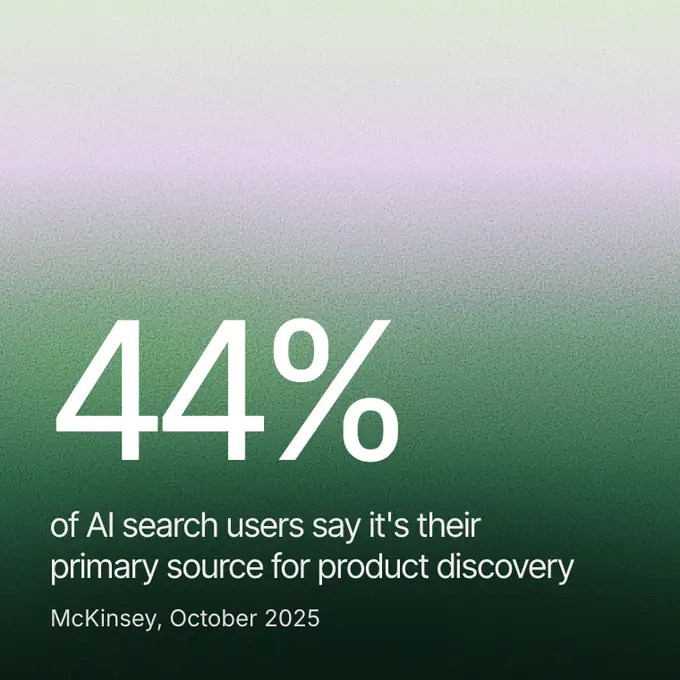
Fifty percent of Google searches now have AI summaries, and 44% of AI search users say it's their primary source for product discovery, ahead of traditional search at 31%. (McKinsey, October 2025) Getting found no longer means ranking in position one on a SERP. It means being cited inside an AI-generated answer.
That shift raises the content bar in two directions simultaneously. AI search engines favor content that is structured for extraction: clear headings, declarative statements, FAQ sections, and schema markup.
And they favor frequency; brands updating content monthly see approximately 23% higher AI coverage than those with stale content. (Erlin data, 500+ brands, 2026)
Manual content production cannot meet both requirements. The teams producing more content, more consistently, with stronger technical structure, are the ones getting cited. Automation is how you build that machine.
Only 16% of brands systematically track their AI search performance today. (Erlin data, 2026) The gap between those who do and those who don't is already 9x, and widening 3.2% every month. (Erlin data, 2026)
The brands closing that gap fastest are the ones that have automated the routine and freed their teams to focus on the substance.
How to build a content automation workflow
A content automation system is only as good as the process it runs on. Automating a broken workflow makes it break faster.
Start with a process audit: Before touching any tool, map out how content currently gets made, from brief to publish. Identify where time is lost: repetitive research tasks, unclear handoffs, manual approval chains, and inconsistent SEO checks. These are your automation candidates.
Pick one workflow to automate first: Blog production is the most common starting point: high volume, predictable structure, clear performance metrics. Automate that end-to-end before expanding to social, email, or paid copy.
Define what automation handles and what humans own: This needs to be explicit, not assumed. A typical split: automation handles keyword research, brief population, first draft, SEO scoring, meta description, social variants, and scheduling. Humans own the angle, the unique insight, the editorial pass, and the final approval.
Build brand guardrails into the system: Feed your brand voice guidelines, forbidden phrases, and tone parameters into the AI tools you use. The more specific the input, the less correction the output requires.
Measure efficiency and quality separately: Track production volume, time per piece, and publishing frequency on one side. Track engagement rate, citation rate, and conversion performance on the other. Automation that speeds up production but reduces content quality is not a win.
Expand from there: Agentic AI systems can reclaim up to 40% of practitioners' time by offloading manual tasks in complex, multi-step workflows. (Monday.com, 2026) But that number assumes the system is built on a solid foundation. Teams that automate before establishing clean workflows spend more time fixing automation errors than they save.
Content automation and AI search visibility
Content automation and AI search visibility are not separate strategies. They are the same system viewed from different angles.
Brands that automate content production tend to publish more frequently, maintain cleaner heading structures, and include schema markup consistently, all factors that directly influence how often AI engines cite them. Structured content with comparison tables earns 25.7% more ChatGPT citations.
Shortlist pages averaging fewer than 10 words per sentence earn 18.8% more citations. (AirOps, April 2026)
The connection between automation and AI visibility works in the other direction too. Once a brand tracks what AI says about them, they can identify which content gaps are costing them citations, build a brief for the missing piece, and push it through an automated production workflow, closing the loop between measurement and action.
This is what separates brands that treat automation as a cost-cutting tool from those that treat it as a growth lever. The former automates to do the same work more cheaply. The latter automates to do more of the right work faster.
Erlin's data from 500+ brands shows that brands with 8+ structured attributes get cited 4.3x more than brands with fewer than 3. (Erlin data, 2026) Building that structured attribute library (across owned content, review platforms, Reddit, and third-party sources) requires consistent production volume. That volume requires automation.
The human-in-the-loop requirement
Automation does not run itself well.
AI-generated content pipelines that produce undifferentiated, generic output hurt performance in 2026. AI search engines are trained to favor authentic, expert content.
Nearly two-thirds of marketers say they need more distinctive, human-centered content to stand out in an increasingly automated landscape. (Security Boulevard, 2026)
The teams running the most effective automated workflows have a non-negotiable human layer. Strategy decisions made by humans. Brand voice is applied and checked by humans. Facts verified by humans. Final approval given by humans.
This is not a caveat about AI limitations. It is how high-performing content operations are designed. The automation handles what it does well: speed, consistency, repetition. The humans handle what they do well: judgment, originality, accountability.
Get that division right, and automation becomes a multiplier. Get it wrong, and you produce more of the same generic content that AI engines learn to skip.