Brand monitoring in 2026 covers two layers: the inputs people publish about you on social media, review sites, forums and news, and the outputs AI platforms like ChatGPT, Perplexity, Gemini and Claude generate about your category. A complete program tests 20 to 30 priority prompts across platforms, tracks share of voice, accuracy and sentiment, and has a protocol for correcting AI errors.
ChatGPT, Perplexity, Gemini, and Claude give confident, synthesized recommendations, sourced from your competitors, your reviews, your Reddit mentions, and sometimes information that was simply made up.
If you don't know what those answers say, you're not doing brand monitoring anymore. You're doing half of it.
This article covers what brand monitoring means in 2026, how it differs from traditional social listening, what the data shows about AI's impact on brand reputation, and what a complete monitoring program actually looks like.
What is brand monitoring in 2026?
Brand monitoring is the practice of tracking how your brand is discussed, recommended, and represented across the channels your buyers use to make decisions. In 2026, those channels include AI search engines.
For most of the last decade, brand monitoring meant social listening, review tracking, and media coverage alerts. Those signals still matter. But they now capture only part of the picture. The other part lives inside the synthesized responses that AI platforms generate when someone asks, "What's the best [product category] for [use case]?"
That's the conversation traditional monitoring tools can't see.
AI brand monitoring tracks the outputs of large language models. What ChatGPT says when someone asks which vendors to evaluate, how Perplexity describes your product positioning, and whether Gemini includes you in a category comparison. It answers four questions traditional monitoring doesn't:
- Is your brand mentioned in relevant AI-generated answers at all?
- How is your brand described, and is the description accurate?
- What sources is the AI drawing on to form its view of you?
- Where are competitors gaining ground in AI responses?
The distinction matters because the audience is different. Traditional monitoring shows you what a finite number of people chose to write about your brand. AI monitoring reveals what millions of users receive as guidance when they ask for decision support. One is reactive. The other is diagnostic.
How AI has changed the brand discovery cycle
Buyers used to discover brands through search, word of mouth, and media coverage. They'd Google a category, scan the top ten results, and visit a few sites. You could measure and influence every step of that journey.
The research cycle has changed. A growing share of buyers now start with a prompt, not a search query. They ask AI a question, get a curated answer with named recommendations and context, and shortlist from there. By the time they visit your website, the consideration set has already been formed by something you didn't write and can't directly control.
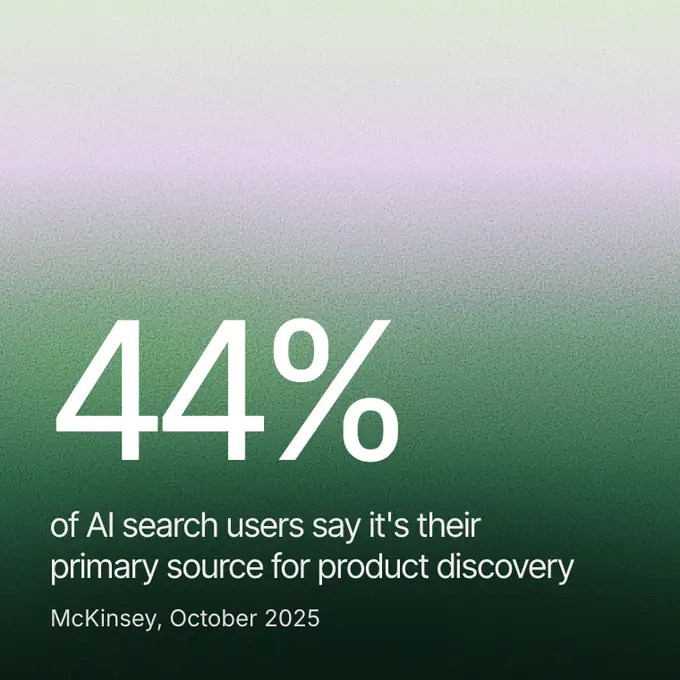
The scale of this shift is significant. ChatGPT had over 400 million weekly active users as of February 2025. (Reuters) Google AI Overviews appear in nearly half of all monthly searches. (Botify/DemandSphere study) According to McKinsey, 44% of AI search users now say it's their primary source for product discovery, exceeding traditional search at 31%.
A Gartner projection puts a concrete number on the reputational stakes: by 2026, 30% of brand perception will be shaped by generative AI content rather than traditional media. (Gartner) That's not a future trend. It's the environment brands are operating in right now.
The implication for brand monitoring is straightforward. If 30% of how buyers perceive your brand is being shaped by AI-generated content, a monitoring program that doesn't include AI outputs has a 30% blind spot. At minimum.
The two layers of brand monitoring you now need
AI brand monitoring and traditional monitoring are not substitutes for each other. They answer different questions. A complete program covers both.
Layer 1: Inputs (traditional monitoring)
Traditional brand monitoring tracks public human conversations: social media mentions, news coverage, review platforms, forums, and community discussions. These are the inputs that shape what AI learns about your brand over time. Reddit discussions, G2 reviews, Wikipedia edits, and news articles all feed the training data and citation sources that LLMs draw from.
If your Reddit sentiment is deteriorating, that becomes an AI problem in two to three months, once the negative discussion starts surfacing as cautionary language in AI responses. Erlin's own data puts this lag at 2-3 months for negative sentiment to move from community discussion to AI outputs. (Erlin data, 500+ brands, 2026) Monitoring and managing the inputs is still critical; it's the upstream work that protects your AI reputation downstream.
Layer 2: Outputs (AI brand monitoring)
AI monitoring tracks what the models are actually generating when users ask about your category. This is what your buyers see. It's the synthesized answer that either includes you, excludes you, or describes you in a way that may or may not be accurate.
This layer requires a different methodology. You can't passively wait for mentions to surface. You have to actively test: run the prompts your buyers would run, across the platforms they use, and track the responses over time. The same prompt can return different results depending on when it's asked, which platform version is running, and how the question is phrased.
Most brands currently do Layer 1 and none of Layer 2. According to Erlin's benchmark data, only 16% of brands systematically track their AI search performance. (Erlin data, 2026) The other 84% are flying with one eye closed.
What AI gets wrong about brands (and why it costs you)
AI hallucinations are not an edge case. They are a predictable feature of how large language models work.
LLMs don't retrieve facts. They predict statistically probable text based on patterns in their training data. When their training data is thin on a particular brand (newer companies, niche products, recently launched features) the model fills the gap with something that reads plausibly rather than admitting uncertainty.
MIT research found that AI models use 34% more confident language when generating incorrect information than when stating facts. (MIT, January 2025) The more wrong the AI is, the more certain it sounds.
For brands, this creates a specific type of risk that traditional monitoring tools were never designed to catch. A hallucination isn't a negative tweet you can respond to. It isn't a bad review; you can flag. It's a dynamically generated response, unique to each query, that disappears after the conversation ends. There's no paper trail. There's no URL to find. There's no author to contact.
Erlin's error detection data shows the cost of not monitoring: brands that don't actively track AI outputs take 67 days on average to discover errors in how AI describes them.
Monitored brands detect the same errors in 14 days. (Erlin data, 500+ brands, 2026) That's 53 extra days of buyers receiving inaccurate information about your product, pricing, capabilities, or competitive positioning.
The damage isn't limited to niche or newer brands. Newer or less-documented brands experience hallucinations in 40-60% of detailed queries. Even well-established brands with a strong online presence see hallucinations in 5-15% of queries. (ReputaForge analysis) At scale, that's a meaningful percentage of the conversations that shape shortlists in your category.
What Erlin data shows about AI brand visibility
Erlin's 180-day study of 500+ brands tracked across ChatGPT, Perplexity, Gemini, and Claude produces the clearest picture available of what actually drives AI brand visibility, and where most brands are failing.
The coverage gap is wide and growing: 50% of brands score below 35% prompt coverage across the four major AI platforms. The gap between the top 15% and the bottom 10% is 9x today, and it's widening at 3.2% every month. (Erlin data, 2026)
Four factors drive 89% of AI visibility variance: The first is fact density: brands with 9+ structured facts about their product, pricing, use cases, and integrations achieve 78% average AI coverage.
Brands with fewer than 3 facts achieve 9%. Each additional structured attribute adds approximately 8.3% median coverage. The second factor is third-party validation: 68% of AI citations come from third-party sources, not brand-owned websites. Reddit, Wikipedia, G2, and YouTube collectively account for the majority of where AI platforms source brand information.
The third factor is structured data: comparison tables, FAQ schema, and llm.txt files. FAQ schema drives a 28% coverage lift in approximately 21 days. Comparison tables produce a 34% lift in 14 days.
The fourth factor is content recency: brands updating content monthly see 23% higher AI coverage than those with stale content. Content older than 24 months averages 18% AI coverage. Content under three months old averages 48%.
These four levers explain why traditional SEO performance doesn't predict AI visibility. You can rank in the top 3 on Google and still be absent from AI responses. The signals AI platforms use are different. That's why the monitoring requirement is different.
How to build a brand monitoring program for the AI era
A program that covers both layers (inputs and outputs) doesn't require starting from scratch. It requires extending what you already track.
Step 1: Map your priority prompts
Start with the 20-30 queries your buyers are most likely to run when evaluating options in your category. These fall into three groups: category queries ("what are the best [product type] tools?"), comparison queries ("how does [your brand] compare to [competitor]?"), and problem queries ("how do I [solve the specific problem your product addresses]?").
These are the prompts that, when your brand appears in the answer, generate the highest-intent traffic: visitors who arrive pre-qualified by a recommendation and tend to convert better than traditional organic visitors.
Step 2: Test across platforms, not just one
ChatGPT, Perplexity, Gemini, and Claude do not return identical results. Your brand may appear consistently in one platform and be absent from another. Each platform has different training data freshness, different source weighting, and different citation behavior.
A complete monitoring program tests the same prompt set across all four major platforms on a daily or near-daily cadence. Weekly testing is insufficient for competitive markets; AI responses can shift between monitoring cycles.
Step 3: Track what's being said, not just whether you appear
Appearing in an AI response is not the same as being described accurately or favorably. Monitor three dimensions: your share of voice (how often you appear versus competitors for the same prompt), the accuracy of the information (pricing, features, integrations, positioning), and the sentiment framing (is your brand positioned as a top recommendation, a cautionary note, or somewhere in between?).
Errors in how AI describes you are more damaging than absence, because a buyer who receives wrong information doesn't know it's wrong.
Step 4: Connect AI monitoring to your content and source management
The most effective response to poor AI coverage is improving the signals AI platforms draw from, which means addressing the four drivers: structured facts on your owned content, third-party presence on review platforms and communities, structured data formats like FAQ schema and comparison tables, and content freshness through a regular update cycle.
This isn't a separate workstream. It's the same content and PR work you're doing already, redirected to the signals that drive AI visibility.
Step 5: Set up error response protocols
When you find a hallucination, you need a process, not just awareness. The basic protocol: document the error with a timestamp and the platforms where it appears, publish an authoritative correction on your owned channels, submit feedback to the affected platforms, and monitor for resolution.
Speed matters here. Brands that respond to AI errors within 48 hours can reduce reputation damage by 70-80% compared to delayed responses. (AmICited analysis)
What the monitoring gap is costing brands right now
Brand monitoring gaps have always had a cost. In the AI era, that cost has a harder edge.
Consider the competitive displacement math. High-traffic prompts in a given category churn at 23% month-over-month, meaning which brands that appear in the answer change regularly.
Long-tail prompts churn at 8%. The median recovery time after a brand loses a citation is 45 days. (Erlin data, 2026) If you're not monitoring, you don't know you've lost the citation until well after the window to respond has closed.
The error cost is also compounding. When AI misrepresents your pricing, your integrations, or your use cases, the downstream effects include customer support overload (buyers who receive wrong information arrive with wrong expectations), lost conversions (buyers who shortlisted you based on inaccurate capabilities eliminate you during qualification), and a competitive advantage handed to whichever brand AI is recommending instead.
32% of digital marketing leaders now name GEO as their top priority for 2026. (Conductor research) The brands treating AI visibility as a future concern are ceding ground to the ones treating it as a current one.
The bottom line
Brand monitoring has always been about knowing how buyers see you before it costs you. The channel mix has changed. The stakes have not.
AI platforms now mediate a growing share of the research buyers do before they ever reach your website. Monitoring only the channels you could see five years ago means missing the conversations that are actively shaping your category now.
Monitored brands detect AI errors in 14 days. The rest take 67.
Check your AI visibility and see exactly where your brand stands across ChatGPT, Perplexity, Claude, Google AI Mode, Gemini, and Copilot.