The AI Visibility Ladder is Erlin's five-tier model, built from tracking 500+ brands, that places your brand by AI prompt coverage: AI Invisible (0 to 15%), AI Fragile (15 to 35%), AI Present (35 to 60%), AI Preferred (60 to 80%) and AI Dominant (80%+). Climbing it means fixing entity clarity first, then fact density and structured data, then third-party validation, then content freshness.
Potential customers are asking AI who to buy from. Most brands aren't in the answer.
Not because their products aren't good. Because AI systems like ChatGPT and Perplexity make decisions based on signals that most SEO strategies were never built to optimize for.
A brand can rank on page one of Google and still not appear in a single AI recommendation for the same category. That matters because AI-referred visitors arrive pre-qualified and tend to convert better than traditional organic visitors. Brands that aren't cited don't get considered.
This guide explains what AI visibility is, how AI systems decide which brands to recommend, where most brands sit today, and what you can do to start showing up.
What is AI visibility?
AI visibility measures how often and accurately your brand appears in answers generated by AI tools such as ChatGPT, Perplexity, Gemini, and Claude.
When someone asks an AI assistant for a recommendation, the model synthesizes information from across the web and names a small set of brands in its response.
If yours isn't one of them, you don't exist in that conversation. There is no second-place spot. No page two. You're either in the answer, or you're not.
That's what makes AI visibility different from traditional SEO. Traditional search gave brands a ranked list of links. A weaker position still meant some visibility. AI search is binary per query.
Here's what that looks like in practice. Erlin surfaces key visibility metrics, platform breakdowns, and top competitors for any domain.
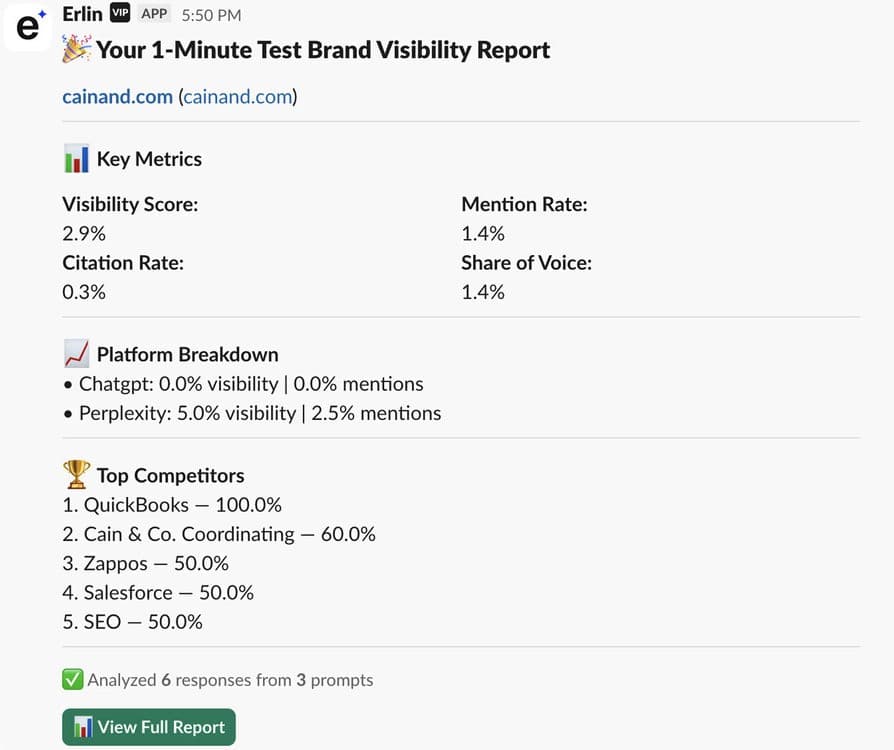
For cainand.com, the audit returned a Visibility Score of 2.9%, which puts the brand in the AI Invisible tier. The platform breakdown tells an important story: 0.0% visibility on ChatGPT, which drives 91% of all AI referral traffic, but 5.0% on Perplexity.
That asymmetry matters. Being present on Perplexity but absent from ChatGPT means you're invisible to the vast majority of AI-driven discovery.
The competitor comparison in the audit is revealing. QuickBooks sits at 100% share of voice and appears in every relevant AI answer. That 97.1 percentage-point gap between QuickBooks and cainand.com is not a brand-recognition problem. It is a machine-readability problem.
QuickBooks has years of structured data, third-party reviews, and factual content that AI systems can extract and cite. Cainand.com hasn't yet built that foundation. A Citation Rate of 0.3% means that out of the prompts Erlin analyzed, cainand.com appeared as an actual cited source in almost none of them.
The AI visibility ladder
Erlin tracked 500+ brands across ChatGPT, Perplexity, Gemini, and Claude over 180 days. That research produced a five-tier maturity model that shows where brands sit and what separates each level.
AI Invisible (0 to 15% coverage): Fewer than 3 verifiable facts, no third-party validation, content older than 18 months, and no structured data. Around 10% of tracked brands sit here.
AI Fragile (15 to 35% coverage): Shows up sometimes, inconsistently, and usually only for narrow, branded queries. Around 20% of brands fall in this range.
AI Present (35 to 60% coverage): Getting cited regularly for core category queries with a basic structured content foundation in place. About 25% of tracked brands reach this tier.
AI Preferred (60 to 80% coverage): Consistently cited in high-intent and comparison queries. Strong third-party authority signals and fresh content. The top 30% of brands tracked by Erlin operate here.
AI Dominant (80%+ coverage): Cited frequently across core and adjacent categories with sustained citation authority across platforms. Only 15% of brands reach this level.
50% of brands score below 35% prompt coverage across the four major AI platforms (Erlin data, 500+ brands, 2026).
Most brands that haven't thought about AI visibility before are somewhere between AI Invisible and AI Fragile. Checking your AI visibility in Erlin shows where you sit, how you compare to competitors, and what to fix first.
Why AI visibility matters now
AI-sourced traffic converts differently, and usually better than traditional organic traffic. That difference exists because AI search filters intent upstream.
When a user finds you through a Google result, they may be early in their research. When an AI recommends you in response to "what's the best [X] for [specific use case]?", the comparison work is already done. The click is closer to a decision.
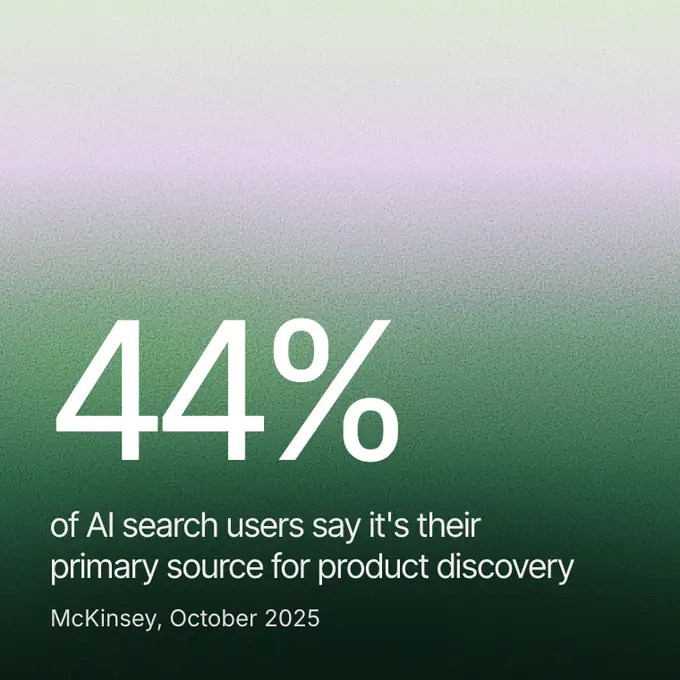
The scale of the shift makes timing matter. McKinsey projects that $750 billion in US revenue will flow through AI-powered search by 2028. 44% of AI search users say AI is now their primary source for product discovery, ahead of traditional search at 31% (McKinsey AI Discovery Survey, October 2025).
The first-mover advantage is real. Erlin's data shows brands that optimize early gain a 3 to 5x citation advantage over brands that optimize later for the same queries.
AI engines reinforce early visibility over time. Only 18% of the 200+ marketing leaders surveyed by Erlin in Q4 2025 have an active AI visibility strategy (Erlin survey, 2026).
Why AI visibility is different from SEO
The common assumption: "We rank well on Google, so AI should cite us too."
Erlin tracked 500+ brands and found that traditional SEO ranking does not reliably predict AI citation. The two systems use different signals.
Traditional SEO rewards keyword density and backlink volume. AI visibility rewards entity clarity, fact density, and third-party citations. SEO results are deterministic. The same query produces the same ranking. AI results are probabilistic and shift constantly.
Domain authority does not guarantee AI citations. Erlin found that smaller, focused brands with a domain authority below 20 consistently outperform Fortune 500 companies in specific query categories. AI doesn't default to the biggest brand. It defaults to the clearest one.
How AI search works
When a user asks a purchase-intent question, the AI runs a multi-step filtering process. Erlin's research across 500+ brands and 15,000+ purchase-intent prompts mapped four stages.
Query expansion (Stage 1): The AI generates 5 to 6 related variations from a single prompt to fully understand the intent, constraints, and use cases behind the question.
URL retrieval and filtering (Stage 2): The AI pulls 35 to 42 candidate sources and filters by accessibility, relevance, structure, and freshness. At this stage, 83% of sources get disqualified.
Sentence extraction (Stage 3): From the sources that survive, the AI extracts specific factual statements that directly answer the question. Most extracted content gets discarded.
Final citation (Stage 4): The AI synthesizes what remains and selects 3 to 5 brands to feature in the response.
AI visibility is a compression problem. Your content has to survive four rounds of elimination, being accessible, structured, factually dense, and up to date, all at once.
What AI actually evaluates
Four drivers explain 89% of AI visibility variance (Erlin data, 2026).
Fact density. Brands with 9+ structured attributes appear in 78% of relevant AI answers. Brands with 0 to 2 facts appear in only 9% of cases. AI can't cite what it can't extract. Marketing copy built on adjectives gives AI systems nothing to work with (Erlin data, 2026).
Source authority. 68% of AI citations come from third-party sources. Only 32% come from brand-owned websites. Reddit discussions produce 3.4x higher citation lift. Wikipedia articles produce 2.9x. Your own website, by itself, only gets you baseline performance (Erlin data, 2026).
Structured data. Adding an llm.txt file, FAQ schema, or comparison tables produces 28 to 34% higher AI coverage within 14 to 21 days. Static HTML with schema markup achieves 94% AI parsing success. JavaScript-rendered content achieves 23% (Erlin data, 2026).
Content freshness. Brands updating content monthly see 23% higher AI coverage than brands with stale content. Without updates, brands lose 1.8% AI coverage per month, with no obvious signal that it's happening (Erlin data, 2026).
How to measure your brand's AI visibility
67% of marketing leaders surveyed by Erlin couldn't measure their AI visibility. 58% said no one owned it organizationally. 52% said they lacked the time or resources to tackle it (Erlin survey, 200+ marketing leaders, 2026).
Here's how to start.
Step 1: run a baseline audit
Query 10+ brand-relevant prompts across ChatGPT, Perplexity, and Gemini. Use prompts that match how buyers actually search: "best [category] tool for [use case]", "alternatives to [competitor]", "[problem] solution for [industry]".
Note whether you appear, where you appear, and what the AI says about you. Erlin does this automatically and benchmarks results against competitors.
Step 2: set up tracking in Erlin
- Sign up at app.erlin.ai/get-started.
- Add your domain: Erlin uses this to identify your brand context and start pulling signals.
- Select competitors: Erlin suggests up to 5 based on your category.
- Choose prompts: Erlin generates high-intent prompts relevant to your category. Keep all suggested prompts to start.
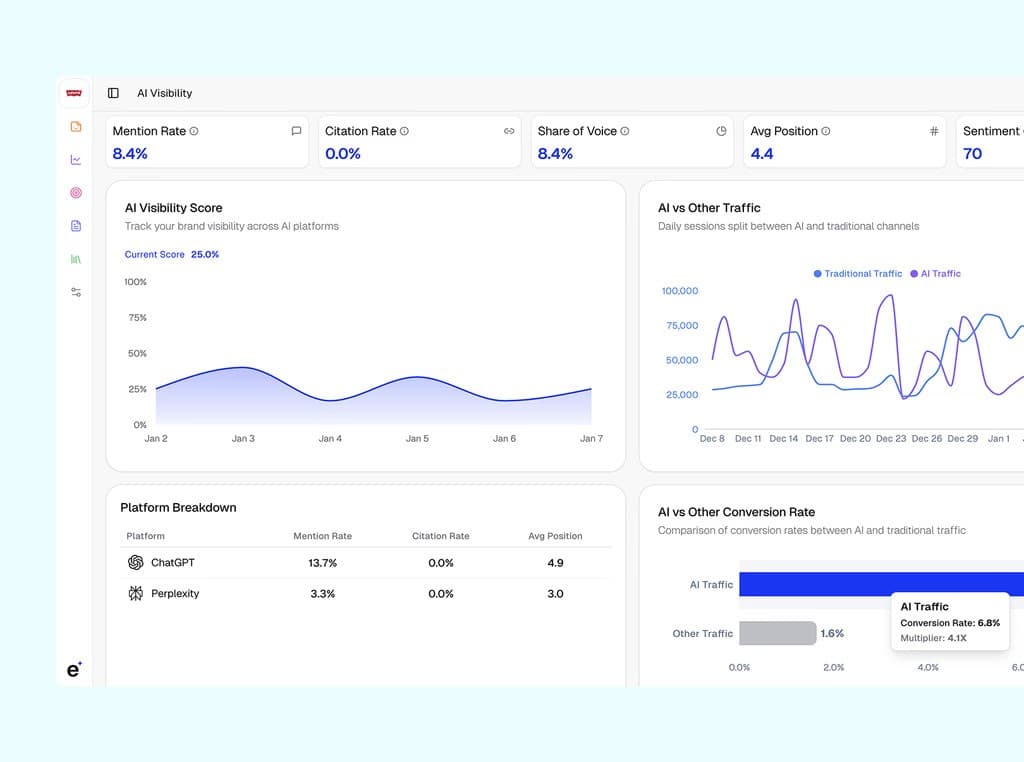
- Review your snapshot: You'll immediately see your AI Visibility Rank, Traffic Rank, and competitor comparison.
- Explore AI Visibility Analytics: The full dashboard shows your AI Visibility Score, platform breakdown, and competitor leaderboard. After connecting GA and GSC, you can see AI versus non-AI traffic and conversion rates.
- Track prompt-level performance: Under AI Visibility > Prompts, you can see how each tracked prompt performs across platforms, view exact AI answers, and check whether you're being cited or mentioned.
Step 3: track the metrics that matter
- AI visibility volume: how often your brand gets mentioned or cited across platforms over time. This is your baseline before attributing changes to content or strategy.
- Share of voice: your percentage of mentions against competitors for high-intent prompts in your category.
- AI Overviews inclusion: whether your content appears in Google's AI-generated overviews. AIO inclusion correlates with broader AI visibility.
- Mention quality and sentiment: being the top recommendation with a citation link is different from being mentioned in passing. Erlin's dashboard shows mention rate, citation rate, average position, and sentiment score by platform.
- AI referral traffic: sessions arriving from ChatGPT, Perplexity, and Claude tracked in GA4 as referral traffic. This is your clearest signal that AI mentions are driving real visits.
How to climb the AI visibility ladder
Tier 1 → 2: getting from AI Invisible to AI Fragile
At this tier, the issue is machine interpretation. AI systems don't clearly understand who you are or what you do. Latent, a healthcare software company, was in exactly this position. Their site wasn't categorized as a healthcare software provider. It appeared to AI systems as a generic services site.
The fix:
- Rewrite your homepage and core service pages to explicitly state what you do, who you serve, and which industry you belong to.
- Use clear, unambiguous language, not "we help companies grow" but "we build custom EHR integrations for mid-size healthcare providers."
- Repair broken backlinks.
- Add your site to relevant industry directories.
- Publish content that addresses your industry's broader questions, beyond just product features.
Latent did exactly this using Erlin and went from essentially invisible to receiving 157 qualified AI sessions in one quarter, their first-ever AI traffic.
Tier 2 → 3: from AI Fragile to AI Present
At this tier, the issue is fact density and structured data. The brand shows up sometimes, but only for narrow, branded queries.
Run the brand fact audit:
- Is pricing publicly accessible without forms?
- Are core features in scannable formats like lists, tables, and FAQs?
- Is competitive positioning explicit and comparable?
- Are key claims backed by exact values?
- Is operational information easy to locate?
Every "no" is a gap in what AI can confidently extract about you. Add an llm.txt file, implement FAQ schema, and add comparison tables that explicitly position you against alternatives.
These changes typically produce 28 to 34% higher AI coverage within two to three weeks (Erlin data, 2026).
Tier 3 → 4: from AI Present to AI Preferred
At this stage, the issue is third-party validation. Your own website only gets you baseline citation rates.
Brands that consistently appear in high-intent queries have Reddit threads discussing them, Wikipedia references, G2 and Capterra reviews, and trade publication mentions. 68% of AI citations come from these third-party sources (Erlin data, 2026).
The approach is concrete:
- Earn reviews on G2, Capterra, or industry-specific platforms
- Engage in relevant Reddit and forum discussions
- Pursue coverage in industry publications
- Build a YouTube or video presence around problems your product solves.
Tier 4 → 5: AI Preferred to AI Dominant
Getting to 80%+ coverage is as much a content freshness problem as anything else. Brands that update monthly see 23% higher AI representation. Content under 3 months old achieves 48% average coverage. Content over 24 months old drops to 18% (Erlin data, 2026).
At this tier:
- Establish a monthly refresh cadence for core pages
- Build a content calendar that addresses adjacent queries beyond your core category
- Monitor AI answers continuously to correct misrepresentations fast
Unmonitored brands take 67 days to detect errors. Monitored brands catch them in 14 days (Erlin data, 2026).
How to adapt your current SEO strategy for AI visibility
You don't need to abandon existing SEO work. Most of it transfers. Here's what to adjust.
Prioritize long-tail, conversational queries
AI search favors specific, intent-driven questions over head terms. Stop filtering out keywords with low search volumes. Map terms that match how real buyers phrase questions in conversation: "how do I [solve problem]" rather than "[product category]."
Restructure content for extractability
Long-form content is harder for AI to cite directly. Break complex guides into definition blocks, numbered steps, and direct answer sections.
TrustEvals.ai, an AI auditing firm, increased AI-driven traffic 40% year-over-year after restructuring its compliance documentation into machine-readable answer formats. AI systems could then extract and reuse their content directly, increasing citation likelihood across platforms.
Cover your E-E-A-T signals
Ensure author bios are visible and include credentials. Link to original research when citing data. Include first-person experience in content where relevant. These signals help AI systems assess whether your content is trustworthy enough to cite.
Go after community platforms
Reddit alone appears in roughly 40% of AI citations across ChatGPT, Perplexity, and Google AI Overviews (Third-party citation analysis, 680M+ citations, 2025). Participating authentically in relevant subreddits and forums creates citation-eligible content on platforms AI systems already trust.
Add schema markup
Static HTML with schema markup achieves 94% AI parsing success versus 7% for PDF documents (Erlin data, 2026). Implement FAQ schema on Q&A pages, Article schema on blog posts, and Product or Organization markup on key conversion pages.
Make your facts explicit and public
Pricing behind a "contact us" form, features buried in vague marketing copy, and capabilities hidden in whitepapers are invisible to AI systems. Make every fact you want cited publicly accessible in plain, structured language.