

Search has changed more in the last two years than it did in the previous decade. People are skipping Google and going straight to ChatGPT, Perplexity, or Gemini with questions like "what's the best project management tool for a 10-person team?", and they're acting on whatever the AI says.
That shift matters a lot for content. If your brand isn't showing up in those AI-generated answers, you're invisible to a growing chunk of your potential buyers at exactly the moment they're ready to decide.
This guide covers what AI content optimization actually means, why it matters right now, and the concrete steps you can take to show up where it counts.
What Is AI Content Optimization?
AI content optimization is the practice of structuring and formatting your content so that AI-powered search platforms can find it, understand it, and cite it when answering user questions.
That's different from traditional SEO. Classic search optimization was about ranking pages for specific keywords. You'd aim for position 1 on Google and hope people clicked through.
AI content optimization targets something different: being the source that ChatGPT, Perplexity, Gemini, or Claude pulls from when it synthesizes an answer.
The technical term for this is GEO ( Generative Engine Optimization). Some people call it AEO (Answer Engine Optimization) or LLMO (Large Language Model Optimization).
The names differ, but the idea is the same: make your content easy for AI to read, extract, and recommend.
Traditional SEO gives you 10 blue links to compete for. AI search typically cites 2–5 sources per response. The competition is tougher, but being one of those cited sources delivers something a #1 ranking never could: an AI actively recommending your brand by name.
Why Optimize Content with AI Now
Here's the blunt version: traffic patterns are shifting fast, and the brands that build AI visibility now will be far ahead of those who wait another year.
By 2028, an estimated $750 billion in US revenue is expected to flow through AI-powered search, according to McKinsey research. Since 2024, more than $200 billion has been invested globally in AI infrastructure, much of it aimed at marketing and research functions.
And right now, 44% of users already say AI is their primary source of information (Melbourne Business School, Trust and AI research).
For content teams, the conversion argument is probably the most compelling. Erlin.ai's data across 500+ tracked brands shows AI-referred traffic converting at 3–6x the rate of other channels. This is because users asking AI questions are already in decision mode, not just browsing.
They've done their research. They're comparing options. When an AI names your brand in that context, it's worth a lot more than a link at the bottom of a search results page.
And yet, most marketing teams are flying blind. A Q4 2025 Erlin.ai survey of 200+ marketing leaders found:
67% don't know how to measure their AI visibility
58% say no one on their team actually owns it
52% deprioritize it because they can't track ROI
Only 18% have an active strategy
That's a big opening for any brand willing to do the work.
There's also a cost-of-waiting problem. Erlin.ai's analysis shows brands lose approximately 1.8% AI coverage every month their content sits unchanged. Early movers in AI search gain a 3–5x citation advantage over brands that start optimizing later for the same queries. The gap compounds.
How AI Transforms SEO and Content Strategy
AI hasn't replaced SEO. But it's forced a meaningful rethink of what good content actually looks like.
The old playbook (pick a keyword, hit the density targets, build some links) still matters for traditional search. But AI systems evaluate content differently.
They're pulling specific facts, sentences, and structured data from your pages to generate answers. If your content can't be cleanly extracted and cited, it won't show up, regardless of where it ranks on Google.
There are a few things worth knowing about how this actually works under the hood.
When someone asks an AI a purchase-intent question, the system doesn't just search once. It expands that single query into 5–6 semantically related sub-queries, retrieves 35–42 candidate URLs, extracts factual statements from those pages, and then synthesizes 3–5 brands into the final answer.
Most content gets filtered out before the synthesis stage.
What survives that filter? Content with:
Fact density (brands with 8+ structured attributes are cited 4.3× more often than those with fewer than three)
Source authority (third-party validation correlates with 2.6–3.4× higher citation rates)
Structured data (llm.txt files, FAQ schema, and comparison tables drive 28–34% higher AI coverage within 14–21 days),
Content freshness (brands updating monthly see ~23% higher representation than those with stale content)
Here's the thing that trips up most teams: ranking #1 on Google doesn't translate to AI visibility. Erlin.ai tracked 500+ brands and found that traditional SEO ranking explains very little of why a brand gets cited in AI responses.
A brand can be in the top spot on Google and still not show up when someone asks ChatGPT the same question. They use different signals entirely.
AI search also shifts the nature of the content you need. SEO rewarded long, comprehensive pages. AI rewards clarity and extractability.
A page that opens with a direct 50-word answer to the user's question and follows it with well-structured supporting content is more likely to get cited than a 3,000-word essay that buries the lede.
Top AI Tools for Content Optimization
1. Erlin.ai
Erlin.ai is an AI-powered content optimization platform that helps brands boost visibility and rankings, specifically in AI-driven search engines like ChatGPT, Perplexity, Gemini, and Claude.
It analyzes millions of AI conversations to deliver actionable SEO insights tailored for the era of conversational search, enabling content teams to create content that AI models actively recommend.
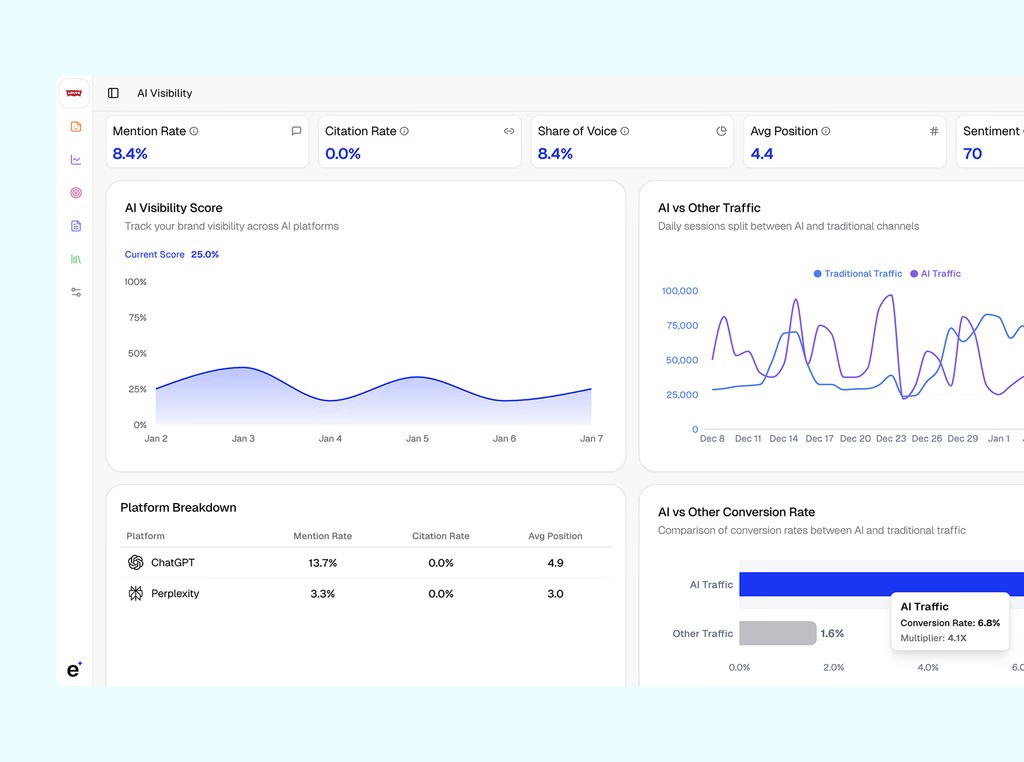
Here are the key capabilities:
Brand Tracking & Analytics: Real-time dashboards monitoring mentions, sentiment, and share of voice across major AI engines, including competitive benchmarking.
Opportunity Discovery: Identifies content gaps and high-value user prompts by analyzing AI query patterns. This helps teams prioritize what will actually move the needle.
Action Center Automation: Turns insights into actionable workflows: automated research, content briefs, outlines, and first-draft generation with human oversight for quality control.
Custom Reporting: Metrics on AI citations, traffic sources, and conversion uplift so you can tie optimization efforts to real outcomes.
Integrations & Alerts: Slack notifications when citation positions or brand mentions shift, plus export options for team collaboration.
For content teams specifically, Erlin reduces brief creation from around 2 hours to 10 minutes, while enabling teams to produce 8 pages per week versus the typical 2–3.
It also runs ongoing content refresh analysis: identifying which existing pages are losing AI mentions and recommending targeted updates to restore visibility.
2. Surfer SEO
Surfer's content editor gives writers a real-time optimization score as they write, analyzing keyword density, content structure, and semantic relevance against top-ranking pages.
The platform's newer AI Visibility Tracking shows how your brand appears across ChatGPT, Perplexity, and Google AI Overviews, built into the tool rather than sold as a separate add-on (on Pro and above).
3. Clearscope
Clearscope focuses on content quality through AI-driven relevance scoring. It assigns letter grades (A through F) based on how well your content covers a topic compared to top competitors, using semantic analysis rather than keyword density.
The Google Docs integration is genuinely smooth: writers get live suggestions without switching platforms. Strong choice for editorial teams where quality standards matter a lot.
4. Semrush
Semrush is the comprehensive option for teams that want one platform covering keyword research, site audits, rank tracking, and AI visibility.
Their AI Visibility Toolkit monitors brand visibility across ChatGPT, Google AI Mode, and Perplexity with share-of-voice analysis. Best for larger in-house teams or agencies that need centralized management.
5. Frase
Frase positions itself as a full research-to-publish workflow tool: brief generation, content scoring, AI writing, and visibility tracking in one place. Good for small teams and individual creators who need to move fast without juggling multiple tools. Budget-friendly relative to the others, with a 5-day free trial.
Step-by-Step Guide to AI-Driven Content Creation
Here's how to actually build content that gets cited.
Step 1: Audit your current AI visibility
Before creating anything new, find out where you stand. Run your brand name and top product categories through ChatGPT, Perplexity, and Gemini.
Are you showing up? What's the context? Which competitors are getting cited when you're not? Tools like Erlin.ai can automate this across hundreds of prompts and give you a benchmark share-of-voice score.
Step 2: Map the prompts your buyers actually use
AI search queries average 23 words, compared to Google's typical 4-word search. Users are asking full questions like "what's the best accounting software for a freelancer with under $50k revenue?"
Find out what those questions are for your category. Erlin's Opportunity Discovery module analyzes AI query patterns to surface the prompts where you're missing coverage.
Step 3: Structure your content for extraction
AI systems extract specific sentences and facts. That means your content needs to be scannable and direct.
Open each page with a clear 40–80 word answer to the core question.
Use H2s and H3s as actual questions people would ask.
Break out facts, specs, and comparisons into tables.
Every H2 section should be self-contained: an AI should be able to pull one section and have it make sense without the rest of the page.
Step 4: Build fact density
AI rewards specifics. Not "we have competitive pricing" but "plans start at $29/month with no setup fee." Not "our platform is fast" but "average load time under 1.2 seconds across 50,000 users."
Erlin's analysis shows brands with 9+ structured facts achieve 78% AI coverage versus 9% for brands with 0–2 facts. Go through your key pages and count the extractable facts, and then fill the gaps.
Step 5: Add schema markup and technical structure
Static HTML with schema markup has a 94% AI parsing success rate. JavaScript-rendered content lands at 23%. PDFs are at 7%. That tells you everything.
Implement FAQ schema on pages with question-and-answer content.
Add comparison tables with explicit product attributes.
Consider creating an llm.txt file to guide AI crawlers on which pages to prioritize.
Check that AI bots aren't being blocked by your robots.txt. It's a more common problem than you'd expect, especially if you're using Cloudflare.
Step 6: Build third-party validation
Your own website only accounts for 32% of where AI platforms find brand information. Reddit discussions, Wikipedia references, review platforms like G2 and Capterra, and YouTube content make up the remaining 68%.
Reddit discussions carry a 3.4× citation lift; Wikipedia a 2.9× lift. This means PR, community engagement, and review generation aren't just branding efforts; they're an AI search strategy.
Step 7: Establish a refresh cadence
Content under 3 months old averages 48% AI coverage. Content over 24 months old: 18%. Brands updating monthly maintain significantly more stable AI visibility.
Set a monthly review for your top 20 pages, not a full rewrite, just updated stats, new examples, and a refreshed "last updated" date. Erlin monitors citation shifts and flags which pages need attention before visibility decays.
Best Practices for AI-Optimized Content
Write for extraction, not just reading: Every section should be able to stand alone. Lead with the direct answer, then add context. AI systems pull sentences, not paragraphs.
Lead your content early: A study analyzing AI citations found that 44.2% of all LLM citations come from the first 30% of a page. Put your most important facts and claims up front.
Use specific numbers over vague claims: "90% of customers see results within 30 days" beats "most customers see fast results." Specific claims are extractable. Vague ones get filtered out.
Vary your content format: Mix prose with tables, FAQ sections, and numbered lists. Comparison tables drive ~34% higher AI coverage within 14 days. FAQ schema drives 28% higher coverage within 21 days.
Maintain consistent brand language: Switching between "HubSpot," "the platform," "the company," and "it" confuses AI entity recognition. Use your brand name consistently. AI systems identify specific entities. Ambiguity gets you filtered out.
Cite authoritative sources: Claims backed by named sources with specific data are more citable than unsupported assertions. If you reference a stat, name the study and the year.
Keep your pricing and features public: Gated information doesn't get cited. If your pricing requires a demo request to access, AI can't extract it. That's a coverage gap.
Publish original research when you can: Proprietary data, benchmark studies, and unique datasets give AI a reason to cite you instead of a dozen similar alternatives. If you have customer data, usage patterns, or survey results, publish them.
Common AI Content Optimization Mistakes to Avoid
Treating GEO as a one-time project: The biggest mistake. AI visibility requires the same ongoing discipline as SEO. Set a cadence. Assign ownership. Content decay is real and measurable. Brands lose around 1.8% coverage per month when they go stale.
Assuming Google rankings predict AI citations: They don't. The correlation is weak. Brands with a domain authority under 20 consistently outperform Fortune 500 companies for specific query categories in AI search. AI cites the clearest source, not the biggest one.
Optimizing only for one platform: ChatGPT drives 91% of all AI referral sessions, but Perplexity, Gemini, and Claude behave differently and weight sources differently. Only 13.7% of citations overlap between Google AI Overviews and AI Mode, according to Ahrefs research. A strategy that only chases ChatGPT will miss meaningful coverage on other platforms.
Publishing AI-generated content without differentiation: AI engines recognize generic, templated content and don't reward it. The irony is that AI-written content often performs poorly for GEO. Brand voice, original research, and expert input make content citable. Polished-but-hollow doesn't.
Ignoring your robots.txt and crawlability settings: Plenty of sites are accidentally blocking AI crawlers. Cloudflare changed its default configuration to block AI bots, which means many brands don't realize they've cut off access. Check your server logs for "ChatGPT-User" as a user agent. If it's not showing up, you may be invisible to AI search by accident.
Skipping third-party validation: Owning your narrative on your own website isn't enough. Reddit discussions, independent reviews, and earned media citations carry more weight with AI systems than anything you publish on your own domain. Brands with no external validation typically see low or fragile AI visibility regardless of how well-optimized their owned content is.
Not measuring: 67% of marketing leaders have no way to measure AI visibility. You can't improve what you're not tracking. At minimum, manually test your brand against 10–15 high-intent prompts monthly across the major AI platforms. Better yet, use a tool that automates this at scale.
Frequently Asked Questions
What is AI content optimization?
AI content optimization, also called GEO (Generative Engine Optimization) or AEO (Answer Engine Optimization), is the practice of structuring your content so AI-powered search engines like ChatGPT, Perplexity, Gemini, and Google AI Overviews can extract and cite it when answering user questions.
How does AI decide which brands to recommend?
When a user asks a purchase-intent question, AI systems run through a multi-stage process: they expand the query into 5–6 related sub-queries, retrieve 35–42 candidate URLs, filter out inaccessible or low-confidence sources, extract specific factual sentences, and synthesize 3–5 brands into the final answer. The brands that survive this process tend to have high fact density, strong third-party citations, structured content, and fresh information.
Does my Google ranking affect my AI visibility?
Only weakly. Erlin.ai tracked 500+ brands and found that traditional SEO ranking explains very little of why a brand appears in AI responses. A brand can rank #1 on Google and not show up when someone asks ChatGPT the same question. AI citation and Google ranking use different signals, so they should be treated as separate channels.
How often should I update content for AI search?
Monthly is the target. Brands updating content monthly see approximately 23% higher AI representation than inactive brands. Content under 3 months old averages 48% coverage; content over 24 months old averages 18%. Think of it as maintaining a 1.8% monthly decay rate that needs offsetting through regular refreshes.
Can smaller brands compete with larger ones in AI search?
Yes, more effectively than in traditional SEO. Focused brands with strong entity context and well-structured content routinely outperform larger competitors in specific query categories. The playing field is more level than Google, where domain authority carries a lot of weight.
What's the fastest way to improve AI content visibility?
Start with the FAQ schema. Identify the 10–15 most common questions in your category, write clear answers with proper schema markup, and track citation rates monthly. Comparison tables are also high-impact — they produce around 34% higher AI coverage within about 14 days. From there, fix any crawlability issues and add an llm.txt file. These technical steps often show results faster than content rewrites.
How do I measure my brand's AI visibility?
Track your brand and top competitors manually by running purchase-intent prompts across ChatGPT, Perplexity, and Gemini monthly. Record whether you appear, where, and in what context. For scale, tools like Erlin.ai automate this across hundreds of prompts and surface your Visibility Score, Share of Voice, Citation Rate, and Sentiment across all major AI platforms.
Share
Related Posts
Generative Engine Optimization Trends for 2026
7 GEO trends reshaping AI search visibility in 2026, with data on citations, structured data, and what actually drives brand coverage.
15 Generative Engine Optimization Best Practices Backed by Latest Research
Generative engine optimization best practices backed by 2026 research. 15 tactics to get your brand cited by ChatGPT, Perplexity, and Google AI Overviews.
AI for Content Planning & Strategy: A Complete Guide
AI for content planning in 2026 means planning for AI search visibility, not just faster drafts. Five-layer workflow, what to automate, what stays human.