AEO is the discipline of getting your brand named and cited inside the single synthesized answers that ChatGPT, Perplexity, Gemini and Google AI give, rather than ranking pages in a list of links. It rests on five pillars: entity and brand clarity, machine-readable structured content, topical depth, first-party knowledge and authority signals. Success is measured by citation rate, mention frequency, answer accuracy and visibility share.
By Q3 2027, AI search will overtake traditional search. The question is, will your brand be visible when it happens?
TL;DR
- AI search overtakes traditional search by Q3 2027 - you have 18 months to prepare
- AI-driven traffic converts 2-3× better than Google organic - massive ROI opportunity
- Winner-take-most dynamics - AI cites 2-3 brands per query, everyone else is invisible
- AEO ≠ SEO - Different rules, different tactics, different metrics
- AEO isn’t just part of SEO anymore; it’s its own discipline built on entities, brand context, and structured, machine-readable content.
- Brands that move early will own AI search visibility, customer acquisition, and attribution
We tracked 500+ brands over 180 days. The ones winning in AI search aren't just tweaking their SEO; they're playing a completely different game. Let's talk about it.
What is answer engine optimization?
Answer Engine Optimization (AEO) is the practice of structuring your brand’s knowledge, content, and data so that AI systems like ChatGPT, Perplexity, Gemini, and Google AI Overviews can confidently cite you as the best answer. In 2026, AEO is no longer an extension of SEO; it is a standalone discipline built on entity clarity, brand context, structured knowledge, and machine-trainable content.
| Area | SEO (Traditional) | AEO (AI Era) |
|---|---|---|
| Goal | Rank pages on SERPs | Get named in AI answers |
| Win condition | Clicks and traffic | Citations and share of voice |
| Search style | Short keywords | Natural-language questions |
| Result format | List of links | One synthesized answer with 2 to 3 brands |
| Trust signals | Backlinks, DR | Entity clarity, first-party data, E-E-A-T |
| Backlink role | Central | Supportive, not primary |
| Content approach | Whole-page optimization | Modular blocks: FAQs, tables, definitions |
| Structure | Human-readable pages | Human + model-readable, with schema |
| Platforms | Mostly Google | ChatGPT, Perplexity, Gemini, AI Overviews |
| Measurement | Rankings, clicks, sessions | Citations, accuracy, AI-driven conversions |
| Competition | Many brands per query | Winner-take-most, few brands per answer |
| Conversion impact | Steady | 2 to 3× higher from AI-qualified visitors |
Why AEO matters now
In 2025, global consumer behavior crossed a milestone: increasingly more product discovery is shifting to AI agents and answer engines than through Google’s traditional ten-blue-links. Platforms like Perplexity and ChatGPT became “starting points” for buying decisions, especially in retail, healthcare, and enterprise software.
Google CEO Sundar Pichai even stated in recent interviews that “search is evolving into something more assistive, more conversational, and more context-aware.” This shift isn’t speculation anymore; it’s measurable. AI answer engines have become the new real estate for visibility.
And in 2026, the brands that win those citations will look very different from the brands that rank on Page 1 today.
This is exactly where Answer Engine Optimization (AEO) enters the picture.
1. The timeline is compressed
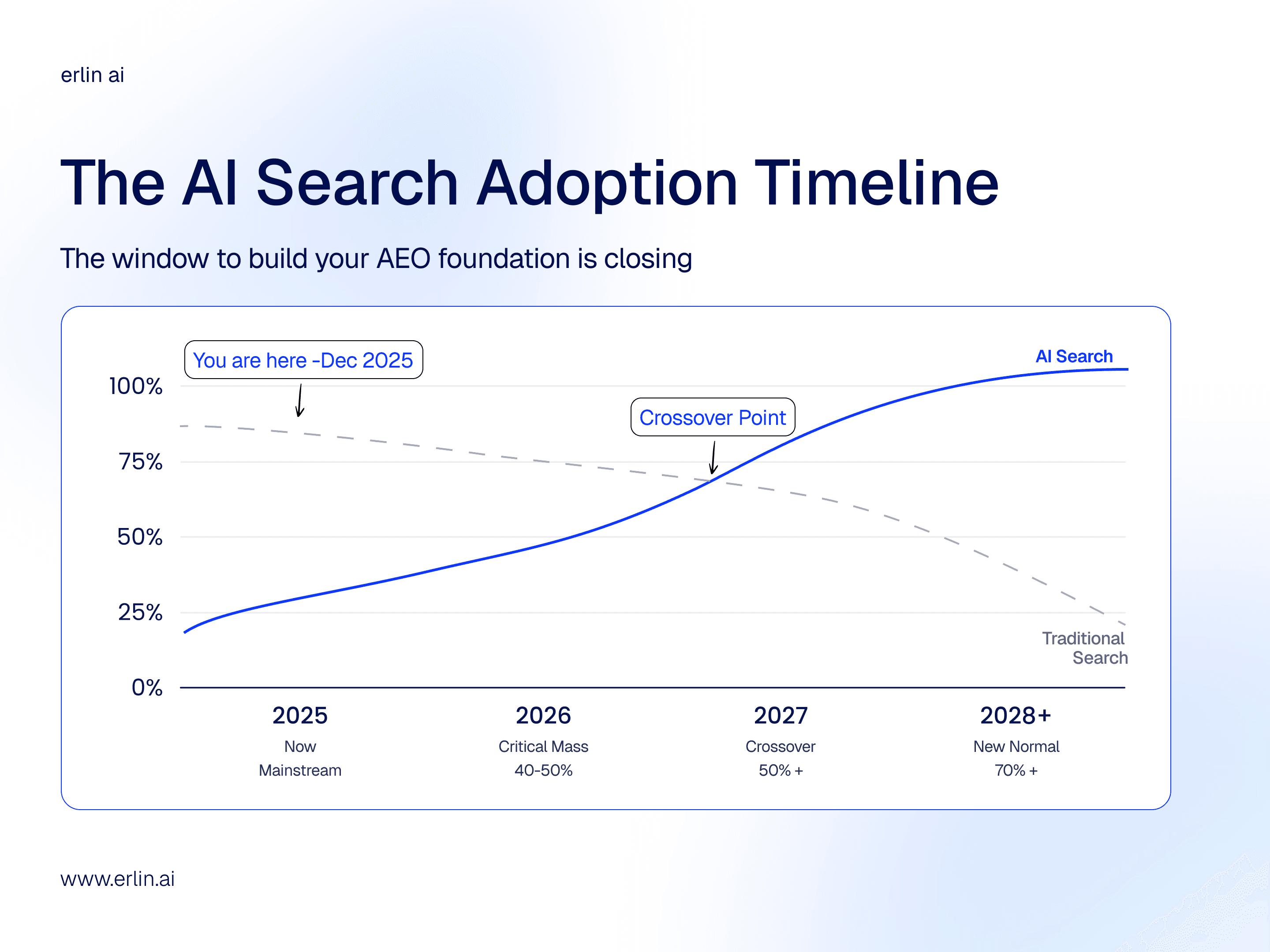
This illustration shows the adoption curve from 2025 to 2028 with the Q3 2027 crossover point
- Now (Dec 2025): AI search is mainstream - billions of queries monthly
- End of 2026: 40-50% of searches go to AI first
- Q3 2027: AI search overtakes traditional search
- 2028+: Brands without AEO = invisible to majority
2. The conversion advantage
Visitors who arrive from an AI answer have already heard a recommendation, so they tend to convert better than Google organic visitors.
Why?
- Higher intent (users asking specific questions)
- Trust transfer (AI recommendation = endorsement)
- Better context (pre-qualified by AI's explanation)
One brand we studied: 4% conversion from Google organic, 11% from AI search traffic. Same product, same landing pages.
3. Winner-take-most dynamics
When AI gives one answer citing 2-3 brands, those brands get 100% of the attention. There's no "page 2." You're either in the answer or you're invisible.
First movers have 3-5× citation advantage over late adopters. The gap widens every month.
The shift: from keyword search to answer retrieval
Traditional SEO optimizes for queries. AEO optimizes for answers.
When a consumer now asks:
- “Which running shoes reduce knee pain?”
- “Is device leasing better than buying for employees?”
AI doesn’t return a list of websites, it returns an integrated, synthesized answer. If your brand isn’t in that answer, you're invisible.
Answer engines work differently:
- They extract meaning, not keywords.
- They cite entities, not long paragraphs.
- They prioritize authority signals, not backlinks alone.
AEO positions your brand to be that trusted, confident source that LLMs pull into their answer fabric.
How AEO evolved from static LLMs to real-time answer engines
AEO exists today because LLMs made a fundamental shift. Early models like GPT-3 and GPT-3.5 were trained once and frozen. Brands had zero ability to influence what the model “knew.”
2024 to 2026 changed that. AI assistants now pull from live retrieval, citation graphs, brand entities, and structured content, meaning brands can influence what gets surfaced.
Answer engines don’t rely on old snapshots anymore. They read the live web, evaluate credibility, pull structured facts, and synthesize the best answer.
That’s exactly why AEO exists and why brands finally have control over how they appear in AI-generated answers.
AEO requires optimizing for retrieval
Traditional SEO tries to influence Google’s ranking algorithms. AEO optimizes for the Retrieval system (RAG), the layer responsible for what information an AI pulls before generating an answer.
Search engines rank pages → Answer engines retrieve facts.
The rules are different:
- Retrieval rewards clarity, structure, and facts.
- Generation rewards authority and consistency.
- Entities determine whether you are eligible for citation at all.
How AI engines pick which brands to recommend
We reverse-engineered how ChatGPT, Perplexity, and Google AI actually work. Here's the AI pattern:
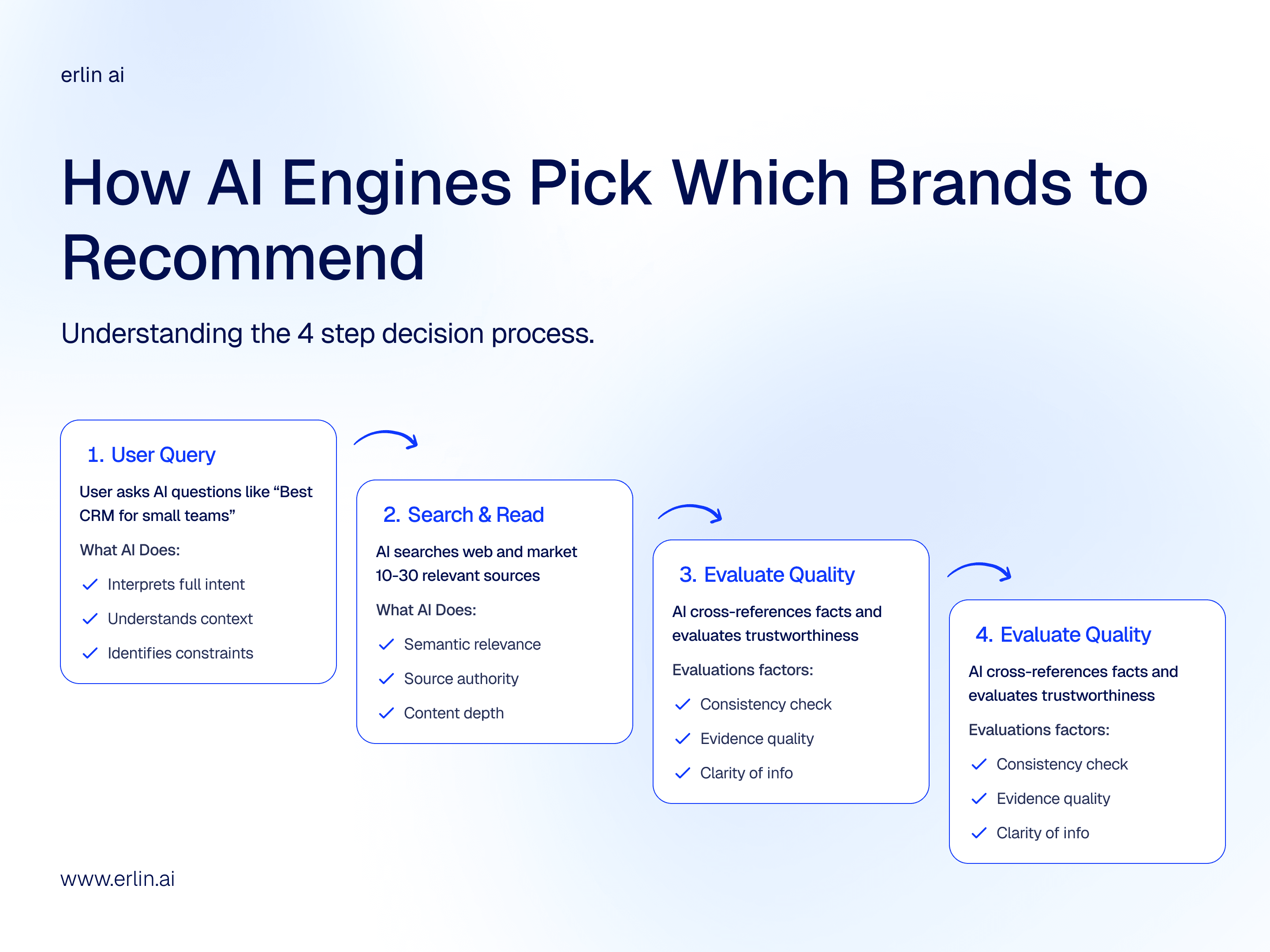
This illustration shows the 4-step process of how AI picks brands with evaluation criteria
Core AEO pillars every brand needs in 2026
AEO requires a structured approach. Below are the pillars that leading brands are already investing in.
Pillar 1: entity & brand clarity
If answer engines cannot classify your brand, they cannot cite you.
You need:
- Clear entity definitions across Google, LinkedIn, Crunchbase, G2, Shopify, etc.
- Consistent product taxonomies
- Clear “What we do” statements
- Unified brand attributes
- Public leadership profiles
- Press mentions that reinforce your category
Pillar 2: structured content (machine-readable)
AI engines prefer content with built-in context boundaries, such as:
- Q&A blocks
- Definition-first paragraphs
- Comparison tables
- Bullet-structured reasoning
- Schema markup
- Short “knowledge atoms”
Pillar 3: context depth (topical authority)
AI reward depth. If you only have 1 to 2 blogs per category, you're invisible.
You need:
- Topic clusters
- Internal link networks
- Expert bylines
- Reference citations
- User-generated data
- Consistent coverage across all subtopics
This builds semantic relevance.
Pillar 4: first-party knowledge (brand-owned facts)
According to industry experts, LLMs increasingly rely on first-party, authoritative datasets.
Examples include:
- Proprietary reports
- Case studies
- Glossaries
- Benchmarks
- FAQ libraries
- Product comparison matrices
- Transparent documentation
Brands that own their data, own the AI answers.
Pillar 5: authority signals for AI
Traditional backlinks aren't enough.
LLMs look for:
- Expert profiles
- Clinical studies
- Certifications
- Publisher mentions
- Trust badges
- Verified reviews
- Press interviews
- Awards
Everything contributes to your confidence score in AI retrieval.
The Erlin.ai perspective: why AEO works differently for DTC & retail
DTC is a high-variance category, AI answers often struggle with:
- Brand differentiation
- Product attributes
- User sentiment
- Pricing and value comparisons
- Real-world use cases
Erlin.ai solves this by creating a brand knowledge graph that LLMs can understand:
- Product attributes → structured
- Brand tone → codified
- Customer pain points → mapped
- Industry benchmarks → indexed
- FAQ intelligence → atomized
This allows DTC brands to win citations in questions like:
- “Best LED hair growth devices under $500?”
- “Top running shoes for flat feet?”
- “Most comfortable hats for summer travel?”
AEO isn’t generic; it demands brand-level intelligence.
Real industry mentions: what leaders are saying
““Search is shifting from answers based on links to answers based on reasoning and context.””
““We are entering a world where every brand becomes an AI-indexed entity.””
““Structured knowledge will define how AI systems decide what is true.””
These industry directions make one thing clear: “AEO is not optional. It's where digital visibility is migrating.”
Your AEO launch checklist
1. Audit your AI presence
- Search "[your brand]" in ChatGPT, Perplexity, Google AI
- Document what they say (accurate? outdated? missing?)
- Note if they confuse you with competitors
Erlin tracks this automatically across six AI engines. Check your AI visibility
2. Fix entity basics
- Verify your Name, Address, Phone are identical everywhere (website, Google Business, LinkedIn, directories)
- Add Schema.org Organization markup to your homepage
- Update your About page with clear category positioning
3. Identify your top 10 customer questions
- Review support tickets, sales call recordings, chat logs
- List the 10 questions prospects ask before buying
- These become your content priorities
4. Search your category in AI
- Ask ChatGPT: "What are the best [your category] for [your target customer]?"
- See which competitors get mentioned and why
- Note what criteria AI uses to evaluate
5. Create your first optimized piece
- Pick your #1 customer question
- Write a comprehensive answer (1,500+ words minimum)
- Include: specific data, real examples, clear structure
- Use headers that summarize each section
- Publish it
6. Start community engagement
- Find 3 relevant subreddits where your customers hang out
- Answer questions helpfully (zero self-promotion)
- Share your expertise authentically
- Do this weekly
7. Set up monitoring
- Weekly: Search your brand in AI engines (track changes)
- Monthly: Search category queries (track competitor citations)
- Quarterly: Full content audit (what's working?)
Erlin automates all of this monitoring for you. Check your AI visibility
8. Optimize your highest-traffic page
- Find your most-visited page
- Add clear, descriptive headers
- Include 2-3 specific data points or statistics
- Add real examples or case studies
- Update any outdated information
How to measure success
Traditional SEO metrics don't work for AEO. Here are the metrics that matter:
| Metric | What It Measures | How to Track | Good Benchmark |
|---|---|---|---|
| Citation Rate | % of relevant queries where you get cited | Search 20 category queries, count citations | 15-25% citation rate |
| Brand Mention Frequency | How often AI mentions your brand name | Track mentions across target queries | 30%+ of category searches |
| Answer Accuracy | Is AI describing you correctly? | Weekly brand searches in AI engines | 90%+ accuracy |
| Visibility Share | Your citations vs competitor citations | Compare across query set | Top 3 in your category |
| AI Traffic Conversion | Conversion rate from AI sources | Tag AI referral traffic in analytics | 2-3× higher than organic |
This is why platforms like Erlin exist, to give you visibility into metrics traditional tools can't see.
Common mistakes to avoid
We studied brands that failed despite significant effort. Five patterns emerged:
1. Treating AEO like SEO Keyword stuffing, thin content, optimization tricks, these actively hurt. AI rewards natural, comprehensive content.
2. Ignoring entity clarity Trying to rank for queries when AI doesn't understand your category = building on quicksand. Fix entity first.
3. Creating shallow content One comprehensive 2,000-word guide beats ten shallow 400-word posts. Quality over quantity matters 10× more in AEO.
4. Not updating content AI heavily penalizes outdated information. A comprehensive 2022 guide with old facts loses to a current 2025 guide with less depth. Update quarterly minimum.
5. Flying blind You can't improve what you don't measure. Brands that monitor AI visibility and adapt outperform those guessing by 5-10×.
The question isn't whether AI search will reshape visibility. It's whether your brand will be visible when it does.