AI engines cite brands whose content is fresh, structured and authoritative, the FSA Framework that Erlin's analysis of 15,000+ AI search sessions supports. Content updated within 90 days earns a 67% higher citation rate, structured content gets cited 73% more often than unstructured narrative, and authority comes from topic-specific entity strength rather than domain authority, so small, focused brands can outperform Fortune 500 companies.
The Big Picture: AI search has overtaken traditional search as the primary discovery method. In December 2025, Google made "AI Mode" the default, marking the complete shift to a citation economy where only 2-3 brands per query get visibility and everyone else is invisible. What We Found: After analyzing 15,000+ AI search sessions, we discovered that citations aren't random, they follow predictable patterns based on three factors: Freshness, Structure, and Authority (the FSA Framework).
The citation selection mystery, solved
We analyzed over 15,000 AI search sessions across ChatGPT, Perplexity, Claude, Gemini, and Copilot to understand one critical question: How do AI engines decide which brands to cite?
The answer isn't random. It's predictable, measurable, and most importantly, something you can influence.
The big numbers
Our analysis revealed patterns that every marketer needs to understand:
Citation Behavior:
- Only 12-18% of brands in our study appeared consistently across queries
- AI engines cite an average of 2.8 brands per query
- First-mentioned brands receive 3× more clicks than the second-mentioned
- Brands optimized for citations see 2.4× higher conversion rates from AI traffic
The Freshness Factor:
- Content updated within 90 days has a 67% higher citation rate
- Time to citation averages 3-14 days, depending onthe platform
- Seasonal content receives 23% more brand mentions during relevant periods
The surprising finding? Small, focused brands with a domain authority under 20 consistently outperform Fortune 500 companies in specific query categories when they understand how citation selection works.
Why citation patterns matter in 2026
The AI search shift is complete
In December 2025, something fundamental changed in how people discover brands. Google quietly replaced its traditional Search button with "AI Mode" as the default. No press release. No announcement. Just a subtle shift that marked the end of one era and the beginning of another.
Traditional search, the ten blue links we've relied on for 25 years, is now the fallback option, not the default.
What does this mean for brand visibility?
In traditional search: Ranking #3 still gets clicks. Page 2 exists. Being visible means appearing somewhere in the results.
In AI search: You're either cited in the answer or you don't exist. There's no page 2 in ChatGPT. No "see more results" in Perplexity. The brands mentioned in the AI's response capture 100% of the attention.
This is the citation economy: A winner-take-most dynamic where 2-3 brands own the visibility for each query, and everyone else is invisible.
The conversion advantage
Brands that appear in AI citations aren't just getting visibility, they're getting higher-quality traffic.
Our data shows AI-referred traffic converts at 2.4× the rate of traditional organic search traffic. Why?
| Conversion Factor | Impact |
|---|---|
| Higher Intent | Users ask specific, qualified questions |
| Trust Transfer | AI recommendation = third-party endorsement |
| Better Context | AI pre-qualifies users with detailed explanations |
| Reduced Friction | Direct answers eliminate comparison fatigue |
When ChatGPT recommends your CRM for "small real estate teams," that user arrives at your site already understanding why you're the right fit. Traditional search can't deliver that level of pre-qualification.
The timeline that changed everything
The shift happened faster than anyone predicted:
- 2023: AI search is "interesting experiment"
- 2024: Early adopters start using ChatGPT for research
- Q1 2025: AI search becomes mainstream behavior
- Q3 2025: AI search matches traditional search volume
- December 2025: Google makes AI Mode the default
- Q3 2027 (projected): AI search fully overtakes traditional search
We're not preparing for the future anymore. We're adapting to the present.
How AI citation selection actually works
Understanding why some brands get cited, and others don',t requires looking under the hood at how AI engines process queries and select sources.
The two core architectures
AI engines operate on two fundamental approaches, and understanding the difference explains why citation behavior varies across platforms.
Model-Native Synthesis: The AI generates answers from patterns learned during training, text from books, websites, licensed datasets. This approach is fast and coherent but can "hallucinate" facts because the model creates text from probabilistic knowledge rather than quoting live sources.
Retrieval-Augmented Generation (RAG): The AI performs a live search, pulls relevant documents or snippets, then synthesizes a response grounded in those retrieved items. RAG trades speed for accuracy and traceability.
Different platforms sit at different points on this spectrum. ChatGPT leans model-native (unless browsing is enabled). Perplexity defaults to retrieval-first. Claude takes a conservative, authority-focused approach. Understanding these architectural differences helps explain their citation behaviors.
The 4-stage citation decision process
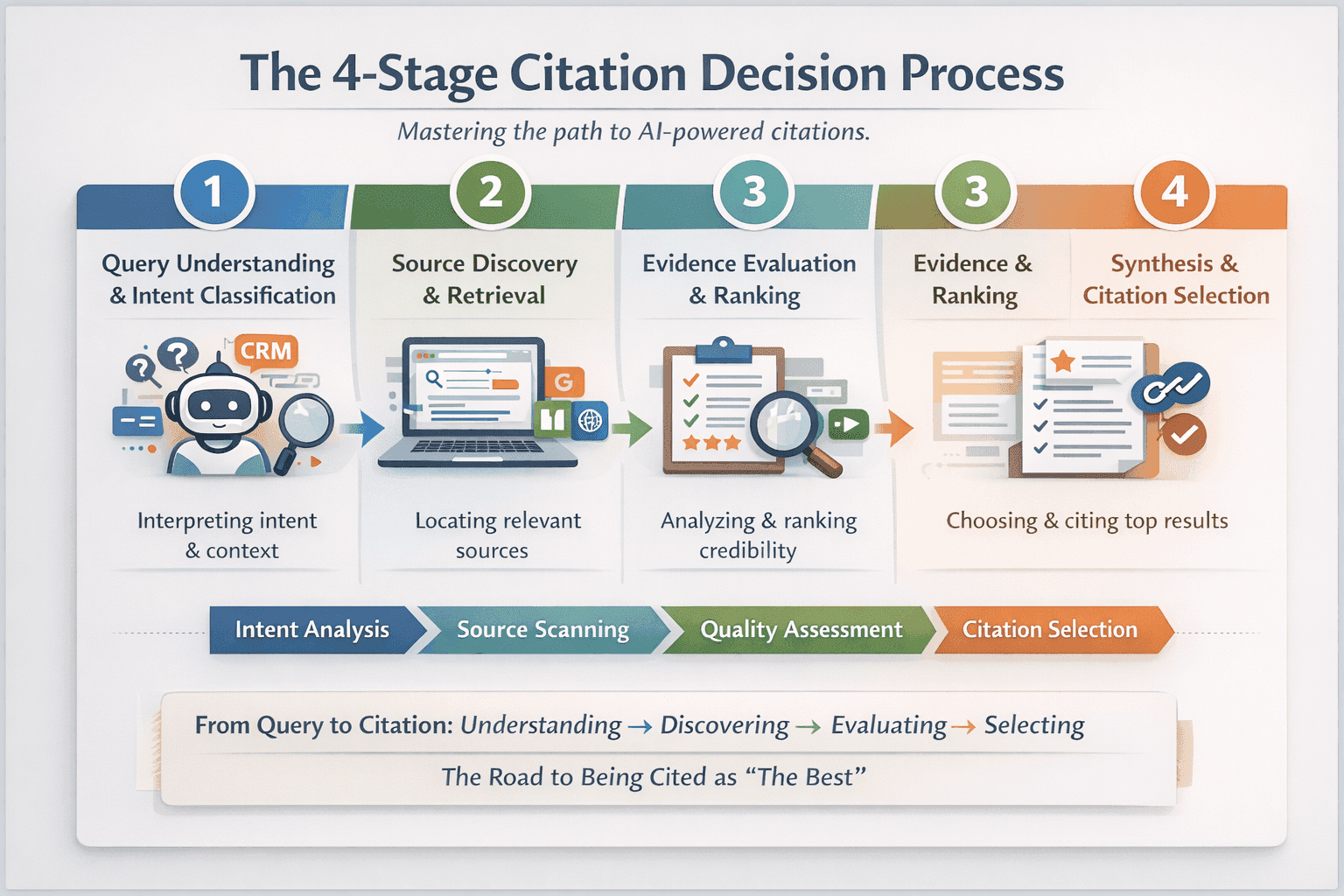
Every AI citation follows a predictable four-stage process. Mastering these stages is the key to consistent visibility.
Stage 1: Query Understanding & Intent Classification
When you ask "What's the best CRM for small real estate teams?" the AI doesn't just match keywords. It:
- Interprets the complete intent (comparison + constraint-based recommendation)
- Understands context and preferences implied
- Identifies what constitutes a "good answer" (specific recommendations with reasoning)
- Maps the query to entity types (software products, business tools)
Intent classification determines everything that follows. A query like "CRM software" might trigger informational results. "Best CRM for small teams" triggers comparative evaluation. "Buy CRM" triggers transactional responses.
Stage 2: Source Discovery & Retrieval
The AI scans 10-30 potential sources depending on platform and query complexity. But where it looks varies significantly:
ChatGPT with model-native approach draws from its training data first, then (if browsing enabled) recent sources. Perplexity searches the live web immediately. Claude prioritizes authoritative, established sources. Gemini integrates Google's knowledge graph and search index.
Source discovery isn't random, each platform has learned preferences:
- Retail and marketplace domains for product queries
- Educational institutions and research sites for informational queries
- Established brand sites for entity-specific queries
- Community platforms (Reddit, forums) for experience-based queries
Stage 3: Evidence Evaluation & Ranking
This is where citation-worthiness is determined. AI engines evaluate sources against multiple criteria:
| Evaluation Factor | What AI Assesses | Impact Level |
|---|---|---|
| Freshness | Update recency, current year references, active maintenance | High |
| Structure | Clear headers, extractable answers, scannable format | High |
| Authority | Entity strength, topic expertise, external validation | High |
| Evidence Quality | Specific data, verifiable facts, detailed examples | High |
| Completeness | Comprehensive coverage, answers full question | Medium |
| Consistency | Agreement with other sources, no contradictions | High |
| Clarity | Easy to extract key information, unambiguous | Medium |
Here's the critical insight: Being the most comprehensive doesn't guarantee citation. Being the most extractable does.
A well-structured 1,500-word guide often beats a rambling 5,000-word article because AI can confidently pull specific answers from the structured content.
Stage 4: Synthesis & Citation Selection
The AI synthesizes findings and decides which 2-4 brands to name. This stage explains why:
- Some brands get cited with links, others just get mentioned
- Position matters (first-mentioned brands get 3× more clicks)
- Platform citation styles differ (Perplexity shows all sources, ChatGPT is selective)
The synthesis stage also determines whether you're featured as "the best" or just "one option." The language surrounding your mention carries as much weight as the mention itself.
Platform-by-platform citation patterns
Our analysis of 15,000+ purchase-intent prompts across 500+ brands over 180 days revealed that each platform has a distinct "personality" for how it discovers, evaluates, and cites brands. Understanding these differences is essential for optimization.
The platform reality check
First, the market dominance data from our tracking:
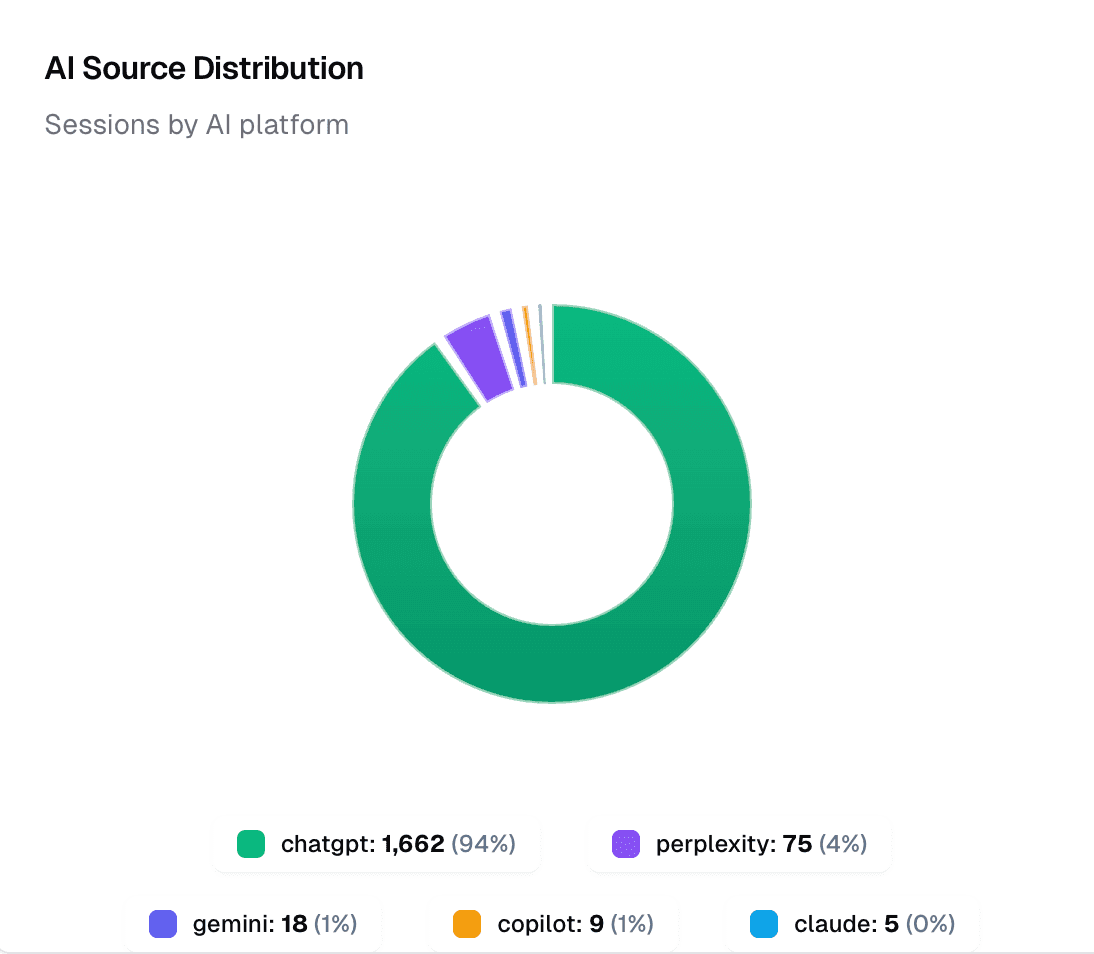
AI Source Distribution: Sessions by AI Platform (Erlin)
Source: Erlin analytics dashboard
ChatGPT's 94% dominance means it should be your primary optimization target, but don't ignore the other 6%. Perplexity's 4% represents highly engaged research-oriented users. These platforms serve different user intents and require different optimization approaches.
ChatGPT: the comprehensive recommender
Citation Behavior:
- Average brands per response: 4.2-5.8 depending on query type
- Citation frequency: 87% of eCommerce queries include brand mentions
- Maximum brands in single response: 24 brands observed
- Source preferences: Established retailers (Amazon, Target), brand sites, comprehensive guides
What ChatGPT Favors:
- Long-form educational content (2,000+ words)
- How-to guides with step-by-step instructions
- Comparison articles with clear criteria
- Product category overviews
- Definitional content with examples
Citation Style: ChatGPT tends to provide brand names in list format with brief explanations. It may include links if browsing is enabled, but often provides recommendations without direct source attribution when operating in model-native mode.
Perplexity: the research engine
Citation Behavior:
- Average brands per response: 3.8-4.5 brands
- Average citations per response: 8-12 sources (highest transparency)
- Unique domain diversity: Extremely high, pulls from widest source variety
- Source preferences: Recent content, data-driven analysis, multiple authoritative sources
What Perplexity Favors:
- Recent, timely content (< 90 days optimal)
- Data-driven analysis with statistics
- Comparative research
- Industry reports and studies
- News and trend analysis
Citation Style: Perplexity's defining feature is transparency. It provides inline citations with visible source links for every claim. Users can trace exactly where information came from, making it the most "research-friendly" AI platform.
Claude: the conservative authority
Citation Behavior:
- Average brands per response: 2.5-3.5 brands (most selective)
- Citation approach: Conservative, authority-focused
- Evaluation time: Longer consideration of source credibility
- Source preferences: Heavily weighted toward earned media and established authorities
What Claude Favors:
- Authoritative, expert-written content
- In-depth analysis and commentary
- Peer-reviewed or academically rigorous content
- Established publications
- Clear expertise signals
Citation Style: Claude is selective about citations. It sets a higher bar for inclusion, prioritizing source credibility over source quantity. When Claude cites you, it's a strong authority signal.
Gemini & Google AI: the integrated ecosystem
Citation Behavior:
- Gemini average brands: 4.5-5.5 brands per response
- AI Overview frequency: Appears on 40-50% of eligible queries
- Integration advantage: Direct access to Google's knowledge graph
- Source preferences: Strong preference for Google ecosystem (YouTube 62%+, Google-indexed content)
What Google AI Favors:
- Schema-rich, structured data
- Video content (YouTube massively overrepresented)
- Educational and informational content
- Mobile-optimized, fast-loading pages
- Google Business Profile integration for local
Citation Style: Google AI Overview provides educational context and often includes source links visible in the UI. It intentionally minimizes commercial content, relying on traditional organic results below for transactional queries.
The FSA framework: why brands get cited
After analyzing thousands of citations across platforms, three factors consistently determine visibility. Content strategist Cassie Clark identified these as the FSA Framework, Freshness, Structure, and Authority, and our data validates this model while revealing deeper patterns within each factor.
Factor 1: freshness
What It Is: Freshness signals how recent, current, and actively maintained your content is. It's the heartbeat of your website, the signal that tells AI your information is reliable and up-to-date.
Why It Matters: Our analysis shows content updated within the last 90 days has a 67% higher citation rate than content older than 6 months. AI engines prioritize fresh content because it's more likely to be accurate for time-sensitive queries.
Freshness Signals AI Recognizes:
1. Publication and Update Dates
- Current year in title ("Best CRM 2026")
- Visible "Last updated: [Date]" timestamps
- Recent publish dates in sitemap
- Schema dateModified markup
2. Recent Content Activity
- New related articles within past 90 days
- Updated sections with new examples
- Fresh data and statistics
- Current screenshots and visuals
3. Site-Wide Freshness Signals
- Active publishing schedule
- Regular content updates
- New pages being added
- Active blog or news section
4. External Freshness Indicators
- Recent brand mentions across the web
- Current press coverage
- Fresh backlinks
- Active social presence
Factor 2: structure
What It Is: Structure determines how easily AI can extract information from your content. Well-structured content is machine-readable, meaning AI can quickly find, understand, and cite specific information without reading your entire article.
Why It Matters: Our data shows structured content (with clear headers, lists, tables) gets cited 73% more often than unstructured narrative content of similar length and quality.
Think of structure as your extractability score. Can AI lift your answer without needing full context?
Structure Elements AI Favors:
- Clear, Question-Based Headers
Choose This - "What Should Small Teams Look for in a CRM?"Not This - "Our Thoughts on CRM Selection"
Choose This - "Key Features Comparison: CRM vs Project Management"Not This - "Feature Overview" - Definition-First Paragraphs Start sections with clear, extractable definitions:
"Answer Engine Optimization (AEO) is the practice of structuring content so AI systems can confidently cite you as the best answer."
- Structure Quality Test: Ask yourself: "Can someone understand this section without reading what came before it?"
If yes → Good structure for AI
If no → Revise to be more self-contained
Factor 3: authority
What It Is: Authority in AI search is fundamentally different from traditional SEO. It's not about domain authority (DA) or backlinks. It's about entity strength, what AI knows about your brand's expertise in a specific topic area.
The Critical Distinction:
| Traditional SEO | AI Search |
|---|---|
| Domain Authority (DA 50+) | Entity Strength |
| Total backlink count | Topic-specific mentions |
| Generic authority | Narrow expertise depth |
| Site-wide metrics | Category-specific signals |
Why It Matters: We've seen brands with DA under 15 consistently outrank Fortune 500 companies (DA 90+) in AI citations, when the smaller brand has stronger entity association with the specific topic.
Authority Is Built Through:
1. Depth Over Breadth
- 15 articles on "CRM for real estate teams" beats 100 generic CRM articles
- Topic clusters demonstrate systematic expertise
- Consistent focus signals specialization
2. Multi-Platform Presence
- Your website
- LinkedIn articles
- Guest posts
- Podcast appearances
- YouTube videos
- Conference presentations
AI builds entity understanding from patterns across platforms
4. Third-Party Validation
- Press mentions connecting you to your topic
- Industry publication features
- Expert roundups
- Podcast guest appearances
- Conference speaking
- Award recognition
5. Clear Positioning Everywhere
- Same descriptor on every platform
- Consistent category association
- Unified author bios
- Clear company positioning
What makes content citation-worthy: winning patterns
Beyond the FSA framework, certain content patterns and formats consistently trigger more citations. Our analysis revealed specific triggers that significantly increase your citation probability.
1. Keywords and prompts that trigger citations
AI engines respond differently to different query types. Understanding high-citation keywords helps you target the right queries.
High-Citation Query Patterns:
| Query Pattern | Average Brands Cited | Best Platform |
|---|---|---|
| "Best [category] for [use case]" | 5.8 brands | ChatGPT |
| "Budget/affordable/cheap [product]" | 6.2 brands | ChatGPT, Perplexity |
| "Compare [X] vs [Y]" | 4.5 brands | All platforms |
| "What is [concept]" | 3.2 brands | ChatGPT, Claude |
| "How to [do task]" | 3.8 brands | ChatGPT |
| "[Product] recommendations" | 5.1 brands | ChatGPT, Perplexity |
| "[Product] reviews" | 4.7 brands | Perplexity |
Prompt Length Impact:
- Short keyword (1-2 words): 2.1 brands cited average
- Natural question (8-12 words): 4.8 brands cited average
- Detailed prompt with constraints (15+ words): 6.2 brands cited average
Users ask AI engines conversational questions, not keyword fragments. Optimize for complete questions, not isolated keywords.
2. Content formats that get cited
Citation Rate by Content Type:
- Comprehensive Guides (2,000+ words) - 43% citation rate
- Comparison Articles - 38% citation rate
- How-To Tutorials - 35% citation rate
- Definition/Glossary Content - 34% citation rate
- Data-Driven Reports - 31% citation rate
- Product Reviews - 28% citation rate
- Listicles/Rankings - 25% citation rate
Key Insight: Depth matters more than format. A comprehensive 2,500-word comparison guide beats ten shallow 400-word listicles.
3. Timing and seasonality
Seasonal Citation Boost: Content aligned with seasonal needs sees significantly higher brand mentions:
- Holiday/gift content: +23% brand mentions during season
- Year-end content ("Best of 2026"): +18% citations in Q4/Q1
- Tax/financial content: +31% citations January-April
- Back-to-school content: +27% citations July-September
Time to Citation by Platform:
| Platform | Average Time | Fastest Observed | Freshness Priority |
|---|---|---|---|
| Perplexity | 3-7 days | 24 hours | Highest |
| Gemini | 5-10 days | 48 hours | High |
| ChatGPT | 7-14 days | 3 days | Medium-High |
| Claude | 10-21 days | 7 days | Medium |
The citation gap diagnostic: why you're not getting cited
Most brands aren't getting cited because of one or more fixable gaps. This diagnostic helps you identify exactly what's blocking your visibility.
The 5-minute citation visibility test
Step 1: Test Your Current Visibility
Pick your 5 most important queries, the questions potential customers ask before buying. For example:
- "Best [your category] for [target customer]"
- "How to choose [your category]"
- "[Your category] comparison"
- "What is [your core concept]"
- "[Your category] for [specific use case]"
Search each query in:
- ChatGPT
- Perplexity
- Claude (if accessible)
- Gemini
Document for each:
- Are you mentioned?
- Are competitors mentioned? (List them)
- What position are you in answer? (First, second, third, etc.)
- Do you get a link or just a mention?
Step 2: Analyze Who IS Getting Cited
For each competitor that appears, visit their content and evaluate:
Freshness Check:
- When was it last updated?
- Does it have current year in title?
- Are examples and screenshots current?
- Does it reference recent trends or data?
Structure Check:
- Does it have clear, question-based headers?
- Can you quickly find specific answers?
- Does it use lists, tables, or comparisons?
- Is information easy to extract?
Authority Check:
- How much content do they have on this topic?
- Do they have clear expert positioning?
- Are there author credentials visible?
- Do they have external validation (press, mentions)?
Step 3: Identify Your Specific Gap
Citation Gap Analysis Checklist:
FRESHNESS GAP
- Content older than 6 months
- No recent updates visible
- Old examples or screenshots
- No current-year references
STRUCTURE GAP
- Long narrative paragraphs
- Vague or generic headers
- Buried key information
- No lists, tables, or clear formatting
AUTHORITY GAP
- Thin topic coverage (< 10 pieces)
- Unclear positioning
- Weak author bios
- No external mentions or validation
EVIDENCE GAP
- Vague claims without data
- No specific examples
- Missing comparisons
- Lack of proof points
The top 5 citation blockers
Based on analyzing hundreds of brands with zero citations, these are the most common problems:
1. Outdated Content (Found in 67% of non-cited brands)
The Problem: Last updated 2+ years ago, old examples, outdated statistics, no current relevance signals.
What you can do instead:
- Update top 10 pages with current year
- Replace old examples and screenshots
- Add "2026 Update" sections
- Implement quarterly refresh schedule
2. Poor Structure (Found in 59% of non-cited brands)
The Problem: Dense paragraphs, vague headers, buried information, no extractable answers.
What you can do instead:
- Rewrite headers as questions
- Break paragraphs into 3-4 sentences
- Add lists for any multi-item content
- Create comparison tables
- Add definition-first sections
3. Weak Entity (Found in 54% of non-cited brands)
The Problem: Thin topic coverage, inconsistent positioning, no clear expertise demonstration.
What you can do instead:
- Create topic cluster (10-15 related pieces)
- Unify positioning across all platforms
- Build comprehensive author bio
- Pursue 3-5 external mentions
- Add Organization schema
4. Wrong Content Type (Found in 43% of non-cited brands)
The Problem: Sales-focused landing pages instead of educational content, keyword-stuffed listicles, thin product descriptions.
What you can do instead:
- Create separate educational content hub
- Write comprehensive guides (not sales copy)
- Focus on answering customer questions
- Build comparison and how-to content
5. Platform Mismatch (Found in 38% of non-cited brands)
The Problem: Optimizing for wrong platform's preferences, ignoring platform-specific signals.
What you can do instead:
- ChatGPT: Add comprehensive, long-form content
- Perplexity: Maximize freshness and data
- Claude: Build authority signals
- Gemini: Add schema and video content
Platform-specific optimization tactics
While the FSA framework applies universally, each platform has specific preferences that can boost your citation rate when properly optimized.
ChatGPT optimization checklist
- Create long-form, comprehensive content
- Use clear, extractable structure throughout
- Include specific product details and comparisons
- Maintain presence on major marketplaces (for product brands)
- Focus on educational angle over sales
- Update content quarterly minimum
- Add clear definitions at start of sections
Content Types ChatGPT Rewards:
- Complete buyer's guides
- Comparison articles with criteria
- How-to tutorials with steps
- Category overview articles
- Problem-solution content
Perplexity optimization checklist
- Maximize freshness (update monthly)
- Include specific data and statistics
- Cite your own sources clearly
- Create research-backed content
- Publish new content frequently
- Add timestamps prominently
- Use current examples and trends
Content Types Perplexity Rewards:
- Data-driven analysis
- Industry trend reports
- Research studies
- Comparative analysis
- News and timely content
Claude optimization checklist
Priority Actions:
- Build clear expertise and authority
- Seek earned media placements
- Add detailed author credentials
- Create academically rigorous content
- Prioritize quality over quantity
- Reference authoritative sources
- Demonstrate depth of expertise
Content Types Claude Rewards:
- Expert analysis and opinion
- Thought leadership pieces
- In-depth guides
- Research-backed content
- Professional industry resources
Gemini/Google AI optimization checklist
Priority Actions:
- Create YouTube video content
- Optimize for Google's core ranking factors
- Maintain fast, mobile-friendly site
- Add Google Business Profile (for local)
- Use Google Search Console
- Focus on E-E-A-T signals
Content Types Gemini/Google AI Rewards:
- Video content (YouTube priority)
- Educational guides
- Schema-rich pages
- Mobile-optimized content
- Visual content with images
The universal foundation
Remember: All platforms reward content that is Fresh, Structured, and Authoritative. Platform-specific tactics are optimizations on top of this foundation, not replacements for it.
Optimization Priority:
- First: Master FSA framework (applies everywhere)
- Second: Optimize for your primary platform (likely ChatGPT given 94% share)
- Third: Add platform-specific tweaks for others
Five mistakes keeping you invisible to AI
After analyzing hundreds of brands with zero or inconsistent citations, these five patterns emerge repeatedly.
Mistake #1: treating AI search exactly like SEO
What brands do: Apply traditional SEO tactics, keyword stuffing, backlink schemes, thin content with exact-match keywords.
Why it fails: AI engines evaluate content meaning and extractability, not keyword density.
The fix:
- Write for humans first, optimize for AI second
- Focus on clarity and complete answers
- Use natural language, not keyword repetition
- Structure for extractability, not just crawlability
Mistake #2: publishing without updating
What brands do: Create content, publish it, never touch it again. Content sits unchanged for 12-24 months.
Why it fails: AI engines heavily penalize stale content.
The fix:
- Set quarterly update reminders
- Add "Last updated: [Date]" prominently
- Update examples, statistics, screenshots
- Maintain "living document" approach
Mistake #3: ignoring structure
What brands do: Write beautiful prose with long narratives and buried key information.
Why it fails: AI can't extract answers from narrative content.
The fix:
- Headers = questions
- First sentence = key point
- Break paragraphs into 3-4 sentences
- Use lists, tables, comparisons
Mistake #4: thin topic coverage
What brands do: Publish one article per major topic, covering breadth instead of depth.
Why it fails: AI evaluates your complete body of work. One article = weak entity signal.
The fix:
- Pick 2-3 core topics
- Create 10-15 pieces per topic
- Build comprehensive topic clusters
- Go deep, not wide
Mistake #5: assuming high DA = citations
What brands do: Rely on strong domain authority, assuming AI will naturally cite them.
Why it fails: AI citation is about entity strength, not domain metrics.
The fix:
- Build topic-specific authority
- Focus on entity strength (narrow expertise)
- Create educational, not sales content
- Demonstrate clear expertise
What's coming: the future of AI citations
As AI search evolves, citation patterns will shift. Here's what to prepare for based on current trends.
Emerging citation trends
1. More Platforms, More Complexity
- SearchGPT launching from OpenAI
- Meta AI expanding in WhatsApp/Instagram
- Apple Intelligence entering the space
Implication: Need to track more platforms, but FSA fundamentals remain universal.
2. Real-Time Fact Checking
- Platforms getting better at cross-referencing sources
- Higher bar for citation inclusion
Implication: Accuracy and evidence quality becoming more critical.
3. Personalized Citations
- AI learning user preferences over time
- Citations tailored to user history
Implication: Niche expertise and specific use cases more valuable.
The durable strategy
Focus on fundamentals that won't change:
- Fresh content - Always valued
- Clear structure - Always necessary
- Demonstrated authority - Always required
- Helpful, accurate information - Always wins
Platform-specific tactics will evolve. The FSA framework is durable.
Conclusion: citations are the new rankings
The shift from rankings to citations is complete. AI search now drives buying decisions, and only cited brands capture attention. The good news? Citations follow predictable patterns. Small brands with the right approach consistently beat larger competitors. And the first-mover advantage remains strong, brands optimizing now see 3-5× better results than late adopters.
The citation economy opportunity
We're in the early innings of the citation economy. The brands investing in AI visibility now, while it's still a competitive advantage will own category visibility for years.
In 2027, when AI search fully overtakes traditional search, these investments won't be optional. They'll be table stakes.
The question isn't whether to optimize for AI citations. It's whether you'll be visible when your customers start their buying journey with AI.
See exactly how AI engines see your brand
Erlin tracks your AI citations automatically across ChatGPT, Perplexity, Claude, Google AI Mode, Gemini, and Copilot. Get weekly reports showing:
- Your citation rate vs competitors
- Platform-specific performance
- Content gaps and opportunities
- Specific optimization recommendations
Stop guessing. Start knowing.